Nov 11, 2026 – Nov 12 · Daily Brief

Aircraft No Longer Fear Satellite Signal Loss: Quantum Navigation Receives First Airworthiness Certification

43 items · 13 sourcesPDFThis issue's roundup is free
02Hardware

Hardware Frontiers

Superconducting Route

IBM Unveils 520-Qubit Nighthawk r3 Chip and Outlines Thousand-Qubit Interconnect Roadmap

Following recent reports on IBM's superconducting hardware evolution, on November 12, 2026 (Beijing Time), IBM officially unveiled its Nighthawk r3 superconducting processor at its Quantum Developer Conference. The processor integrates 520 programmable physical qubits on a single chip. IBM also released a multi-chip interconnect technology roadmap targeting 1,040 qubits by 2027, alongside the launch of a managed hybrid workflow system [8]. Benchmarked against current superconducting production baselines—where leading chips (such as Heron r2 and Willow with 105 to 120 qubits) generally target two-qubit gate fidelities (two-qubit operational accuracy) of 99.5% to 99.9%—Nighthawk r3 expands single-chip programmable scale by 3.33x from the 120 qubits of the previous-generation Nighthawk [8]. However, high-density superconducting arrays remain constrained by TLS (two-level system defect state) fluctuations and microwave crosstalk; achieving the surface code (a 2D topological fault-tolerant error-correcting code) threshold demonstrated by Google Willow (error suppression factor Λ ≈ 2.1) still awaits full-distribution fidelity and real-time closed-loop error correction data validated by independent third parties. The chip will directly bolster IBM's cloud full-stack computing matrix and widen ecosystem differentiation with vendors pursuing high-fidelity chiplet strategies. Enterprise customers are expected to validate its co-acceleration value on medium-depth circuits by 2027.

Q-CTRL Demonstrates Autonomous Cold-Start Calibration of a 21-Qubit Superconducting Chip in Under 3 Hours

Using its Boulder Opal control platform, Q-CTRL achieved an end-to-end, one-button cold-start calibration on Dutch chipmaker QuantWare's 21-qubit Contralto-D21 superconducting processor, compressing the time required to bring the system from an unparameterized initial state to operational gate fidelity down to under 3 hours [10]. Compared to traditional cumbersome workflows heavily reliant on senior engineers manually tuning pulses over 48 to 72 hours, this technology cuts superconducting processor calibration and maintenance downtime by over 90%, overcoming a key human-resource bottleneck in routine deployments of scaled quantum hardware [10]. This development directly benefits third-party open-architecture chipmakers and research institutions lacking in-house control algorithm teams, accelerating the transition of superconducting compute toward standardized data center rack-mounted deployments, with expectations to become a baseline procurement specification for modular supercomputing centers within 2 years.

NVIDIA and Alice & Bob Deploy High-Speed Bus to Connect GPUs for Cat-Qubit Decoding

French startup Alice & Bob collaborated with NVIDIA to interface GPU compute units with a topologically protected cat-qubit (coherent state superposition bosonic qubit) system via NVQLink (a high-speed hybrid quantum-classical interconnect bus), experimentally completing LDPC (low-density parity-check code) error-correction decoding [16]. Compared to baseline error correction overheads, where mainstream 2D surface codes require a physical-to-logical qubit ratio of approximately 105:1 (such as in Google's surface code architecture), cat qubits autonomously suppress bit-flip errors via coherent state physical symmetry. Paired with LDPC codes, this architecture holds promise for reducing the physical-to-logical qubit ratio to below 10:1. Performing syndrome decoding within microseconds using classical microarchitectures overcomes the latency barrier for real-time integrated feedback in bosonic error correction [16]. This milestone cements classical chip giants' strategic positioning in fault-tolerant quantum foundation compute, shortening the anticipated commercial engineering verification timeline for topological bosonic architectures by 2 to 3 years.

Rigetti Posts Q3 Revenue of $1.4M and Secures Potential $100M Federal Agreement

Following recent coverage of its passive cost-reduction initiatives and technical roadmap evolution, Rigetti released its Q3 2026 financial results, reporting quarterly revenue of $1.4 million, containing net loss to $3.1 million, and securing a potential procurement agreement of up to $100 million with the U.S. Department of Commerce [15]. The significant narrowing of net losses compared to historical peaks and the federal procurement commitment provide a liquidity backstop for advancing wafer-scale modular tiling of its 84-qubit and 108-qubit Cepheus-1 chips [15]. This injects counter-cyclical capital into the publicly traded pure-play superconducting full-stack hardware vendor, securing an approximate two-year operational window to elevate median two-qubit gate fidelity above 99.5% and validate multi-chip cryogenic interconnects before 2027.

Neutral-Atom Route

Quantum X Labs Unveils Execution Roadmap to Reach 800 Logical Qubits by 2030

Neutral-atom hardware developer Quantum X Labs published its latest technical roadmap, setting a goal to build a fault-tolerant system with approximately 800 logical qubits by controlling over 100,000 physical qubits before 2030 [21]. Against published SOTA benchmarks in the neutral-atom domain—where the current world record for verified logical qubits is the 96 logical qubits reported by QuEra in Nature 2026 (based on 448 physical qubits and [[16,6,4]] codes), and the largest physical array record stands at Atom Computing's 1,180 qubits—the target represents an ~85x expansion in physical qubits and an over 8x increase in logical qubits. As a long-term vendor commitment, it still faces rigid physical constraints, including the 1 to 10 Hz repetition rate inherent to neutral-atom systems and atomic loss bottlenecks during continuous loading and replenishment. While this roadmap intensifies fundraising competition in neutral-atom array scaling, investors and defense evaluation bodies will closely inspect whether undisclosed post-selection rates were applied across the logical operation pipeline.

Resonance Fluorescence Direct Readout Overcomes Cold-Atom Detection Camera Latency Bottleneck

Researchers have successfully demonstrated a fast, non-destructive quantum state readout scheme based on resonance fluorescence in neutral-atom systems, bypassing the exposure and frame-transfer latency of conventional electron-multiplying charge-coupled device (EMCCD) cameras [25]. Conventional camera detection typically introduces a 10 to 50 millisecond overhead, whereas resonance fluorescence direct readout compresses atomic qubit state measurement times down to the sub-millisecond regime (a reduction of more than an order of magnitude), crossing a critical latency threshold for mid-circuit single-qubit measurement and reset in real-time quantum error correction [25]. However, in dense atomic arrays, this method still requires spatial optical isolation in micro-regions to suppress decoherence on adjacent data qubits caused by scattered spontaneous emission. This clears the physical latency bottleneck for inline, real-time feedback error correction in optical-tweezer shuttling arrays, helping neutral-atom hardware narrow its intrinsic clock-cycle gap with superconducting routes during error-correction cycles.

Trapped-Ion and Photonic Routes

Electro-Optic Converter Achieves 67% Energy Conversion Efficiency Across Optical and Millimeter-Wave Bands

A research team developed a novel triply resonant electro-optic conversion device, achieving an energy conversion efficiency of up to 67% for quantum state signals between telecom optical waves and microwave/millimeter waves [24]. Benchmarked against cross-frequency quantum interconnects, where microwave-to-optical conversion efficiencies historically hovered between 10% and 30%, this 67% figure is over 2.2x mainstream reported levels, setting a new public record and providing a high-efficiency electro-optic bridge to connect quantum chips across distinct dilution refrigerators [24]. However, practical deployment in distributed networks still lacks a crucial milestone: suppressing thermal noise photons introduced by optical pumping down to the quantum ground-state limit (added noise photons substantially below 1) at millikelvin temperatures. This advance directly empowers distributed interconnects for superconducting and semiconductor quantum-dot systems, shaving 3 to 5 years off hardware R&D timelines for multi-cryostat modular quantum computing clusters.

Single-Step Dynamical Decoupling Extends Qutrit Coherence Time by Over 10x

Using a simplified single-step control scheme in an ultracold atomic ensemble, an experimental team achieved a 93% fidelity high-dimensional logic gate on a qutrit (a quantum unit with three basis states), extended quantum coherence time by more than 10x (over an order of magnitude), and simultaneously demonstrated a three-channel Mach-Zehnder interferometer [18]. This approach eliminates dephasing errors accumulated from conventional multi-pulse sequences; through compact single-pulse dynamical decoupling, it proves the engineering feasibility of manipulating higher-dimensional quantum states with extended coherence [18]. Nonetheless, compared to mainstream SOTA two-qubit gate fidelities exceeding 99.9%, a 93% gate fidelity remains at least an order of magnitude below the fault-tolerant threshold for high-dimensional error correction. This achievement primarily benefits high-sensitivity quantum gravimeters and compact quantum frequency standards, carving out a new physical pathway for miniaturizing defense geological exploration and inertial guidance systems.

DARPA Advances QBI Program to Stage C with Rigorous Compute ROI Accounting

The Defense Advanced Research Projects Agency (DARPA) Quantum Benchmarking Initiative (QBI) has entered Stage C verification. In an interview, IonQ's Chief Scientist for Federal revealed that this stage focuses on baseline accounting of whether system computational value substantially outweighs the total lifecycle cost of the hardware [2]. This signals that national research procurement assessments of trapped-ion and other full-stack routes are shifting from isolated laboratory physical parameters (such as gate fidelity or qubit count) toward economic appraisals of full-system computational returns and total cost of ownership [2]. This shift will compel trapped-ion arrays to accelerate solutions for slow ion shuttling transit times and inadequate multi-channel laser modulator integration, ultimately determining the allocation of tens of billions of dollars in long-term government and defense contracts over the coming years.

Spin Quantum-Dot Route

Delft Spin Quantum-Dot Team Clinches ERC Synergy Grant

On November 12, 2026 (Beijing Time), four core physicists from Delft University of Technology and QuTech in the Netherlands were jointly awarded a European Research Council (ERC) Synergy Grant to tackle scalable networking and fidelity limits in silicon spin qubits [19]. While two-qubit gate fidelities in silicon spins have reached up to 99.99% (for a single donor-atom pair) and random spot tests on 300 mm wafers have exceeded 99%, multi-qubit scaled devices have generally plateaued at around 10 qubits due to microscopic charge noise fluctuations. The collaborative grant aims to resolve the engineering deadlock surrounding dense nanogate fan-out routing and on-chip microwave control [19]. This long-term capital injection will consolidate Europe's lead in silicon CMOS-compatible manufacturing routes and accelerate the process of semiconductor foundries onboarding quantum chip tape-outs onto existing EUV lithography lines.
03Algorithms

Algorithms and Software

Variational Algorithms and Quantum Chemistry

Qunova Hybrid Variational Algorithm Reaches Chemical Accuracy on 80-Qubit Hardware

South Korean quantum software startup Qunova announced that its HI-VQE algorithm completed an electronic ground-state simulation of the 4Fe-4S iron-sulfur cubane cluster on 80 physical qubits, reaching chemical accuracy in energy calculations (an error of less than 1 millihartree, or ~1.6 kcal/mol, relative to high-order reference solutions) [40]. This marks the world's first instance of pushing quantum chemistry simulation accuracy to the industrial threshold on 80-qubit scale hardware, effectively overcoming the barren plateau problem (gradient vanishing during parameter optimization) that prevents conventional variational algorithms from converging on more than 40 noisy qubits [40]. However, the current verification target remains a molecule solvable via numerical approximations on classical supercomputers; demonstrating computational advantage over classical limits in strongly correlated, multi-reference systems must still await fault-tolerant hardware. This breakthrough significantly elevates procurement expectations for mid-scale noisy quantum hardware across pharma pipelines and industrial catalysis R&D divisions, prompting multinational chemical corporations to initiate dedicated algorithm benchmarking programs.

IBM and Mitsubishi Chemical Implement Autoregressive Variational Simulation on 70-Qubit Chip

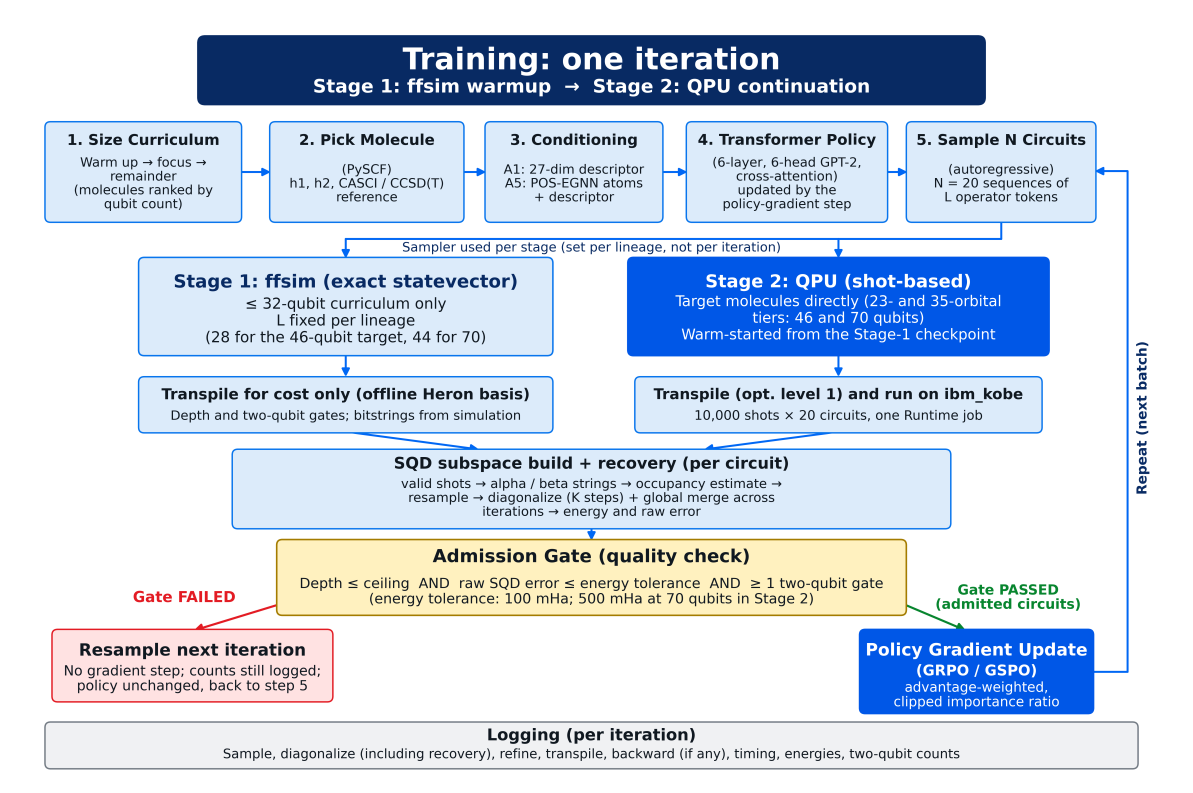
IBM Quantum, Mitsubishi Chemical, Keio University, and NVIDIA jointly completed a generative quantum eigensolver experiment within a 70-qubit hardware framework. Using an autoregressive transformer (a deep-learning sequence generation architecture), they successfully simulated complex organotin photoresist molecules used in extreme ultraviolet (EUV) lithography, reducing total gate count and circuit depth to one-fifth of conventional methods [12]. By using a classical generative network for efficient prior sampling of quantum state configurations, this approach circumvents the fatal vulnerability of deep unitary coupled-cluster circuits experiencing rapid decoherence on noisy hardware [12]. This proves the feasibility for key semiconductor materials enterprises to decipher complex formulation mechanisms by coupling classical heterogeneous compute with near-term quantum processors, and is expected to be integrated into synthetic screening pipelines for advanced photoresists and specialty electronic gases within the next 2 years.

Error-Correction Compilation and Algorithm Benchmarking

Tailored Logical Clifford Circuit Compilation Cuts Gate Overhead by Over 30%

Published online in npj Quantum Information, researchers proposed a logical Clifford circuit compilation framework for stabilizer codes (a widely used class of topological quantum error-correcting codes) tailored specifically to hardware physical topology, achieving optimal routing without requiring additional ancilla physical qubits [4]. Standard compilers often overlook the sparsity of chip coupling graphs when mapping logical gates, introducing numerous SWAP gates that incur additional noise. The new scheme reverse-engineers and reorganizes logical gate sequences under hardware topological constraints, compressing the average number of additional two-qubit gates required for logical operations by over 30% [4]. The algorithm can be directly embedded into the foundational compilation software for neutral-atom optical-tweezer shuttling arrays and superconducting heavy-hexagonal topology chips, providing middleware vendors with a plug-and-play mathematical tool for instruction-set optimization.

Cluster-State Architecture Successfully Constructs Deterministic Phase Oracle Subroutine

Utilizing multipartite entangled cluster states and adaptive feedforward measurements, researchers experimentally constructed a two-qubit phase oracle (a quantum black-box subroutine used to mark target solutions) under a measurement-based quantum computing (MBQC) architecture, realizing a core building block for Grover's quantum search algorithm in measurement-based paradigms [22]. This is the first experimental implementation of a structured multi-qubit phase-inversion subroutine in a purely entangled measurement system devoid of unitary gate operations, filling a critical gap in standardized high-level algorithm modules for measurement-based architectures [22]. The scheme offers a reusable, standardized foundation for photonic MBQC enterprises developing high-level algorithm libraries, clearing a technical barrier in moving from physical state preparation to practical combinatorial optimization algorithms.

IQM Probes Boundaries of Multi-Qubit Quantum Machine Learning on Two Superconducting Processors

Finnish hardware company IQM conducted performance stress testing of quantum machine learning on its 54-qubit Emerald and 20-qubit Garnet chips, employing up to 45 physical qubits to classify the Fashion-MNIST image dataset using quantum kernel methods [23]. Benchmarking via arbitrator and challenger models revealed that under current physical gate noise environments, quantum kernel methods have yet to demonstrate a generalization advantage over traditional support vector machines in classical image classification tasks [23]. This quantitative assessment punctures blind optimism in academia and industry regarding near-term QML entirely displacing classical deep learning, compelling the community to refocus on feature extraction from materials and molecular data possessing intrinsic quantum many-body properties.

04Industry

Industry and Ecosystem

Commercial Financing and Defense Airworthiness

Q-CTRL Closes $290M Series C, Setting Software Infrastructure Record

Global quantum control software frontrunner Q-CTRL announced the completion of an oversubscribed $290 million (approx. AUD 415 million) Series C private equity funding round, led by Salesforce Ventures, with participation from new and existing investors including Bullhound Capital and Affinity Partners [20]. The transaction sets an all-time record for a single financing round in the quantum computing low-level control software and infrastructure space. It reflects how venture capital, against the backdrop of lengthened full-stack hardware commercialization horizons, is concentrating heavily on leading control-layer players that demonstrate immediate recurring software subscription revenue and high technical moats [20]. The proceeds will be fully deployed to expand its global commercial engineering deployment teams, accelerate integration between the Boulder Opal platform and major hardware production lines, and scale the penetration of its quantum sensing hardware into aerospace sectors.

Ironstone Opal Quantum Magnetic Navigation System Secures Civil Aviation DO-160 Airworthiness Certification

Q-CTRL announced that its Ironstone Opal quantum magnetic navigation system has officially attained RTCA DO-160 (Environmental Conditions and Test Procedures for Airborne Equipment) airworthiness certification, becoming the world's first quantum navigation payload qualified for deployment on commercial passenger airliners and UAVs [9]. The system utilizes high-sensitivity atomic quantum magnetometers to map local geomagnetic field fingerprints at high frequencies, achieving fully passive autonomous positioning independent of external RF signals, making it inherently immune to malicious jamming and spoofing targeting GPS and BeiDou satellite signals [9]. This marks the first time quantum precision sensing hardware has bridged the gap from delicate laboratory setups to meet rigorous commercial flight standards, opening a multi-billion-dollar satellite-denied backup navigation market across global commercial trunk airlines, ocean freighters, and long-endurance special-purpose UAVs. Initial flight trials on commercial airline fleets are expected within 3 years.

Tech Titan Alliances and Industrial Adoption

PsiQuantum and AMD Deepen Compute Collaboration to Build Fault-Tolerant Classical Foundation

Silicon photonic quantum computing firm PsiQuantum and semiconductor giant AMD announced an expanded strategic collaboration focusing on the heterogeneous classical compute foundation required for million-physical-qubit fault-tolerant quantum systems, co-designing an ultra-low-latency real-time control architecture based on AMD Versal adaptive SoCs [36]. Because photonic fusion-based error correction must process massive discrete pulse data generated by single-photon avalanche detectors at megahertz clock rates, custom hardware-adaptive programmable logic can compress syndrome measurement decoding latency to within the fault-tolerant time window [36]. This move strengthens supply-chain resilience for PsiQuantum's utility-scale photonic quantum computing centers under construction in Brisbane, Australia, and Chicago, USA, establishing an architectural counterweight at the hardware layer against NVIDIA-dominated classical computing interconnect frameworks.

Quandela and Hermes-Epitek Launch Photonic Quantum Industrialization R&D in Asia-Pacific

French full-stack photonic quantum computing startup Quandela signed a Memorandum of Understanding (MoU) with semiconductor equipment and service giant Hermes-Epitek to establish a joint R&D project advancing the industrial manufacturing and system integration of integrated photonic quantum processors, exploring the installation of commercial integrated systems in the Asia-Pacific region under subsequent agreements [27]. By partnering with an established Asian semiconductor equipment distributor, the European full-stack photonic startup establishes a transnational supply chain spanning single-photon source epitaxial growth, nanophotonic circuit packaging, and regional field support [27]. This will accelerate the landing of photonic quantum hardware across core Asia-Pacific semiconductor clusters and provide an accessible validation platform for semiconductor foundries exploring in-line quantum precision defect inspection.

Anyon and Q-CTRL Join Forces to Build Self-Calibrating Hybrid Quantum-HPC Systems

Superconducting quantum tech company Anyon Technologies established a deep partnership with Q-CTRL to bundle its superconducting quantum computing hardware—integrated with NVIDIA GPUs—with Q-CTRL's proprietary Boulder Opal automated microwave pulse calibration software, launching self-calibrating hybrid rack units for HPC centers [11]. By replacing intricate low-level manual physics tuning with automated software, the solution allows quantum acceleration cards to execute automated health-checks and warm-standby boot sequences akin to classical GPU servers [11]. This lowers the day-to-day operational barrier for regional supercomputing centers and large private cloud clients adopting quantum hardware, accelerating the integration of superconducting quantum processors as standard accelerator plug-ins within HPC clusters.

Patero Partners with Horizen Labs to Launch Enterprise Quantum-Safe Migration Services

Cybersecurity tech firm Patero and Horizen Labs announced a strategic partnership to launch an integrated solution for large multinational enterprises and financial networks, covering cryptographic asset lifecycle inventory, PQC (post-quantum cryptography, novel encryption resistant to quantum attacks) hybrid cryptographic upgrades, and network resilience assessments [13]. Leveraging automated traffic probes and a dynamic cipher-suite replacement engine, the solution allows enterprises to execute smooth, phased replacements of transport layer security protocols without disrupting active core business operations [13]. This moves enterprise post-quantum transitions from compliance consulting into active on-network implementation, accelerating substantive defense upgrades across financial and critical information infrastructure ahead of the anticipated 2030 Q-Day (the projected date when quantum computers break legacy cryptography).

Wall Street Formally Endorses Seven-Pillar Infrastructure Framework for Quantum Finance

Following recent reports on financial institutions piloting quantum optimization and risk algorithms, overseas financial think tanks and capital institutions have further solidified a seven-pillar infrastructure framework supporting quantum finance adoption, detailing specific standards spanning Value-at-Risk simulations, dynamic portfolio rebalancing, post-quantum cryptography roadmaps, and capital security reserves for Q-Day [1]. This indicates that multinational commercial banks and asset managers are elevating their quantum computing engagement from early proof-of-concept (PoC) trials into long-term institutional frameworks governing infrastructure procurement, algorithmic compliance audits, and cybersecurity baselines [1]. The release of these guidelines will directly steer sovereign wealth funds and Wall Street investment banks in establishing dedicated quantum incubation funds, accelerating the transition of derivative pricing and 24/7 anti-fraud algorithms from theory into financial regulatory sandboxes.

People and Ecosystem Moves

Distinguished Theorist Scott Aaronson Joins Qedma Scientific Advisory Board

Israeli software company Qedma, specializing in quantum error suppression and noise mitigation algorithms, announced that Scott Aaronson, Chair Professor at UT Austin and computational complexity theorist, has officially joined its Scientific Advisory Board [35]. The addition of a top theoretical physicist and complexity theory authority significantly bolsters Qedma's industry standing in theoretical quantum error correction threshold verification and near-term quantum advantage algorithm design [35]. This aids the firm in securing credibility during technical due diligence with international defense agencies and tier-one financial institutions, paving the way for its error-mitigation middleware to enter mainstream cloud compute integration catalogs.

Haiqu and OrangeQS Bolster Executive Leadership to Accelerate Commercial Expansion

Quantum system optimization software vendor Haiqu appointed Kortny Rolston-Duce as Head of Ecosystem Development and Marketing to spearhead the adoption of its noise-adaptive compilation tools across superconducting and cold-atom processors within research communities and defense laboratories [34]. Simultaneously, Dutch automated quantum chip test equipment manufacturer OrangeQS announced the appointment of Raj Badoni as Chief Commercial Officer to drive sales of its high-throughput microwave characterization systems to semiconductor foundries and quantum chip R&D facilities [39]. These executive appointments signal that European quantum startups are collectively transitioning past early exploratory technology R&D into a new phase of scaled customer acquisition and commercial contract execution.

Universities and Semiconductor Giants Deploy Distributed Initiatives to Advance Quantum Talent and Basic Research

Florida Atlantic University's (FAU) College of Engineering and Computer Science received a $3 million grant from the U.S. Department of Labor specifically to build a comprehensive quantum workforce training program to bridge industry staffing shortages [37]. Communications semiconductor titan Broadcom announced full funding for 26 Caltech research fellows over five years to conduct interdisciplinary exploration into frontier quantum science and architectures [26]. Additionally, India's Manipal Academy of Higher Education (MAHE) deepened technical training collaborations with quantum control developer QuantrolOx to cultivate specialized engineers capable of independently managing quantum dilution refrigeration and control lines [42]. Industry capital and government funding are simultaneously targeting workforce foundations and academic origins, ensuring a long-term talent supply to support downstream hardware manufacturing scaling.

05Other

Academic Frontiers

Integrated Photonics and Micro/Nano Devices

Cornell Develops Microchip-Integrated Laser Cooling to Resolve Footprint Bottleneck

A Cornell University research team developed a chip-scale integrated laser cooling process that replaces bulky, free-space optical mirror assemblies with micro/nano silicon nitride waveguide resonator chips, achieving optical deceleration and low-temperature trapping of moving atomic beams at the micrometer scale [5]. Traditional cold-atom quantum computers rely heavily on ultra-high vacuum chambers and discrete optical mounts occupying several square meters. This chip-scale laser cooling technology shrinks the cooling optical path directly onto the surface of a photonic integrated circuit for the first time, overcoming a physical integration bottleneck in transitioning cold-atom hardware to compact, rack-mounted systems [5]. The technology lays a miniaturized optoelectronic foundation for portable quantum gravimeters, airborne atomic clocks, and large-scale array architectures in high-density neutral-atom quantum computers.

MIT Lincoln Laboratory Microsystem Integration Platform Wins 2026 R&D 100 Award

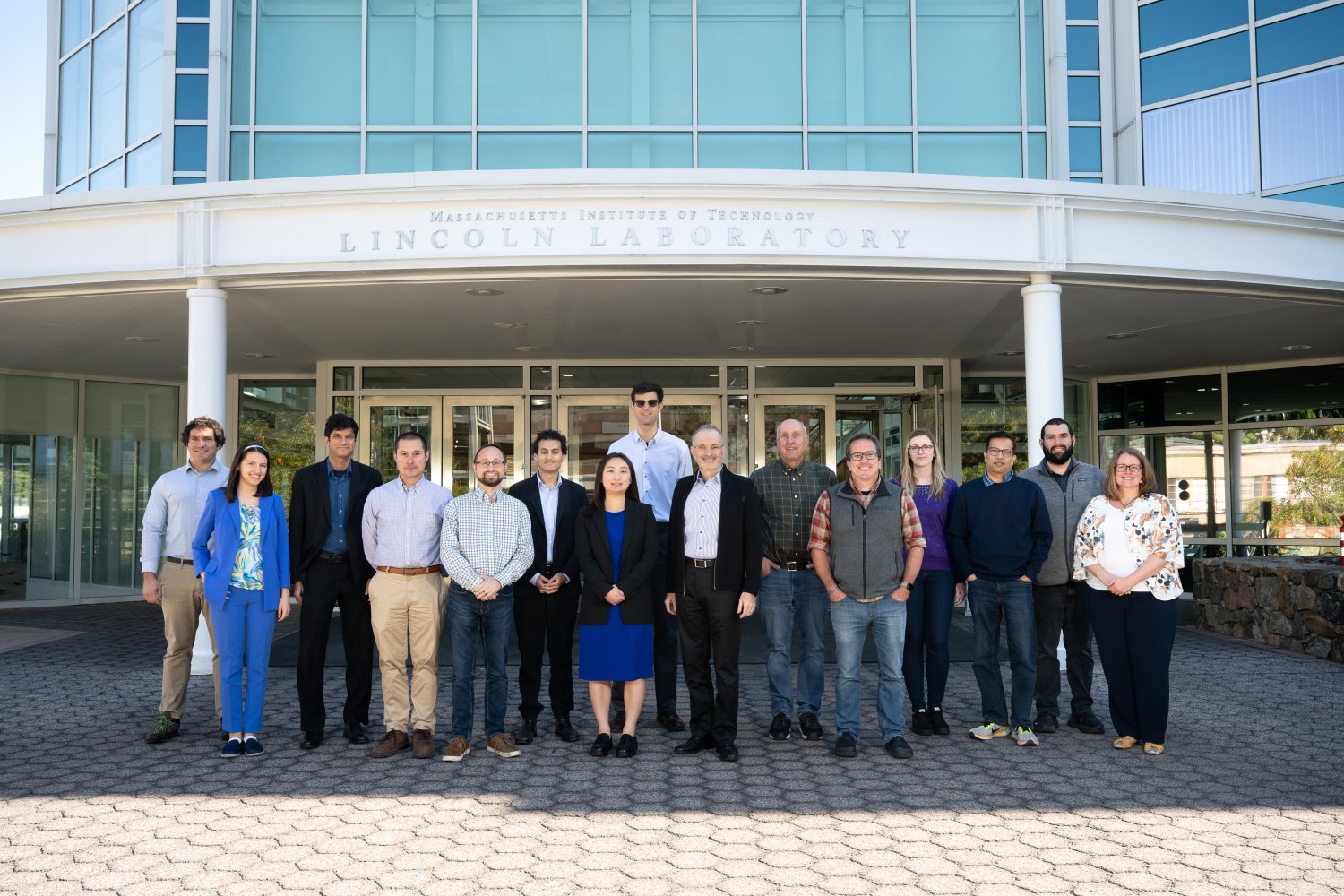
Three core technologies developed by MIT Lincoln Laboratory—a high-security operating system, a quantum microsystem packaging platform, and 5G anti-jamming algorithms—were selected as winners of the 2026 R&D 100 Awards [3]. Its award-winning quantum microsystem platform integrates deep-cryogenic microwave coplanar waveguides, miniature vacuum thermal insulation packaging, and on-chip low-loss optical distribution networks within a compact, chip-scale heterogeneous module, achieving high-isolation physical interconnects for sensitive quantum micro-systems [3]. This underscores the engineering expertise of premier defense research institutions in ultra-miniaturized quantum chip packaging and harsh-environment durability, setting a volume-manufacturing standard for military quantum sensors deployed in vehicular and airborne environments.

Cross-Disciplinary Applications and Quantum Materials

Photonic Quantum Chip Sampling Features Significantly Enhance Malware Detection Rates

Researchers leveraged an ORCA Computing PT-2 photonic processing chip to extract time-bin multimode boson sampling features and map them into high-dimensional vector spaces to detect heavily obfuscated, complex network malware [14]. Experimental data demonstrated that a hybrid classification architecture incorporating photonic interference features from the PT-2 chip delivered notable accuracy gains in identifying polymorphic malware variants compared to purely classical models, showing high sensitivity in capturing deep nonlinear correlations within restructured code [14]. This sets a precedent for the commercial application of room-temperature, telecom-band photonic quantum co-processors in high-performance computing scenarios such as backbone network firewalls and cloud-native real-time traffic threat mitigation.

Quantum Many-Body Screening Reveals Compounds Overlooked by Traditional Kinase Inhibitor Models

In a virtual screening campaign for lead compounds targeting the Alzheimer's-related kinase DYRK1A, researchers compared molecular interaction spaces generated directly by a quantum processor against scoring matrices from classical tabular chemical databases, finding that the quantum approach identified a set of high-potential binding molecules entirely outside the predictive domain of classical models [17]. The experiment verified that noisy quantum states, when capturing the 3D charge distribution and non-local electron correlations of polycyclic aromatic molecules, break free from the localized search limitations of classical 1D or 2D molecular fingerprints, avoiding false-negative errors common to classical conformational scoring [17]. This offers a reservoir of novel chemical scaffolds for neurodegenerative drug discovery and encourages biopharma funds to integrate quantum algorithms into initial target screening workflows.

Ultrathin Hexagonal Boron Nitride Defects Exhibit Anomalous Strong Light-Phonon Coupling

Physicists observed an anomalous, coherent strong interaction between photons and lattice phonons (quasiparticles of collective lattice vibrations) within point defects of monolayer hexagonal boron nitride (hBN), challenging the long-held assumption that point defects solely degrade coherent optical properties [6]. The study revealed that polaritons excited by localized defects can tightly confine mid-infrared optical fields at the nanoscale, allowing ultra-weak optical signals to trigger intense coherent lattice resonances and providing an intrinsic coherence mechanism for building long-lived solid-state single-photon sources [6]. The discovery presents a disruptive 2D quantum material candidate for developing on-chip quantum light sources, micro/nano phononic cavities, and on-chip photonic quantum networks operating at room temperature or under mild refrigeration.

CAS Hefei Institutes Establish Unified Theoretical Criteria for Classifying Unconventional Magnets

A research team from the Institute of Solid State Physics, Hefei Institutes of Physical Science, Chinese Academy of Sciences, achieved a fundamental theoretical breakthrough by establishing a unified framework incorporating spin space groups and lattice symmetry criteria to systematically classify altermagnets and various unconventional topological magnetic materials [7]. Previously, fragmented classification standards hindered systematic predictions of microscopic properties. By defining unified criteria, this framework identifies microscopic symmetry rules for constructing materials that exhibit zero macroscopic stray magnetic fields alongside up to 100% spin polarization [7]. This provides a foundational theoretical guide for designing ultrafast read/write solid-state spin qubit storage media resistant to external magnetic interference, as well as low-dimensional superconductor-ferromagnet heterostructures required for topological quantum computing.

06Impact

Today's Impact

  1. Civil Aviation Operators and Defense Mission Equipment Providers:

- Impacted Entities: Commercial airlines, avionics integrators, long-range logistics drone developers, and defense autonomous navigation procurement authorities.

- Tangible Change: Q-CTRL Ironstone Opal's DO-160 environmental airworthiness certification establishes satellite-independent quantum geomagnetic navigation as a regulatory-compliant avionics option, removing GPS spoofing and electronic jamming as fatal single points of failure for flight safety [9].

- What to Watch Next: Flight profile data from the world's first deployment of a quantum magnetic compass on a commercial airliner or heavy-payload defense cargo drone, alongside standardizing recurring airworthiness evaluation criteria.

  1. Semiconductor Material Manufacturers and Industrial Catalysis Laboratories:

- Impacted Entities: Photoresist chemical formulators, semiconductor wafer foundries, and clean-energy catalyst development teams.

- Tangible Change: Qunova achieved chemical accuracy on an 80-qubit cluster [40], coupled with IBM and Mitsubishi Chemical executing deep-learning variational modeling of 70-qubit complex photoresist molecules [12], confirming that noisy intermediate-scale quantum hardware can directly match classical supercomputing accuracy for specific industrial-grade chemical systems.

- What to Watch Next: Transitioning algorithms from weakly correlated systems (which classical supercomputers can approximate) to strongly correlated reaction transition states and bimetallic catalytic active sites where classical enumeration fails.

  1. Quantum Control Software and Infrastructure Startups:

- Impacted Entities: Microwave pulse optimization developers, automated chip characterization software vendors, and quantum OS startups.

- Tangible Change: Q-CTRL's $290M round set a software-layer valuation record while demonstrating one-click cold-start calibration of superconducting chips in under 3 hours [10][20]. This confirms the platform-level value of the control layer in rapid commercialization and cross-architecture portability, disincentivizing full-stack hardware builders from developing custom control middleware in-house.

- What to Watch Next: Whether third-party automated calibration software can rapidly expand beyond QuantWare into leading hardware ecosystems such as IBM and Rigetti to become a de facto industry-standard control interface.

  1. Chief Information Security Officers and Financial IT Compliance Teams:

- Impacted Entities: CISOs of multinational commercial banks and securities exchanges, alongside enterprise network architects.

- Tangible Change: Wall Street's seven-pillar financial infrastructure framework formalizes Q-Day preparedness guidelines [1], while Patero and Horizen Labs rolled out production-network PQC migration services [13], shifting post-quantum transitions from academic advisories into mandatory enterprise IT revamps backed by legal and audit pressures.

- What to Watch Next: Adoption metrics for hybrid encryption architectures across core backbone networks and the publication of vulnerability auditing standards ahead of the Global Post-Quantum Readiness Summit in January 2027.

07Other

Editorial Commentary

The quantum information industry is undergoing a profound narrative pivot: the yardstick for technological maturity has detached from isolated laboratory physical benchmarks and turned toward the dual scrutiny of engineering deployability and financial balance sheets. Whether it is DARPA setting system compute value exceeding total hardware lifecycle cost as a baseline checkpoint in QBI Stage C, or airborne quantum navigation payloads braving rigorous trials to secure civil aviation DO-160 certification, the industry is sending an unequivocal signal: capital and defense sectors are no longer writing checks for mere lab demos; only hardened engineering outcomes that plug seamlessly into existing industrial and avionics architectures while delivering measurable ROI can survive.

Concurrently, a commercial divergence between foundational hardware and software infrastructure is accelerating. While full-stack hardware vendors remain locked in grueling physical battles over physical qubit coherence times, crosstalk suppression, and cryogenic interconnects, the infrastructure software layer—headlined by pulse-level control, automated cold-start calibration, and heterogeneous classical-quantum compute integration—has been the first to achieve commercial closed loops, securing record-breaking capital infusions. This software-defined middleware not only drastically deflates the specialized labor costs of daily hardware maintenance and tuning, but also creates a noise-mitigating buffer for upstream chemical simulations, materials design, and cryptographic migration, emerging as the true operational anchor determining the timeline for real-world quantum utility.