Germany's Sovereign Tech Fund officially provided financial backing to global non-profit certificate authority Let's Encrypt, targeting the quantum-resistant overhaul of its underlying PQC (post-quantum cryptography) infrastructure and the core Boulder issuance software[17]. Business significance: Impacts 64.3% of active internet websites globally and billions of edge devices; as the foundational backbone for free Transport Layer Security (TLS) certificates worldwide, Let's Encrypt's transition to quantum-resistant signatures directly initiates the full-scale post-quantum migration of public internet communication protocols[17]. Landscape impact: Forces major global web browsers, mobile operating systems, and network edge gateways to fully support post-quantum certificate chain validation before 2027, compressing the sunset window for legacy RSA and ECC encryption schemes across the public internet ecosystem[17].
Following recent hardware roadmap advancements, quantum computing company Quantinuum reported its Q3 2026 financial results, recording quarterly revenue of $9.05 million—a 233% year-over-year increase—while raising its full-year 2026 revenue guidance to between $31 million and $34 million, with its Helios system achieving a record logical fidelity of 99.9995%[11]. Business significance: The revenue surge was primarily driven by cloud compute access contracts and hardware deployment procurements, demonstrating healthy cash flow capabilities for pure quantum hardware-as-a-service models among industrial R&D subscription clients; against its multi-billion-dollar standalone valuation, strong revenue growth eases cash-burn concerns in its pre-IPO phase[11]. Landscape impact: Solidifies the trapped-ion architecture's pricing power in the high-end enterprise fault-tolerant computing market, placing direct competitive pressure on superconducting and neutral-atom peers regarding commercial compute monetization velocity[11].
Following reports on November 6 of quarterly revenue exceeding $170 million, publicly traded trapped-ion firm IonQ disclosed further operational details: of its $173.8 million Q3 revenue, both IonQ platform compute services and SkyWater wafer foundry manufacturing ramped up significantly, yielding a GAAP net income of $563.96 million and driving total backlog to $1.2 billion, with the company officially raising its full-year 2026 revenue guidance to above $505 million[10]. Business significance: The consolidation of wafer foundry services and quantum networking hardware deliveries substantially expanded cash flow streams beyond compute subscriptions, while net profit showed robust positive performance driven by asset fair-value revaluations and long-term government delivery contracts[10]. Landscape impact: Accelerates a shift in secondary market valuation models for the quantum sector from pure R&D long-term discounting toward industrial metrics that weigh semiconductor manufacturing deliveries and execution capability on massive backlogs[10].
Major UK asset managers Scottish Widows and Aberdeen Investments, via a Long-Term Asset Fund (LTAF), directly allocated UK corporate defined-contribution pension capital to domestic quantum chip companies Oxford Quantum Circuits (OQC) and Quantum Motion for the first time[4]. Business significance: Marks the first time primary financing channels for quantum hardware broke out of the narrow loop of early-stage venture capital and government research grants, tapping into the multi-hundred-billion-pound deep pool of institutional retirement pensions[4]. Landscape impact: Provides at least 5 to 7 years of patient capital runway for UK superconducting and silicon spin quantum computing deep-tech enterprises, establishing a precedent for unlocking alternative asset investments by pension funds across Europe and globally[4].
The State of Illinois officially approved a $500 million capital investment for planning and constructing the Illinois Quantum and Microelectronics Park (IQMP) on Chicago's South Side lakefront, primarily dedicated to large-scale packaging and system integration of superconducting processors[14]. Business significance: Represents the largest state-level specialized quantum infrastructure capital injection in the US to date, establishing an industrial powerhouse backed by state fiscal guarantees, led by university research, and anchored by industry giants such as IBM[9][14]. Landscape impact: Greatly strengthens the North American Midwest's ability to attract top global quantum engineering talent and supporting supply chains (cryogenic refrigeration, high-frequency microwaves, ultra-pure materials), intensifying regional races for quantum industrial dominance[14].
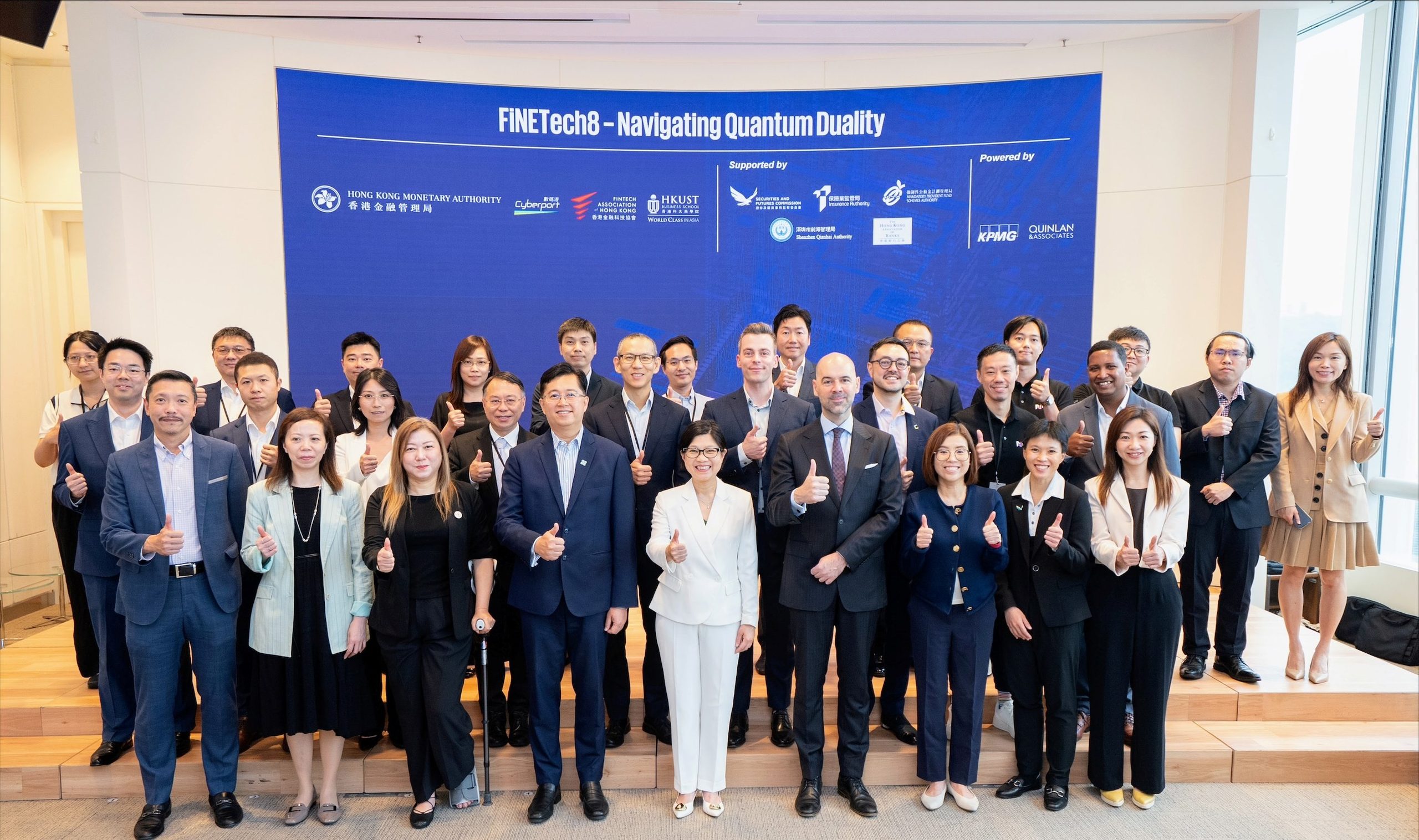
Following recent financial post-quantum strategic initiatives, the Hong Kong Monetary Authority (HKMA) and the Hong Kong University of Science and Technology jointly released the "Post-Quantum Cryptography Toolkit" for the banking sector, establishing a framework for transitioning banking infrastructure to quantum resistance before 2030 and aiming to raise banking institutions' Quantum Preparedness Index (QPI) from 2.3 to 10.0 points[7]. Business significance: Marks the first time a regional supreme financial regulator has instituted quantitative metrics and a compliance countdown deadline, compelling commercial banks to designate cryptographic asset migration as a mandatory line item in annual IT capital expenditure budgets[7]. Landscape impact: Sets a post-quantum compliance benchmark for core transaction, clearing networks, and cross-border payment gateways across the Asia-Pacific region, projected to trigger over $10 million in security middleware upgrade procurements by multinational banks over the next three years[7].
Following recent quantum strategic deployments, South Korea officially launched its sixth-generation national supercomputer, codenamed "Hangang," with a theoretical peak performance of 614 petaflops (PFLOPS), and established an engineering timeline to complete physical and network interconnection with IonQ's Tempo quantum processor before May 2027[6]. Business significance: A national computing platform establishes quantum computing as a standard accelerating co-processor, paving the way for hybrid dispatch protocols bridging hundreds-of-petaflops classical compute with high-coherence trapped-ion hardware[6]. Landscape impact: Seizes the commanding heights in Asia-Pacific quantum-classical hybrid computing, constructing a national-scale hybrid simulation testbed for the semiconductor, shipbuilding, and next-generation battery industries[6].
Abu Dhabi Maritime Academy, smart logistics solutions provider Quincus, and Quantinuum entered into a multi-year technical R&D collaboration to resolve international maritime logistics bottlenecks using real-world port operational throughput data via hybrid quantum computing, high-performance classical supercomputing, and classical operations research and heuristic algorithms[12]. Business significance: Targets container berth allocation, fairway congestion control, and heavy handling asset utilization at Middle Eastern hub ports, taking lifecycle carbon reduction as an optimization metric to explore the commercial benefits of quantum-inspired and hybrid quantum-classical algorithms in complex real-world logistics scheduling[12]. Landscape impact: Accelerates the adoption of quantum algorithm proofs-of-concept among Middle Eastern sovereign wealth funds and logistics conglomerates, expanding industrial operations research into a third high-value testbed alongside finance and pharmaceuticals[12].
Following recent rollouts of India's National Quantum Mission, domestic quantum security firm QNu Labs, funded under the National Quantum Mission, officially launched systematic enterprise training courses on quantum security for large government and enterprise clients, deeply integrating real-world production deployment cases in quantum secure communication and post-quantum cryptographic migration[8]. Business significance: Locks in client mindshare through upstream technical training, utilizing educational services as the top-of-funnel entry point for post-quantum cryptographic software gateways and hardware security modules[8]. Landscape impact: Promotes self-reliant and controllable cryptography across government, defense, and financial infrastructure in the South Asian subcontinent, cultivating a talent pipeline of quantum security engineers in emerging markets[8].
The European Union officially launched the major research initiative EQUIP to enhance pan-European security resilience, focusing on tackling hardware resistance against physical side-channel attacks and algorithmic hardening standards for post-quantum cryptography across IoT, intelligent connected vehicles, and edge-cloud systems[20]. Business significance: Addresses technical bottlenecks where existing post-quantum algorithms are difficult to deploy on low-power, compute-constrained edge chips and vulnerable to electromagnetic and power side-channel leakage[20]. Landscape impact: Establishes industry security admission standards for European automotive manufacturing and industrial IoT entering the post-quantum era, preempting systemic supply chain paralysis caused by future quantum decryption of smart vehicle systems and industrial sensors[20].