Nov 2, 2026 – Nov 3 · Daily Brief

Threshold for Quantum Computers to Break Banking Encryption Drops to 20,000 Qubits

39 items · 12 sourcesPDFThis issue's roundup is free
02Hardware

Hardware Frontier

Cat Qubits and Superconducting Hardware

French quantum computing startup Alice & Bob measured an average idle bit-flip (quantum state 0-to-1 error) lifetime of 44 minutes on single-qubit devices using bosonic cat qubits (encoded in Schrödinger cat states) fabricated with microwave superconducting resonators, while the bit-flip lifetime of its 12-qubit Helium 2 processor reached 3 to 4 hours[8]. An updated resource estimate released the same day shows that a fault-tolerant architecture built on cat qubits would require only approximately 23,000 physical qubits and just over 3 days of computation time to break the mainstream commercial cryptosystem RSA-2048[39].

Compared with the current published state-of-the-art (SOTA) baseline for superconducting architectures (Google's Willow chip with a single-qubit decoherence time T₁ of ~100 μs and two-qubit gate fidelity of 99.5% to 99.9%), conventional superconducting circuits (microwave superconducting circuit computing) typically exhibit bit-flip lifetimes on the microsecond-to-millisecond scale; Helium 2 pushes idle bit-flip lifetimes into the hour scale, achieving a physical hardware-level suppression of bit-flip noise by millions of times in time scale[8]. This directly slashes the physical qubit budget required to break RSA-2048 from millions under conventional surface codes (2D lattice quantum error-correcting codes) to just over twenty thousand[39]. However, significant shortcomings remain before this path achieves practical utility: cat qubits autonomously suppress only bit flips at the physical hardware level, while phase-flip errors (superposition phase errors) still scale linearly with photon number and must rely on 1D repetition codes for error correction; meanwhile, its two-qubit gate fidelity currently sits in the 98% to 99% range—roughly an order of magnitude lower than the commercial all-to-all record of 99.921% achieved by trapped-ion architectures (Quantinuum Helios)—and error-corrected bias-preserving gate operations still await multi-qubit validation[8][39]. This achievement prompts the industry to re-evaluate the commercialization timeline of biased-noise error correction, and is expected to compel quantum cloud providers to reassess their physical qubit scaling roadmaps within 2 to 3 years[8][39].

Neutral-Atom Quantum Computing

A research team combined a Rydberg atom (highly excited neutral atom) processor with the Sample-based Quantum Diagonalization (SQD, ground-state energy calculation via sampling) algorithm to successfully calculate the ground-state energy of the electronic Fermi-Hubbard model (a theoretical model for strongly correlated electrons), converging close to the ground state at a scale of up to 56 qubits while maintaining its convergence advantage with 10 times fewer samples than conventional random sampling[16]. Another group of researchers developed an embedding error-correction scheme based on problem mapping using a Rydberg array of up to 107 atoms, achieving an optimal solution recovery rate of at least 8% in benchmark scenarios where classical optimization algorithms failed to yield correct results, all without introducing additional control hardware complexity[13].

Compared with the current published SOTA baseline for neutral-atom platforms (QuEra's 2026 demonstration of 448 physical qubits and 96 logical qubits in error-corrected operations, and Atom Computing's 1,180 physical qubit array), this 56-qubit Fermi-Hubbard simulation matched small-scale exact numerical solutions in molecular-level diagonalization accuracy, demonstrating that neutral atoms offer a practical sampling advantage in many-body ground-state searches[16]; the 107-qubit embedded error correction directly converted the mapping redundancy overhead of atomic geometry into error-correction gain for the first time[13]. However, neutral-atom platforms still face fundamental physical constraints on the path to universal fault-tolerant computing: their cycle repetition rate is bottlenecked by atomic laser cooling and reloading processes, typically falling in the 1 to 10 Hz range—4 to 5 orders of magnitude slower than microwave superconducting circuits; simultaneously, mid-circuit readout (measuring a subset of qubits during computation) fidelity and crosstalk suppression have yet to reach surface-code fault-tolerant thresholds[13][16]. This progress delivers an immediately viable quasi-fault-tolerant approach for condensed matter physics simulations and is expected to drive materials simulation firms from pure numerical modeling toward neutral-atom hybrid computing within 1 to 2 years[13][16].

Photonic Quantum and Communication Devices

Researchers have developed a highly non-degenerate entangled photon-pair source capable of simultaneously emitting visible photons at a wavelength of 548 nm and telecom-band infrared photons at 1550 nm, showing strong potential to lower detector costs in entanglement-based QKD (quantum key distribution) systems[23].

In traditional entanglement-based QKD systems, both endpoints must be equipped with costly 1550 nm superconducting single-photon detectors; this architecture requires a telecom-band detector at only the long-distance optical fiber endpoint, while the local endpoint can utilize inexpensive, high-efficiency silicon avalanche photodiodes (APDs), directly eliminating the hardware expense of one costly infrared detector[23]. Compared to the current published SOTA baseline for photonic quantum computing (PsiQuantum's 99.22% two-qubit fusion fidelity on 300 mm wafers with detection efficiency ≥95%), this source effectively reduces the marginal hardware cost of deploying QKD endpoints, though full-system end-to-end loss budgets and multi-user network interface multiplexing rates still require further experimental validation[23]. This approach will trim deployment costs for metropolitan quantum-secured private networks and data-center facility nodes, and is projected to accelerate the adoption of QKD terminals across financial and governmental backbones within 2 years[23].

Quantum Sensing and Precision Measurement

An experimental team employed an engineered dynamical decoupling (suppressing noise via microwave pulses) pulse sequence to extend the quantum coherence storage time of a quantum sensor in high-noise environments from milliseconds to tens of milliseconds, achieving a full 10-fold increase in duration[12]. Another nanoscale measurement experiment demonstrated that previously overlooked nanoscale mechanical dissipation effects within microstructures structurally interfere with some of the world's most sensitive nanostring sensors[27].

The pulse-sequence technique eliminates systematic errors stemming from control drift and microwave distortion without altering the probe's physicochemical structure, lowering the signal-to-noise ratio threshold by an order of magnitude[12]; meanwhile, the discovery of nanoscale dissipation effects delineates physical boundaries for weak-force measurements under extremely low signal-to-noise ratios[27]. This technology directly empowers biological biomagnetic field measurements and subsurface gravity-gradient navigation, and is anticipated to translate into upgrade solutions for high-end geophysical exploration and medical imaging hardware within 1 to 2 years[12][27].

Superconducting Engineering and Topological Hardware

Led by Forschungszentrum Jülich, the nearly five-year German flagship quantum computing consortium QSolid formally concluded, successfully delivering a complete demonstration prototype bridging superconducting chip hardware with the low-level software stack[18]. Scottish superconducting hardware manufacturer Quantcore showcased its superconducting quantum hardware R&D efforts and manufacturing ambitions to Scotland's Minister for Higher and Further Education and Minister for Innovation[36]. Irish startup Equal1 announced the appointment of Andrew Flynn, who brings over two decades of semiconductor manufacturing experience, as Chief Operating Officer to lead the commercial delivery of its rack-mountable quantum computer, RacQ[37]. Meanwhile, a research team provided the latest experimental evidence of resilience against local perturbations, supporting the theoretical foundations of topological quantum computing (braiding anyons to resist noise)[4].

The progress of QSolid and Quantcore marks a systematic convergence of European superconducting quantum efforts from fragmented academic research toward industrialized foundry manufacturing standards[18][36]; Equal1 is driving silicon CMOS (complementary metal-oxide-semiconductor) qubits toward packaging inside standard server rack physical form factors[37]. This will enhance Europe's domestic self-reliance across the quantum hardware manufacturing supply chain, and is expected to compress deployment cycles for enterprise clients procuring rack-mounted quantum compute from annual custom builds down to quarterly deliveries[18][36][37].

03Algorithms

Algorithms and Software

Quantum Error Correction and Dynamical Noise Suppression

A study published in npj Quantum Information proposes a fault-tolerant quantum error correction scheme using constant-excitation stabilizer codes tailored for coherent noise environments, proving that logical qubits retain their error-correction protection boundaries even amid complex interference caused by coherent error accumulation[3]. Another theoretical team proposed a universal protocol using collisional dynamics to detect and suppress quantum decoherence (quantum state degradation due to environmental interference), protecting arbitrary numbers of qubits without requiring prior, precise knowledge of the environmental noise spectrum[14].

Conventional quantum error correction predominantly assumes noise to be independent, incoherent random perturbations; this study overcomes the theoretical bottleneck where coherent noise destroys error-correction thresholds, constructing a mathematically consistent fault-tolerant circuit design within a constant-excitation subspace for the first time[3]; dynamical protocols requiring no noise priors ease the requirements for hardware control calibration[14]. These two breakthroughs provide firmware-level error-correction solutions for low-level control and readout software stacks in superconducting and semiconductor spin platforms, and are expected to be integrated into compilers across major quantum cloud platforms within 1 year[3][14].

Quantum Search and Nuclear Ground-State Solvers

Researchers developed a new quantum algorithm named QDMin, applying Grover's algorithm (quantum unstructured database search) to locate the true lowest-energy ground states of complex atomic nuclei; after a single quantum computing iteration, the success probability of identifying the true ground-state energy minimum jumped from 25% with classical methods to 92%[11].

Compared with conventional numerical algorithms that perform point-by-point enumeration in exponential parameter spaces, QDMin achieves super-quadratic speedup in finding minimums, though it reveals engineering bottlenecks in state-preparation fidelity when scaled to larger nuclear systems[11]. The algorithm provides a novel computational tool for simulating nuclear reactor materials under extreme conditions and for astrophysical calculations, and is projected to curtail high-performance computing runtimes for large-scale high-energy physics simulations within 3 years[11].

Adaptive Quantum State Tomography Theory

Theoretical and experimental investigations confirm that in multi-qubit quantum state characterization tasks, the number of entangled-state sample copies required by adaptive measurement methods scales only logarithmically with the number of qubits, whereas all static measurement alternatives demand exponentially scaling sample volumes[22].

This marks the world's first quantum learning paradigm to achieve exponential speedup via measurement dynamic feedback without relying on quantum coherence or restricted protocols, eliminating the theoretical barrier where multi-qubit state tomography inevitably faces the curse of dimensionality[22]. The approach reduces the time overhead of factory calibration and gate fidelity benchmarking for multi-qubit quantum chips, and is poised to become a standard software module for automated testing of semiconductor and superconducting quantum chips within 2 years[22].

Quantum Pattern Mining in Medical Data

A team from the College of Engineering and Computer Science at Florida Atlantic University (FAU) conducted an applied quantum computing benchmark evaluating the capacity of quantum classification algorithms to mine feature patterns from extremely small sample datasets of lung cancer symptoms and risk factors[30].

Addressing the overfitting dilemma inherent in high-dimensional, small-sample biomedical data, the study investigated the expressive power of high-dimensional Hilbert spaces in mapping constrained medical features[30]. This work establishes a quantum algorithmic direction for data analysis in small-scale specific disease cohorts during early oncology screening, though broader multi-center comparative validation remains necessary prior to clinical translation[30].

04Industry

Industry and Ecosystem

Institutional Investment and Capital Moves

Scottish Widows, a major UK pension provider managing tens of billions of pounds, officially announced the allocation of workplace pension savings into UK venture-growth technology firms, with the initial portfolio managed by IP Group and slated to include two UK quantum computing companies in its initial investments[34]. Meanwhile, the CO.LAB Quantum incubator in Chattanooga, Tennessee, unveiled the inaugural cohort of four startups selected for its commercialization acceleration program, including Ridge Quantum (commercializing cryptographic technology from Oak Ridge National Laboratory [ORNL]), software developers Superquantum and Esoteriq, and quantum sensing firm Kottackal[38].

As long-term institutional capital with exceptionally conservative risk tolerances, traditional pension funds entering unlisted quantum startup equity indicates that quantum technology in the UK has transitioned from early-stage government frontier grants into a commercial growth stage endorsed by long-term balance sheets like pensions[34]; regional industrial incubators are accelerating the civilian commercial translation of defense-grade national laboratory technologies[38]. This broadens follow-on funding sources for hardware companies and is expected to encourage other mainstream sovereign and corporate pension funds across Europe and the US to pilot allocations in the quantum sector over the next 1 to 2 years[34][38].

National Supercomputing Integration and Defense Deployment

South Korea's Ministry of Science and ICT announced that its sixth-generation national supercomputer, the "Hangang" system, has officially entered full commercial operation, with a design target ranking among the world's top ten in computing power; the South Korean government explicitly stated plans to interconnect and integrate the Hangang supercomputer with a physical quantum computer in the first half of 2027 to form a classical-quantum hybrid system[33]. On the US defense front, quantum systems integrator Qtonic Quantum appointed retired Lieutenant General Roger L. Cloutier Jr., former Commander of NATO Allied Land Command, as Chief Operating Officer to direct the tactical deployment of defense quantum technologies[29].

This signifies that hybrid deployments of supercomputing and quantum computing are advancing from academic demonstrations into national backbone computing infrastructure, likely triggering a wave of quantum compute coprocessor retrofits across national supercomputing centers in Japan, South Korea, and Europe before 2027[33]; having a senior defense commander lead operations indicates that the tactical implementation of quantum cryptography and sensing within NATO military command structures is gathering pace[29].

Financial Quantum-Resistant Migration and Public Cloud Support

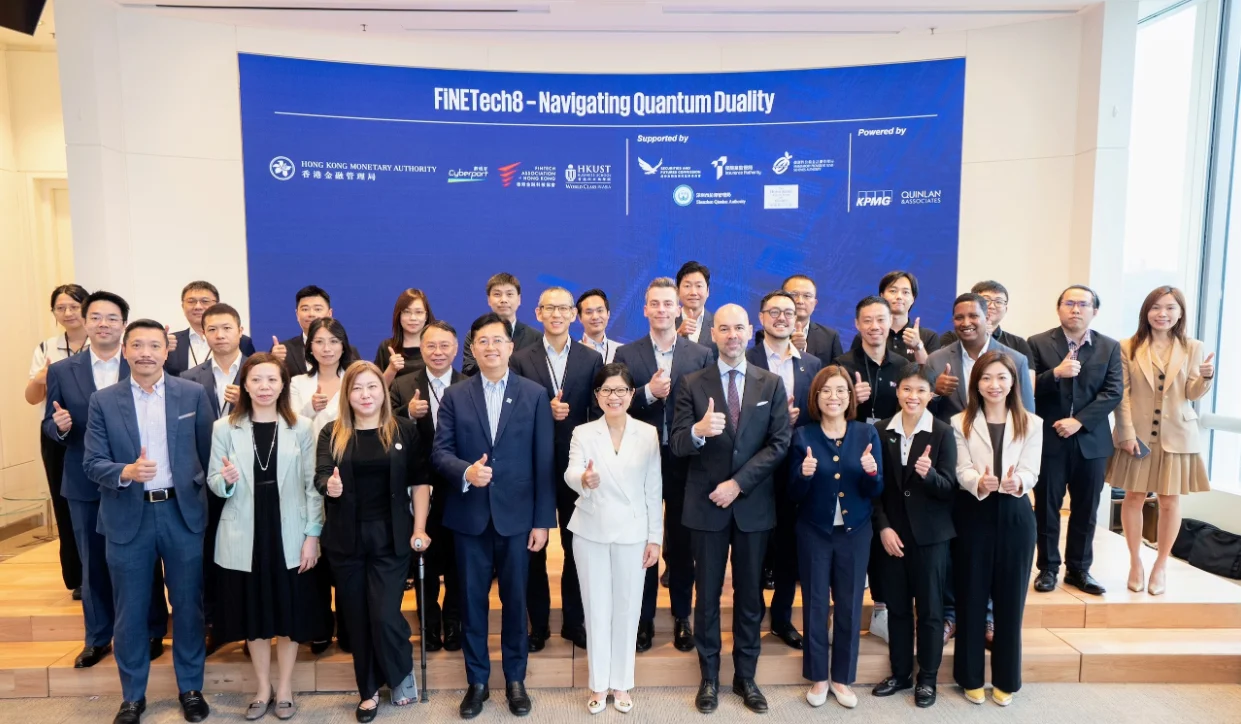
On November 2, 2026 (Beijing Time), the Hong Kong Monetary Authority (HKMA), together with HKUST, officially released a Post-Quantum Cryptography (PQC) toolkit for the banking industry, offering commercial banks a standardized framework for system audits, migration path assessments, and cryptographic agility upgrades[32]. In Southeast Asia, cybersecurity services provider ExeQuantum signed a strategic partnership with Bluebik Titan, a subsidiary of SET-listed Bluebik, aligning with the "Quantum-Ready 2030" national strategy led by Thailand's National Cyber Security Agency to deliver quantum-resistant cryptographic migration implementation services across banking, financial services, insurance, energy, and government sectors[20]. On the same day, AWS Key Management Service (KMS) announced general availability support for ML-KEM, the post-quantum key encapsulation standard finalized by the National Institute of Standards and Technology (NIST)[39].

The rollout of practical toolkits by financial regulators alongside out-of-the-box support in public cloud infrastructure indicates that post-quantum cryptography has completely moved past algorithm selection and entered the stage of system compliance upgrades and commercial implementation[32][39]. IT systems across multinational banks and critical information infrastructure enterprises face concrete upgrade budget expenditures, bringing a clear period of expanding contract volumes for relevant post-quantum security consultancies and system integrators over the next 3 to 5 years[20][32][39].

Talent Think Tanks and Academic Ecosystem

Quantum startup Iceberg Quantum officially established a Berlin office following Sydney and San Francisco, announcing the appointment of Professor Jens Eisert, a quantum computing scholar at Freie Universität Berlin, as scientific advisor while recruiting multiple core R&D researchers from his group[19]. Professor John Martinis of the University of California, Santa Barbara, former head of Google's quantum hardware team, has been invited to deliver a public lecture at the University of Western Australia (UWA) next month on forty years of technical evolution in quantum computing[35].

Startups are setting up R&D branches alongside global top academic hubs to compete for scarce high-tier talent in quantum error correction and hardware architecture; the "academic advisor + spin-off startup" model from elite research groups is becoming the standard paradigm for industrial expansion[19][35].

05Other

Academic Frontier

Condensed Matter Physics and Non-Equilibrium Systems

A research team at the University of Tübingen demonstrated that when long-range particle interactions decay algebraically with distance as (1+|x-y|)^(-π) and satisfy π>2d (where d is the spatial dimension of the system), the "bulk energy gap" (the minimum energy excitation threshold required to excite a particle) in fermionic many-body energy spectra remains stable even under weak interaction perturbations, allowing the system to evolve smoothly toward a new ground state[15]. Another study on non-Hermitian time crystals (non-equilibrium periodic microstructures) revealed that even under weak environmental noise perturbations, the macroscopic periodic behavior of time crystals—theoretically expected to oscillate indefinitely—is disrupted, placing a strict physical upper bound on their lifetime[17]. In addition, materials scientists confirmed via neutron diffraction experiments that controlled modulation of material magnetism can be achieved through microscopic lattice distortions without altering the material's chemical composition[28].

The Tübingen team provides mathematically rigorous stability bounds for quantum simulators operating under long-range Coulomb or dipolar interactions[15]; the noise vulnerability of non-Hermitian time crystals revises previous optimistic forecasts regarding the indefinite survival of open quantum many-body coherent states[17]. This standardizes the computational boundaries for quantum simulations of topological insulators and high-temperature superconducting materials, while revising theoretical lifetime estimation models for spin sensors and topological memory devices[15][17][28].

Holographic Duality and Quantum Simulation Complexity

Theoretical physicist Juan Maldacena offered an accessible explanation of the holographic principle on the science podcast The Quantum Kid, discussing the concept of using quantum computing to simulate the universe[31].

This work translates the Anti-de Sitter/Conformal Field Theory (AdS/CFT) correspondence from high-energy theoretical physics into computable quantum circuit depth assessments, outlining a computational roadmap for laboratory quantum testing of strong gravitational singularity physics[31]. This expands the academic horizon of quantum computing toward ultimate questions in theoretical physics, driving national fundamental quantum science funds in multiple countries to bias funding allocations toward interdisciplinary initiatives[31].

Single-Molecule Quantum Network Interfaces

Experimental physicists demonstrated the physical feasibility of employing single molecules as fundamental building blocks for quantum networks, verifying that an individual organic molecule can serve as a high-coherence single-photon interface to realize optical quantum information interconnects between distributed quantum computing nodes over long distances[5].

Compared to prevailing cold-atom or solid-state color-center approaches, single-molecule systems offer chemical tailorability and wavelength tunability, providing quantum repeaters with a novel carrier featuring exceptionally low material defect-induced losses[5]. This achievement opens a low-cost material avenue for future inter-data-center distributed quantum computer interconnects, and will influence physical-layer component selection for the quantum internet across a 5-to-10-year horizon[5].

06Impact

Today's Impact

  1. Global Banking and Cloud Security Systems: Affected entities include commercial banks, multinational financial institutions, and public cloud users. The Hong Kong Monetary Authority's release of a banking implementation toolkit[32] and AWS KMS's integration of the ML-KEM post-quantum algorithm[39] mark a comprehensive transition of quantum-resistant defense from frontier exploration into mandatory compliance operations in production systems. The next watchpoint is whether major financial regulators in Europe, the US, and Asia-Pacific mandate firm compliance timelines for migrating and decommissioning legacy public-key cryptography[20][32][39].
  2. Fault-Tolerant Quantum Computing Hardware Landscape: Affected entities include superconducting microwave chip developers and error-correction algorithm teams. Alice & Bob extended the idle bit-flip lifetime of its 12-qubit chip to 3–4 hours, which, combined with a resource estimation model requiring ~20,000 physical qubits to crack RSA, disrupts the conventional assumption that superconducting approaches must rely on millions of physical qubits using surface codes. The next watchpoint is whether the team can push two-qubit gate fidelities on the Helium 2 chip beyond the fault-tolerance threshold while maintaining flip suppression[8][39].
  3. Institutional Long-Term Capital and Venture Asset Allocation: Affected entities include global pension funds, sovereign wealth managers, and early-stage quantum hardware startups. The UK's Scottish Widows allocated workplace pension funds to domestic quantum computing startups for the first time[34], dismantling liquidity barriers historically preventing pension capital from entering deep-tech venture investments. The next watchpoint is whether large North American or European pension funds follow suit by establishing dedicated quantum growth funds over the next two quarters[34].
  4. National High-Performance Computing Centers: Affected entities include national supercomputing centers. South Korea's Hangang supercomputer has entered full commercial service and is slated to interconnect with a physical quantum computer in the first half of 2027; combined with the convergence advantage of 56-qubit neutral atoms in Fermi-Hubbard ground-state diagonalization, this moves classical HPC and quantum synergy from simulation exercises into production operation. The next watchpoint will be the end-to-end scheduling latency and real-world acceleration performance of South Korea's first heterogeneous classical-quantum hybrid cluster in the first half of 2027[16][33].
07Other

Editor's Take

The engineering narrative of quantum computing is undergoing a profound calibration. Over past years, the industry was often preoccupied with the linear accumulation of total physical qubit counts as an intuitive metric of technological progress; however, the hardware dynamics featured in this issue make clear that asymmetric engineering and architectural efficiency targeted at underlying physical noise profiles now carry strategic value far exceeding raw qubit numbers. Autonomous hardware noise-suppression architectures, exemplified by cat qubits, eliminate bit flips at their inception through the geometric design of microscopic quantum states, shrinking the physical qubit count required to break classical cryptographic schemes by orders of magnitude. This pivot from brute-force error correction dependent on millions of physical qubits toward physical-native noise resilience coupled with efficient error correction suggests that the timeline to practical utility will not necessarily have to wait for multi-million physical qubit wafers to mature; the threshold to fault-tolerant computing is being redefined faster than anticipated.

In tandem, the gears of global cyber defense are being forced into mesh at the same accelerating pace. From public cloud giants rolling out concrete support for post-quantum standards in cloud key management services, to regional financial regulators handing down practical toolkits directly to commercial banks, the rebuilding of defensive perimeters has moved beyond abstract deliberation and entered an era of engineering implementation directly tied to financial balance sheets. Now that algorithmic projections on the hardware side have compressed the time required to break standard cryptography down to mere days, post-quantum cryptographic migration across global digital infrastructure is no longer a precautionary drill, but an engineering sprint that permits no hesitation.