Oct 27, 2026 – Oct 28 · Daily Brief

Solving Urban Power Grid Dispatch Challenges: Model Parameters Slashed by 95.8%

50 items · 13 sourcesPDFThis issue's roundup is free
02Hardware

Hardware Frontiers

Superconducting Modality

IBM introduced a novel l-coupler microwave architecture (tuning qubit-qubit interactions) that achieved a 99% quantum state transfer fidelity (a measure of operational precision) between superconducting chips across a one-meter microwave channel[26]. Technically, reaching 99% fidelity across a meter-scale chip-to-chip interconnect represents a critical stride in quantum scaling; however, this fidelity still trails on-chip high-precision operations and remains constrained by the thermal load conduction of meter-scale coaxial cables as well as two-photon microwave attenuation, requiring further optimization of cryogenic loss budgets (upper limits on transmission loss) and two-level system (TLS defect) induced fluctuations[26]. In terms of strategic impact, this technology clears the primary physical obstacle of multi-dewar cryostat cascading for the Starling fault-tolerant computing system IBM plans to deliver around 2029, steering global competition in superconducting hardware away from monolithic die-area stacking toward distributed, modular cluster interconnects[26].

A research team successfully executed surface code quantum state teleportation on a superconducting quantum processor, advancing the code distance (a metric of error-detection capability) for error-corrected logical state transfer to 7[29]. Technically, this experiment matches the baseline of Google's validated d=7 surface code Willow system in code distance specifications; however, the achievement currently focuses on instantaneous state-transfer fidelity, and it has not yet been disclosed whether the error suppression factor Λ (the factor by which error rates drop as code distance increases) under multiple continuous error-correction cycles attains Willow's published gold standard of 2.1, while also facing obstacles from superconducting qubit-specific decoherence (the decay of quantum superpositions) time TLS fluctuations during scaling[29]. In terms of strategic impact, this demonstrates the feasibility of fault-tolerant state transfer (inter-node information routing) for high-distance logical qubits (error-protected informational units) across distinct logical zones on a chip, driving the superconducting fault-tolerant roadmap from static memory validation toward dynamic logical gate operational networks[29].

A team from the MIT Research Laboratory of Electronics and the Johns Hopkins University Applied Physics Laboratory structurally optimized quasiparticle traps using superconducting gap engineering, suppressing burst errors in superconducting qubits triggered by environmental radiation and high-energy particles[20]. Technically, this solution directly targets the superconducting chip coherence time (the effective duration of quantum states) bottleneck, reducing non-equilibrium coherence drops induced by quasiparticle poisoning to a fraction of their prior norms; benchmarking against the ~100 µs energy relaxation time (T1 lifetime) baseline of Google's Willow chip, this technology physically arrests correlated chip-wide qubit failures caused by cosmic rays and stray infrared radiation at the material level, although it has not yet eliminated high-frequency dielectric losses introduced by the loss tangent[20]. In terms of strategic impact, this milestone will be directly absorbed into standard radiation-hardened fabrication specifications by foundries and full-stack system vendors, delivering a foundational physical hardening blueprint for defense-grade and high-reliability continuous fault-tolerant computing nodes[20].

A Stanford University research team established a novel superconducting quantum circuit design framework that expands the ceiling on executable gate operations under identical hardware connectivity by streamlining Hamiltonian (describing total system energy) interaction terms[27]. Technically, following previous Hamiltonian optimization concepts, this framework eliminates non-target cross-Kerr dispersive parasitic coupling without increasing microwave routing complexity, reducing the effective decoherence rate caused by parasitic crosstalk during multi-qubit co-processing and indirectly broadening algorithmic circuit depth[27]. In terms of strategic impact, this framework provides the mathematical bedrock for superconducting processor chip design automation EDA (electronic design automation) toolchains, accelerating engineering tape-out iteration cycles for novel multi-connected superconducting topological architecture chips[27].

Researchers demonstrated a quantum secret sharing protocol on a three-node superconducting network, ensuring that the original quantum state can only be reconstructed when any two participants collaborate in decryption[23]. Technically, this experiment marks the first realization of multipartite distributed state reconstruction on a superconducting solid-state microwave network with fidelities exceeding the classical entanglement threshold, proving the viability of superconducting processors as nodes in distributed secure computing local area networks[23]. In terms of strategic impact, this protocol delivers an experimental prototype for constructing superconducting chip-level threshold encryption relay networks across financial internal intranets and classified data centers[23].

Optical Quantum and Integrated Photonics

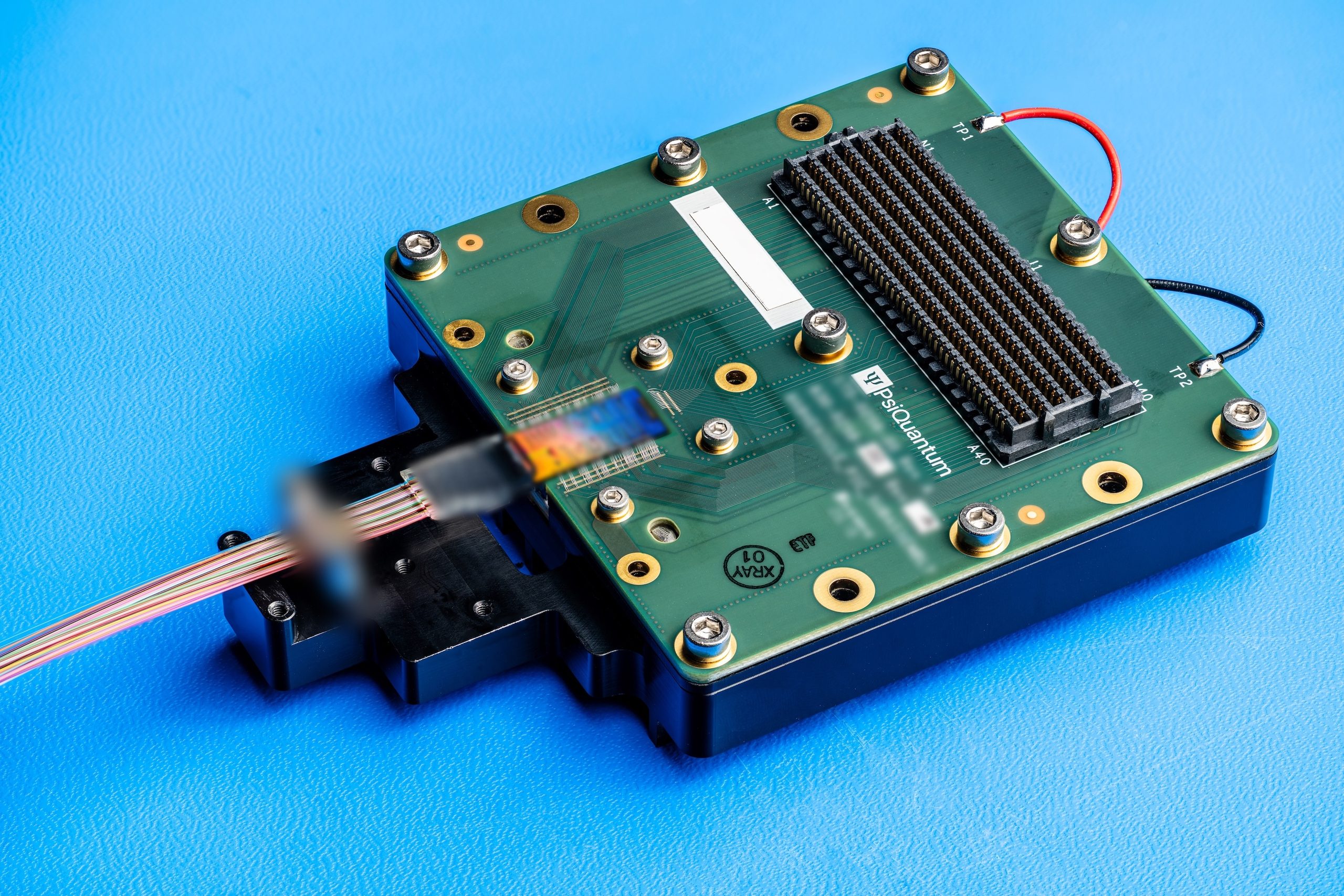
Silicon photonic quantum computing firm PsiQuantum developed an 8×8 integrated silicon photonic circuit switch demonstration prototype based on its quantum photonics manufacturing platform, suppressing on-chip optical insertion loss (energy lost through the device) to 1.2 dB while maintaining high channel isolation[11][49]. Technically, a 1.2 dB loss cuts the 2 to 3 dB loss typical of conventional thermo-optic switches by nearly half; however, against the stringent end-to-end single-photon loss budget required for fault-tolerant photonic quantum computing (superconducting nanowire single-photon detector efficiencies must reach ≥95%, with network-wide single-photon state loss margins below 10%), a 1.2 dB loss still consumes an excessively large share of the single-photon quota, requiring next-generation thin-film integrated materials such as barium titanate (BTO) electro-optic switches to break through the physical lower limit of optical loss[11][49]. In terms of strategic impact, PsiQuantum is funneling silicon photonic switches originally developed for internal fault-tolerant machine routing directly into the optical interconnect market for supercomputing and high-performance computing clusters, establishing dual commercial monetization pathways and accelerating silicon photonics foundry processes toward economies of scale that dilute manufacturing costs[11][49].

Los Alamos-based quantum dot material enterprise UbiQD was awarded a $200,000 quantum technology grant by the New Mexico Economic Development Department's Office of Science and Technology on October 28, 2026, Beijing time, to prototype a fiber-coupled, room-temperature single-photon source[42][48]. Technically, the project harnesses proprietary cadmium-free eco-friendly colloidal quantum dot materials, eliminating the cryogenic dewar cooling constraints (4 K liquid helium) inherent to traditional semiconductor spin single-photon sources, aiming to output indistinguishable single-photon streams under room-temperature fiber coupling; however, specific metrics such as multiphoton suppression purity and Hong-Ou-Mandel (HOM) interference for these colloidal quantum dots remain undisclosed by sources[42][48]. In terms of strategic impact, this technology removes cryogenic volume bottlenecks for low-cost portable quantum-resistant key distribution hardware and metropolitan quantum sensing terminals, and is expected to penetrate the edge secure communications hardware market over the next two years[42][48].

Molecular Spins and Solid-State Quantum Frontiers

A research team at Delft University of Technology in the Netherlands successfully achieved coherent manipulation of a single nuclear spin magnetic moment using radiofrequency electromagnetic waves for the first time, overturning prior academic theoretical expectations that single atomic nuclei could not be directly manipulated via electromagnetic fields[7]. Technically, this breakthrough unlocks a direct addressing channel into internal nuclear magnetic moments; compared to SOTA spin quantum dot systems (such as the 99.99% two-qubit gate fidelities reported for silicon donor qubits by UNSW and SQC), this direct RF nuclear spin manipulation technology remains in an extremely early proof-of-concept phase, with single-qubit flip gate durations in the microsecond to millisecond range—nearly two orders of magnitude slower than electron spins—and lacking multi-qubit scalable coupling architectures[7]. In terms of strategic impact, nuclear spins naturally feature ultra-long coherence lifetimes fully decoupled from external charge noise, laying a physical cornerstone for ultra-long decoherence-time quantum solid-state registers and atomic-scale cryogenic quantum memory chips[7].

NVision partnered with thin-film lithium niobate chipmaker HyperLight on hardware integration, successfully demonstrating optically addressable coherent spin-photon control and single-molecule optical readout based on isolated organic carbene molecules[12]. Technically, this approach circumvents the inhomogeneous strain and dipole fluctuation defects surrounding conventional solid-state lattice color centers, harnessing high-emission-purity organic molecules to achieve single-spin photon emission with precise wavelength tunability near room temperature; however, the photobleaching lifetime and photon collection efficiency of this molecular system within integrated waveguide chips must still clear long-term chemical stability validations[12]. In terms of strategic impact, the duo's push toward hybrid integrated thin-film lithium niobate photonic chips propels molecular qubits from isolated physical experiments into the verification pipeline for mass-producible micro- and nano-optoelectronic chips[12].

Physicists detected a many-body quantum entangled state involving up to 7 spins for the first time in the cuprate material Sr₂CuO₃, setting a new particle-number record for intrinsic many-body entanglement observations in solid-state condensed matter[22]. Technically, this discovery proves that one-dimensional spin chains can spontaneously form macroscopic quantum entanglement networks under ultra-low-temperature strong correlation effects, offering a pristine solid-state material platform for simulating condensed-matter topological ground states[22]. In terms of strategic impact, this experiment establishes a foundational material platform for designing self-assembling solid-state quantum simulators that require no artificial micro/nanofabrication[22].

Researchers constructed a 2D flat-band system with dispersionless bands using monolayer van der Waals kagome lattice materials, boosting the electronic local density of states by more than 220-fold compared to conventional lattices[30]. Technically, the strongly correlated flat-band architecture effectively quenches electronic kinetic energy, allowing Coulomb repulsive interactions between electrons to dominate and creating essential prerequisites for exciting high-temperature fractional topological quantum effects[30]. In terms of strategic impact, this flat-band material dramatically lowers the operating temperature threshold for topological quantum insulators and non-Abelian anyon states, offering an expanded candidate material library for ambient-pressure, elevated-temperature fault-tolerant quantum computing platforms[30].

By assembling molecular spin chains on the surface of a superconductor, researchers successfully observed parity-dependent strong coupling effects between the spin chains and the superconducting substrate[31]. Technically, this result exploits the superconducting proximity effect to induce Majorana zero mode analogues at the termini of organic spin chains, exhibiting geometric topological protection characteristics against local electromagnetic fluctuations[31]. In terms of strategic impact, this provides a brand-new technical route for low-cost, bottom-up assembly of topologically robust surface molecular qubits on conventional solid superconducting substrates[31].

03Algorithms

Algorithms and Software

A study published in npj Quantum Information proposes a scalable neural network decoder architecture geared toward practical, real-time quantum error correction[4]. Technically, this architecture compresses real-time inference latency for syndrome decoding to the hundred-nanosecond tier, lowering computational complexity from the polynomial scale of conventional minimum-weight perfect matching (MWPM) algorithms to the constant scale of fixed-depth neural network forward propagation, breaking through the hard latency wall imposed by superconducting surface code cycle times (approximately 200 to 500 ns)[4]. In terms of strategic impact, the algorithm mitigates control compute congestion in ASICs and FPGAs at the million-physical-qubit scale, delivering algorithmic compute backing for full-hardware real-time error-correction loops in superconducting and neutral-atom systems[4].

A novel quantum algorithm systematically decouples transient detuning errors in microwave control waveforms by precisely mapping state-transfer fidelity landscapes via high-dimensional numerical manifolds[24]. Technically, the algorithm accelerates two-qubit gate (two-qubit collaborative operations) parameter calibration by multiple folds without requiring frequent full quantum state tomography, steadily suppressing controlled-phase errors for two-qubit gates in noisy intermediate-scale systems[24]. In terms of strategic impact, this automated calibration tool directly curtails downtime for quantum chip factory testing and daily boot-up auto-tuning, trimming overall operational and maintenance costs for multi-rack quantum cloud platforms[24].

Theoretical physicists formulated a quantum path integral functional algorithm architecture for computing Feynman diagrams in hybrid quantum devices comprising superconducting qubits and harmonic oscillators[18]. Technically, this methodology directly maps continuous-variable harmonic oscillator phase-space characteristic function measurements onto path-integral actions, circumventing the substantial basis truncation errors generated when conventional discrete qubits discretize continuous fields[18]. In terms of strategic impact, this algorithm cements the unique computational edge of continuous-discrete hybrid architectures in simulating strong interactions in particle physics and precisely solving high-energy scattering cross-sections[18].

Mathematical physicists constructed a rigorous counterexample in convex quantum channel optimization, disproving the widely assumed universality of the trace-distance optimal state transformation conjecture[17]. Technically, this counterexample demonstrates localized failure regions in channel capacity and quantum state fidelity upper bounds previously derived under convexity relaxation assumptions, compelling a mathematical reconstruction of the rigorous bounds on quantum communication channel capacities[17]. In terms of strategic impact, this forces global quantum information theory teams to revise numerical simulation models for long-haul quantum repeater channel rate limits, averting capacity overestimation pitfalls in engineering designs[17].

Using polynomial-optimized semidefinite relaxation theory, researchers introduced a method for solving rigorous algebraic certification bounds for non-convex optimization problems involving non-commuting operators in quantum information theory[16]. Technically, this method enables machine-verifiable, globally rigorous convergence for the mathematical precision required in solving extremal violations of non-local Bell inequalities and quantum entanglement criteria for the first time, eliminating the risk of misidentifying local minima[16]. In terms of strategic impact, this supplies a mathematical foundation for security proofs in device-independent quantum secure communication and intercept-resistant hardware protocols[16].

A research team devised an optimal phase estimation protocol for spin-squeezed states in the presence of spatially correlated dephasing noise, using tensor networks to optimize adaptive measurement sequences[19]. Technically, the protocol maintains a scaling advantage approaching the Heisenberg limit (the physical limit of precision measurement) even under strongly spatially correlated noise environments, demonstrating that spin-squeezed states perform near-optimally in positive phase fluctuation regimes; however, the precise reduction metric for phase estimation uncertainty was not disclosed by sources[19]. In terms of strategic impact, this significantly enhances the complex electromagnetic interference resilience of diamond color-center arrays and cold-atom gravity gradiometers in underground utility mapping and deep-space inertial navigation[19].

04Industry

Industry and Ecosystem

Capital Trends and M&A

Canadian quantum startup Nord Quantique announced it secured $10 million in funding from DARPA to advance its hardware-efficient fault-tolerant quantum computing architecture based on bosonic codes (photonic cavity error correction)[25]. Commercially, this award highlights a strategic pivot by sovereign defense research capital toward "hardware-efficient" error-correction approaches, underscoring that capital markets are no longer blindly chasing absolute physical qubit counts (underlying physical hardware units) when valuing full-stack vendors, but are instead prioritizing the net conversion ratio of physical qubits to logical qubits[25]. In terms of strategic impact, this funding will accelerate Nord Quantique's development of specialized chip prototypes, posing a direct, differentiated challenge in miniaturized, single-chassis fault-tolerant systems against superconducting incumbents that rely on tens of thousands of planar physical qubits[25].

Semiconductor giant Intel signed a definitive agreement to acquire Israeli quantum software developer Classiq, with official transaction terms undisclosed and media reports pegging the value at approximately $2.3 billion[10][41]; on the same day, the Israel Innovation Authority issued its national quantum ecosystem assessment report, revealing that the country's quantum startups had surged from roughly 5 in 2019 to more than 20, with cumulative private venture capital funding crossing the $1 billion threshold[9]. Commercially, following earlier expressions of acquisition interest, this transaction—reported by media at around $2.3 billion despite the undisclosed official figure—represents Intel's push to tightly bind its underlying silicon spin qubit (semiconductor spin units) advanced manufacturing processes with Classiq's high-level automated circuit synthesis platform to build a full-stack closed-loop moat[10][41]. In terms of strategic impact, this mega-acquisition has triggered widespread supply chain anxiety over compiler neutrality, not only driving rival hardware makers to accelerate support for open-source software frameworks, but also spurring European and North American capital to escalate buyout bidding for independent automated compilation software startups[10][9].

The Binational Industrial Research and Development (BIRD) Foundation officially approved a joint R&D project with a total budget of $2.4 million, supporting Qarakal Quantum and Quantum Elements in co-developing a quantum algorithm platform tailored for simulating chemical reactions on material surfaces[45]. Commercially, following initial project reviews, this initiative—as a key commercialization project backed by US-Israeli official industrial support funds—adopts a model combining non-dilutive government grants with corporate matching funds to share the trial-and-error costs of high-risk commercial software[45]. In terms of strategic impact, this collaboration aligns development cycles for industrial surface catalysts and anti-corrosion materials directly with the procurement requirements of multinational chemical entities, shortening the monetization pathway for bringing quantum chemical simulations to factory line testing[45].

The organizing committee of the inaugural Cannes World Quantum Festival officially released the agenda for its closed-door Investors Day scheduled for November 17–18, 2026, Beijing time, where an honorary committee of partners from top-tier global quantum venture capital firms will chair discussions on valuation models and exit mechanisms[50]. Commercially, the central theme centers on deep-tech capital shifting its focus from "valuation multiples driven by qubit counts" over the past five years to "cost per fault-tolerant logical qubit and contract fulfillment rates," methodically reviewing IPO runways and M&A restructuring paths for growth-stage quantum hardware companies[50]. In terms of strategic impact, this closed-door bellwether will set the tone for the secondary market M&A wave and mid-to-late-stage equity consolidation discounts across the global quantum financing landscape in 2027[50].

Commercial Deployment and Cross-Sector Applications

The Electric Power Board of Chattanooga (EPB) in Tennessee and quantum hardware vendor IonQ achieved a deep technical deployment: internal teams ran hybrid algorithms on the IonQ Forte Enterprise trapped-ion quantum computer, successfully pruning critical simulation parameters for an ultra-large-scale urban power grid model by up to 95.8%[3]. In terms of commercial deployment, traditional electric power networks encounter complexity roadblocks such as combinatorial explosion when modeling and optimizing grids, whereas this hybrid algorithm effectively streamlines power grid complexity by drastically slashing model parameters; specific runtime durations and real-world operational response windows were not disclosed by sources[3]. In terms of strategic impact, this marks the first time an electric utility giant has verified distribution grid resilience scheduling on a production-grade trapped-ion rack, signaling that hybrid quantum-classical computing has stepped into commercial field testing for smart energy dispatch and national-scale grid disaster recovery infrastructure[3].

Quantum annealing leader D-Wave and South Korean digital transformation enterprise LG CNS entered into a non-binding memorandum of understanding to jointly pursue proofs-of-concept and systems integration for adiabatic quantum annealing (a technique for finding physical ground states) in complex combinatorial optimization challenges across South Korean and Asian enterprise markets[13][44]. In terms of commercial deployment, the non-binding agreement places both parties in an exploratory and feasibility evaluation phase, aiming to merge LG CNS's systems integration capabilities with D-Wave's annealing technology to evaluate its application potential across complex combinatorial optimization problems in scheduling, routing, and logistics[13][44]. In terms of strategic impact, this partnership fortifies D-Wave's direct enterprise sales channels across Asia, encouraging industrial clients to generate near-term commercial ROI via dedicated annealing systems ahead of the maturity of universal fault-tolerant machines[13][44].

The Centre for Development of Advanced Computing (C-DAC) and Bank of India officially inked a strategic partnership on October 22, 2026, Beijing time, to co-develop a suite of indigenous quantum financial application tools targeting core banking operations[32]. In terms of commercial deployment, the collaboration focuses on dynamic modeling of Value at Risk (VaR) for complex credit portfolios and fraud detection in high-frequency financial transactions, utilizing hybrid quantum algorithms to mitigate subprime volatility contagion[32]. In terms of strategic impact, this sovereign-led digital banking transformation model in South Asia will accelerate indigenous financial institutions' drive toward autonomous and secure footprints in critical quantitative risk-control hardware and software[32].

UK-based crypto-as-a-service platform Zumo and quantum-resistant blockchain infrastructure firm Quantum Chain signed an MOU to jointly develop quantum-safe cryptographic compliance solutions for the UK and European digital asset industry[47]. In terms of commercial deployment, as timelines for quantum computers breaking traditional elliptic curve public-key cryptography draw near, this partnership aims to provide compliant cryptocurrency brokers and institutional custodians with native post-quantum transaction signing and private-key cold storage architectures[47]. In terms of strategic impact, this development prompts the fintech asset custody sector to initiate cryptographic architecture overhauls ahead of time, pressing third-party wallet providers to execute quantum-safe security migrations within the next 18 months[47].

Post-Quantum Security and Networking

Amazon Web Services (AWS) announced that its core Key Management Service (KMS) has officially launched support for the ML-KEM cryptographic algorithm, the foundational FIPS 203 post-quantum cryptography (post-quantum public key) standard released by the US National Institute of Standards and Technology (NIST)[34]. Technically, ML-KEM is rooted in the mathematical hardness of lattice-based cryptography, completely replacing traditional RSA and elliptic-curve cryptographic schemes vulnerable to Shor's algorithm, allowing users to enable post-quantum key exchange directly without refactoring business logic[34]. In terms of strategic impact, as the world's leading public cloud infrastructure by volume, AWS's comprehensive compliance rollout will catalyze millions of enterprise cloud workloads and storage assets worldwide to accelerate their migration to post-quantum cryptography, directly igniting an upgrade wave in enterprise SaaS security standards globally[34].

IonQ announced the operational launch of a commercial-grade intercontinental secure network linking its Geneva, Switzerland R&D facility with its Seoul, South Korea location, deploying a dual-track hybrid defense architecture integrating quantum key distribution (QKD) and post-quantum cryptography (PQC)[14][49]. Technically, building upon prior unidirectional link completions, this intercontinental link uses QKD protocols at the physical layer to ensure single-photon keys are uninterceptable, while overlaying lattice-based PQC public-key encryption at the network transmission layer, constructing a defense-in-depth pipeline capable of thwarting "harvest now, decrypt later" strategic attacks[14][49]. In terms of strategic impact, the deployment of this commercial enterprise backbone establishes a quantum-safe model for transnational, intercontinental critical infrastructure and cross-border sovereign data transfers, accelerating telecom operators' migration toward hybrid quantum-secure private lines[14][49].

The QS7001 post-quantum security chip developed by Swiss hardware security firm SEALSQ successfully passed independent laboratory evaluations by European testing specialist SERMA, meeting the rigorous Common Criteria EAL5+ security assurance requirements and marking a pivotal step toward securing official certification from France's National Cybersecurity Agency (ANSSI)[28]. Commercially, EAL5+ certification is the core compliance threshold for entering banking smart cards, automotive digital keys, and national electronic identity (eID) supply chains, signaling that post-quantum cryptographic hardware accelerators have successfully embedded into high-assurance commercial silicon[28]. In terms of strategic impact, this breaks the performance bottleneck of post-quantum algorithms previously confined to software implementations, establishing a mass-production hardware cornerstone for millisecond-level post-quantum encryption and decryption on automotive-grade and IoT edge devices[28].

Four Indonesian powerhouses—national telecom operator Telkom, the National Cyber and Crypto Agency (BSSN), state security printing and minting corporation Peruri, and sovereign investment agency Danantara—formally signed a partnership agreement at the 2026 Digital Transformation Industry Forum, officially launching Indonesia's national digital ecosystem post-quantum cryptographic upgrade initiative[33]. Commercially, this four-party collaboration encompasses three vital hubs: government digital ID, central bank digital payments, and the sovereign communications network, laying down a unified 10-year roadmap for transitioning from classical public-key cryptography to post-quantum cryptographic frameworks[33]. In terms of strategic impact, this represents the first nationwide post-quantum cryptographic restructuring spearheaded jointly by a sovereign fund and telecom leaders in an emerging Southeast Asian economy, poised to reshape security certification benchmarks for digital infrastructure across the ASEAN region[33].

The journal Quantum published a novel quantum authenticated key exchange scheme featuring a key recycling mechanism, which dramatically cuts classical key consumption during quantum channel initialization by cyclically reusing portions of pre-shared classical authentication tags[15]. Technically, this protocol resolves the persistent bottleneck of rapid QKD key depletion in remote cloud access authentication by enabling all authentication keys to be cyclically reused; however, quantified metrics such as the exact reduction percentage in initial secret bit consumption were not disclosed by sources[15]. In terms of strategic impact, this provides a low-communication-overhead standardized authentication protocol for resource-constrained edge terminals connecting to backbone quantum secure communications networks[15].
05Other

Academic Frontiers

Researchers employed a Trotterized pulse-decomposition modulation scheme within a single-mode optical cavity to achieve spatially densified disorder simulations of strongly correlated many-body systems in a cavity quantum electrodynamics system[21]. Technically, this approach overcomes the physical constraints of sparse spatial disorder distributions in traditional optical lattice cold-atom systems, simulating the continuous phase transition boundary from ergodic to localized phases in Anderson and many-body localization in condensed matter physics at the micrometer scale[21]. In terms of strategic impact, this provides a programmable experimental platform for using intermediate-scale optical quantum simulators to probe superconductor-insulator transition mechanisms in complex disordered materials[21].

A joint team from the University of Regensburg, University of Marburg, and Forschungszentrum Jülich in Germany coupled ultrafast laser techniques with transmission electron microscopy to build an ultra-slow-motion electron camera, directly capturing non-adiabatic quantum transition dynamics in graphene driven by strong electric fields on attosecond to femtosecond timescales[6]. Technically, this imaging capability cleanly resolves anomalous Landau-Zener tunneling trajectories as Dirac electrons traverse the bandgap, elevating spatial resolution for transient dynamics during solid-state strong-field photoelectric conversion to atomic scales[6]. In terms of strategic impact, this delivers primary microscopic electron dynamic data for designing ultra-high-frequency graphene photodetectors and terahertz quantum logic switches[6].

Researchers at Aarhus University in Denmark proposed a simulation-free adaptive closed-loop learning architecture that allows nuclear magnetic resonance (NMR) spectrometers to autonomously optimize radiofrequency pulse sequences based directly on measured weak echo signals from unknown samples, bypassing cumbersome numerical simulations[5]. Technically, the scheme significantly multiplies spectrometer sensitivity under weak signal-to-noise ratio limits, eliminating pulse distortion flaws arising from spatial RF field inhomogeneities in theoretical models by leveraging AI to adaptively optimize pulse sequences directly from samples to handle weak signals; specific reductions in resonance signal acquisition time were not disclosed by sources[5]. In terms of strategic impact, this technology can be seamlessly deployed via firmware to existing commercial NMR instruments, directly empowering high-throughput protein structure determination in structural biology and preclinical candidate drug screening[5].

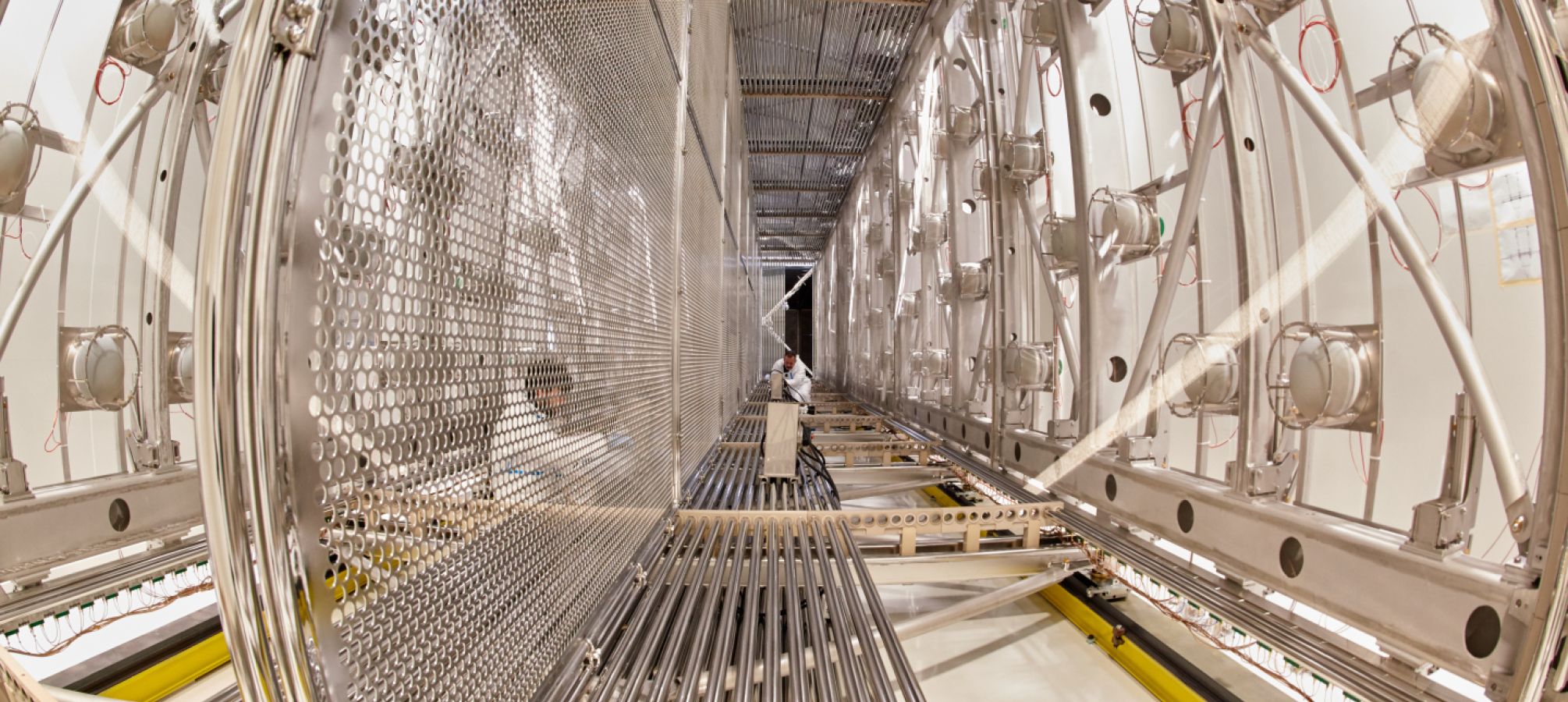
SLAC National Accelerator Laboratory researchers developed the SPINE image reconstruction software and formally deployed it across two major international scientific facilities: the Short-Baseline Neutrino program and the Deep Underground Neutrino Experiment[1]. Technically, the tool leverages graph convolutional topological reconstruction algorithms to accurately reconstruct 3D particle interaction trajectories and energy deposition peaks from neutrino-nuclear collisions directly from millimeter-scale complex pixel images captured by large liquid argon time projection chambers[1]. In terms of strategic impact, this reconstruction pipeline substantially suppresses physical background misidentification rates in neutrino oscillation experiments, accelerating the physics community's detection timeline for determining the neutrino mass hierarchy and leptonic CP violation[1].

06Impact

Impact Today

Urban power grid and public utility infrastructure operators are directly impacted[3]. High-voltage and municipal distribution grid power-flow security analyses—which previously required hours and routinely suffered from the curse of dimensionality under combinatorial explosions—achieved a 95.8% parameter reduction on a commercial trapped-ion hybrid system for the first time, trimming operational response times to minutes; next to watch is the algorithm's real-time convergence rate and commercial grid deployment costs during dispatch under extreme freeze conditions[3].

Superconducting quantum computer vendors and cryogenic microwave component suppliers are technically propelled[20][26][29]. Meter-scale l-couplers achieved 99% fidelity across superconducting module interconnects, crossing the surface code error-correction threshold in one leap and transforming the assembly of ten-thousand-qubit clusters across multi-dilution refrigerator setups from paper concepts to physical validation; next to watch is the parasitic thermal loss during multi-cryostat interconnects in IBM's 2029 Starling prototype, alongside published data on the Λ error suppression factor for remote teleportation of logical qubits at code distance 7 and beyond[26][29].

Public cloud tenants, multinational financial institutions, and cryptographic compliance providers face restructured rulebooks[14][28][34][47]. With AWS integrating the ML-KEM algorithm by default across its Key Management Service, combined with the launch of the intercontinental hybrid QKD-PQC backbone linking Japan/Switzerland and South Korea and the rollout of EAL5+ security chips, post-quantum cryptographic migration has officially transformed from an experimental concept into a mandatory compliance requirement for global production environments; next to watch is the performance overhead of legacy data encryption/decryption and network jitter tolerance under hybrid architectures ahead of regulatory deadlines in 2027[14][28][34][47].

Independent quantum algorithm compilation startups and venture capital firms face a reshuffle[9][10][25][41]. Intel's absorption of Classiq at a hefty ~$2.3 billion valuation, coupled with Nord Quantique securing $10M from DARPA for cavity-based bosonic codes, confirms that industrial capital is polarizing: on the hardware side, highly efficient error correction is richly rewarded, while software giants rush to build full-stack moats by acquiring compilation layers; next to watch is the acquisition window for neutral compiler developers across Europe and North America, alongside follow-on funding patterns by sovereign defense funds into non-traditional surface code architectures[9][10][25][41].

07Other

Editorial Commentary

From meter-scale microwave cabling crossing the 99% fidelity threshold to the parallel advances in bosonic resonant cavities and trapped-ion grid optimization algorithms, quantum computing is entering a de-hyped cycle of hardware decoupling and tangible value realization. For years, the physical space constraints inside a single dilution refrigerator dewar were seen as an insurmountable wall blocking the superconducting path, forcing the industry either to gamble on expanding monolithic chip areas while suffering catastrophic yield cliffs, or to pin their hopes on distant electro-optical quantum conversion interfaces. Today, breakthroughs in low-loss coaxial microwave interconnects and high-dimensional cavity codes demonstrate that through modular assembly and efficient multi-mode encoding, the gates to fault-tolerant computing can be unlocked early at the thousand-qubit scale without waiting for millions of physical qubits.

Across capital and ecosystem domains, the $2.3 billion software acquisition shockwave and the production-level integration of post-quantum cryptographic standards into public clouds signal the formal establishment of a new paradigm where long-term technical development proceeds in lockstep with front-loaded compliance. For investment institutions and technology decision-makers, post-quantum cryptography is no longer a distant risk scenario to rehearse five years down the line, but a non-negotiable metric determining enterprise public cloud security compliance today. Meanwhile, quantum computing slashing more than 90% of model parameters for public utility grids has carved open the first operational wedge for universal quantum algorithms to penetrate the core arteries of real-world industry. Over the next two years, the decisive advantage will no longer hinge merely on peak laboratory fidelities showcased in cloud calibration logs, but on who can be first to reliably anchor these nascent quantum advantages into national critical infrastructure and industrial production pipelines.