Superconducting Modality
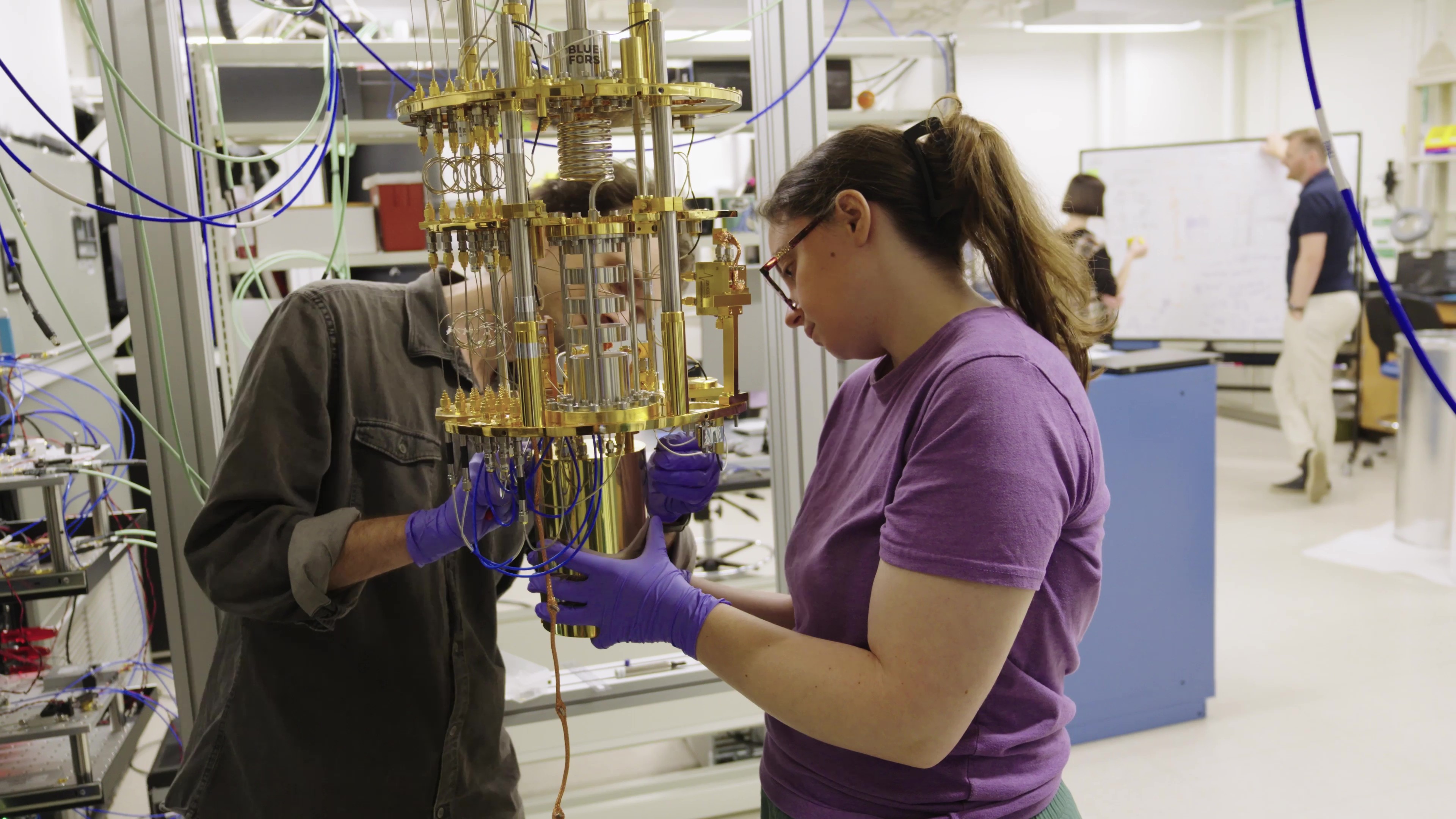
A joint team from Forschungszentrum Jülich, RWTH Aachen University, and the University of Cologne achieved single-qubit logic gate operations lasting just 6.8 nanoseconds (billionths of a second) on superconducting qubits (qubits formed by superconducting circuits), measuring an operational fidelity (a metric of operational precision) above 99.98%[6]. In terms of technical significance, this speed reduces typical superconducting single-qubit gate duration (conventionally in the 15 to 30 ns range) by more than half, with single-qubit fidelity slightly exceeding the 99.95% baseline of current cloud-accessible, production-grade systems (such as IBM Heron r2 and Google Willow); however, in full hardware benchmarking, this milestone has not yet extended to two-qubit logic gates, leaving a substantial engineering gap to bridging mainstream two-qubit gate latencies of 20 to 100 ns and mitigating two-level system (TLS, energy loss from microscopic material defects) fluctuations[6]. In terms of landscape impact, this ultra-short gate duration establishes a microwave pulse-shaping paradigm for European superconducting hardware teams exploring high-clock-rate control, poised to drive the evolution of high-frequency arbitrary waveform/pulse generation hardware over the next two to three years[6].
A novel wide-strip superconducting microstrip single-photon detector demonstrated a 99.6% resolution fidelity in multi-photon counting tests, successfully resolving up to 8 distinct photon arrival times with a peak separation of 2.15 between the electrical signals of the 7th and 8th photons[31]. In terms of technical significance, the device resolves the saturation-distortion bottleneck where conventional single-photon detectors can only differentiate a small number of coincident photons, expanding the time-resolved channel count to 8[31]. In terms of landscape impact, this high-fidelity multi-photon detection module will directly empower optical quantum computing entangled-state verification and high-throughput optical fiber communication nodes within the coming year[31].
The quantum microwave pulse optimization algorithm Q-PRONTO achieved a single-qubit gate error rate of 6.6×10⁻⁴ (corresponding to a fidelity of ~99.934%) in superconducting system tests, exhibiting quadratic convergence in optimization speed[32]. In terms of technical significance, compared with the near-linear convergence profile of conventional optimization tools, this approach synthesizes control waveforms in fewer iteration steps, though its single-qubit error rate still lags slightly behind the 99.95% baseline of top-tier production devices[32]. In terms of landscape impact, the method reduces classical computational resource overhead for low-level microwave calibration, benefiting system integrators by shortening initial bring-up calibration cycles for multi-qubit chips[32].
Trapped-Ion Modality
A German team developed LYNX, a trapped-ion (electromagnetic field-confined ion technology) processor featuring 31 physical qubits (unencoded hardware units), measuring a Quantum Volume (QV, a holistic system performance benchmark) of 2¹⁵ (32,768) across 15 physical qubits, corresponding to an average two-qubit gate error rate of 2.84×10⁻³ (fidelity ~99.716%)[27]. In terms of technical significance, against the leading publicly available trapped-ion baseline—Quantinuum Helios, which delivers a 99.921% two-qubit gate fidelity (error rate ~7.9×10⁻⁴) across all qubit pairs under 98-qubit all-to-all connectivity and a Quantum Volume of 2²⁵ (~33.55 million)—LYNX's two-qubit gate error rate is roughly 3.6 times higher, with a Quantum Volume trailing by ten binary orders of magnitude, illustrating that its multi-ion shuttling control and crosstalk suppression must still overcome high-density optoelectronic integration hurdles[27]. In terms of landscape impact, the chip provides a medium-scale domestic prototype for European trapped-ion hardware, though reaching the tier-1 global commercial compute bracket will require two to three years of iteration[27].
Solid-State Spins & Novel Energy-Level Systems
The open-source control architecture SpinQICK leverages RF-SoC (Radio Frequency System-on-Chip) technology to achieve coherent control over all-to-all connected quantum dots (semiconductor spin encoding units), directly extracting voltage noise profiles from quantum dot transport characteristics using just a single oscillation parameter Nosc=35[25]. In terms of technical significance, this breakthrough eliminates reliance on expensive, bulky discrete instrumentation; compared with the spin modality's SOTA two-qubit gate fidelity of >99% in wafer-scale production screening, low-cost control systems serve as a pivotal enabler for scaling spin qubits past the ten-qubit threshold and overcoming operational constraints[25]. In terms of landscape impact, substantially lowered R&D barriers for mid-to-small research institutions and startups will accelerate the cadence of laboratory validation for silicon spin arrays over the next two years[25].
A research team from the Department of Physics at the University of Rochester advanced high-dimensional quantum bit (qudit, multi-level quantum information unit) experiments, demonstrating high-density information encoding by manipulating three-level and higher quantum states[45]. In terms of technical significance, single-node multi-level architectures transcend conventional binary two-level constraints to provide a larger Hilbert space per physical node, theoretically reducing the physical chip footprint required for error-correcting codes by over one-third[45]. In terms of landscape impact, high-dimensional systems open a novel topological compression pathway for superconducting and semiconductor full-stack architectures, poised to reshape compiler architecture specifications in the mid-to-long term[45].
Experimentalists utilized the electron spin forces of nitrogen-vacancy (NV) centers (solid-state diamond defect spins) within diamond samples to successfully displace a micro/nanoscale macroscopic object by up to 1.5 micrometers (millionths of a meter)[9]. In terms of technical significance, this marks the first physical demonstration of microscopic electron spin quantum states directly mechanically actuating a macroscopic micromechanical structure, bridging the coupling boundary between microscopic spin coherent states and macroscopic mechanical displacement[9]. In terms of landscape impact, it establishes a novel actuation mechanism for ultra-sensitive quantum mechanical sensors and MEMS on-chip integration[9].