Oct 19, 2026 – Oct 20 · Daily Brief

Nearly 97% of 140,000 mobile apps lack defenses against quantum decryption

64 items · 18 sourcesPDFThis issue's roundup is free
02Hardware

Hardware Frontiers

Trapped Ions

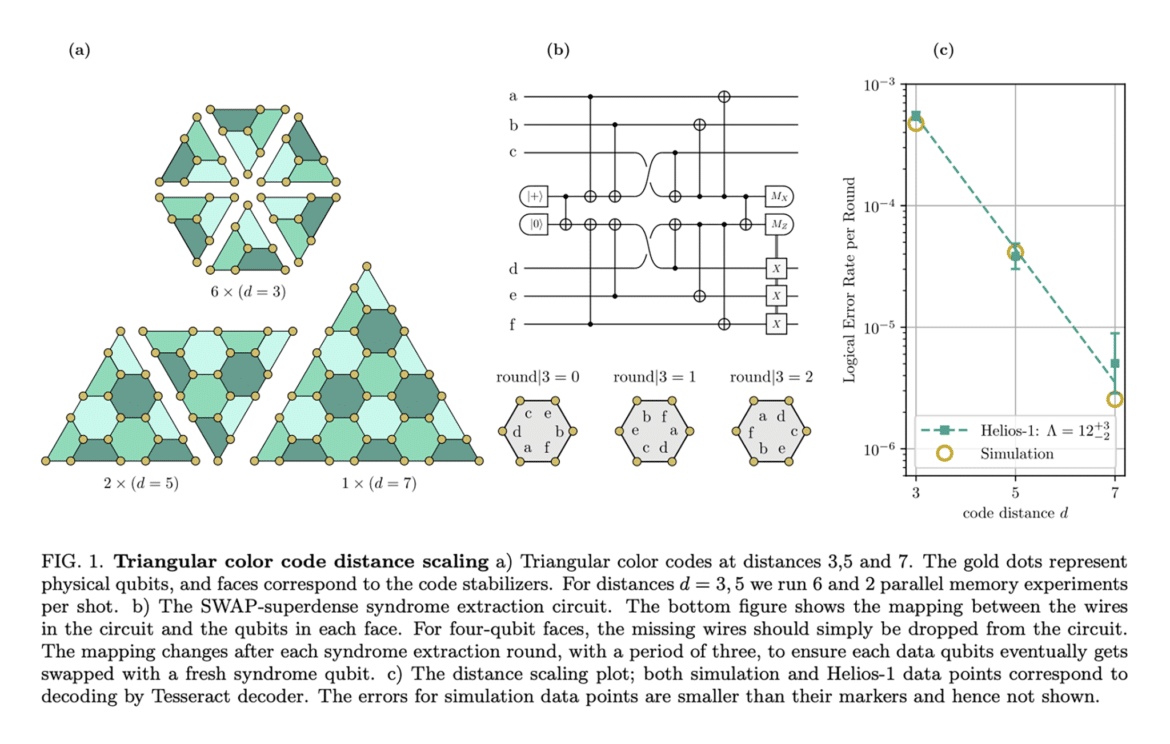
Following reports on October 19, 2026 (Beijing Time) that logical qubit (error-correction-protected information units) memory error rates were suppressed to 5×10⁻⁶, Quantinuum disclosed that its Helios trapped-ion chip, when running a distance-7 (a metric for fault-tolerant redundancy) color code (a 2D topological fault-tolerant error-correction scheme), requires nearly 200 milliseconds (approx. 200,000 microseconds) per error-correction round[13].

In terms of error suppression, the system reduces error rates by approximately 12-fold for each unit increase in code distance, yielding a suppression factor of 12—equivalent to 5.7 times the baseline of Google's Willow superconducting surface code (a 2D lattice error-correction scheme) (Λ≈2.1), while two-qubit gate (two-particle entangling logical operations) fidelity remains undisclosed[13]; however, an error-correction cycle of approximately 0.2 seconds exposes the physical bottleneck of the trapped-ion approach: constrained by ion-shuttling transport overhead and laser cooling latencies, its actual execution clock rate is only about 5 Hz, lagging six orders of magnitude behind the nanosecond-scale gate times (20 to 100 ns) of superconducting architectures, and still facing the fundamental physical hurdle of accumulated environmental decoherence (decay and degradation of quantum states) in extended algorithms[13]. While this progress cements the advantage of trapped ions in high-precision quantum memory, it compels hardware vendors to tackle low-latency ion-routing schemes to satisfy the demands of fault-tolerant computing.

UK quantum hardware firm Universal Quantum unveiled a novel error-correction decoder that empirically reduced communication error-correction overhead and transmission error rates during modular ion-trap chip interconnection[31]. By utilizing adaptive check topologies, the scheme mitigates measurement latencies across inter-chip ion transport and photonic links[31], clearing communication hurdles to break through single-chip physical trapping limits and construct thousand-qubit distributed trapped-ion clusters.

A research team at the University of Oxford extended the coherence time of a mixed-species two-ion entangled state composed of distinct elements to over 10 seconds in the laboratory[60]. Leveraging the inherent physical immunity of dual-species ions against measurement-induced light scattering crosstalk, this technique dramatically prolongs coherence times compared to conventional non-clock-state ions, approaching the second-scale baseline of single-species ion clock states[60], and accelerating the practical deployment of crosstalk-resilient interfaces for quantum repeaters and distributed nodes.

Neutral Atoms

Taiyi Quantum closed cumulative funding exceeding 1 billion RMB (approx. $149.6 million) within nine months of founding, achieving unicorn status to focus on developing fault-tolerant quantum computing hardware based on ytterbium atoms, and open-sourced its low-level compiler and control toolchain, LUOSHU[16].

Currently, the public neutral-atom SOTA is held by Atom Computing at a scale of 1,180 physical qubits, while QuEra demonstrated 96 logical qubits in Nature 2026; Taiyi Quantum adopts divalent electron energy levels of ytterbium atoms, aiming to push two-qubit gate fidelity toward the 99.5% baseline set by Harvard University, yet practical application remains bottlenecked by the platform's 1 to 10 Hz cycle repetition rate constraints and shuttling/loading losses, with its empirical hardware metrics and post-selection rates (the proportion of valid data retained after discarding errors) still awaiting validation by peer-reviewed public data[16]. This funding round breaks North America's capital monopoly over the high-precision neutral-atom track, and is projected to catalyze a domestic full-system competitive landscape before 2027.

Semiconductors and Spin Quantum Dots

Researchers manipulated electron-hole spin qubits in semiconductor quantum-dot devices using purely in-plane electric fields, with measured single-qubit gate fidelity breaking through 99%[23].

The public SOTA for single-qubit gate fidelity in spin quantum dots typically requires ≥99.9% (e.g., Diraq achieving 99.85% at 1 Kelvin), while two-qubit gate SOTA peaks at 99.99% achieved by Australia's SQC; this milestone of hole spins crossing the 99% threshold successfully leverages an in-plane field configuration to circumvent strong anisotropic decoherence noise inherent to valence-band holes, though the overall modality remains restricted to sub-10-qubit scales (SOTA device-level ≤12 qubits) and relatively low gate-operation-to-lifetime ratios (10² to 10³)[23]. This achievement confirms that hole spins can achieve high-speed, all-electrical manipulation without on-chip micromagnets, reinforcing chipmaking giants' confidence in utilizing mature semiconductor fabrication lines to manufacture quantum chips.

Superconducting and Novel Qubits

French quantum startup Alice & Bob completed testing on three cat-qubit demonstration chips under the French Defense Innovation Agency's PROQCIMA program[30]. Cat qubits (superconducting units that leverage non-linear photonic states in microwave cavities to intrinsically suppress bit flips) autonomously suppress bit-flip errors at the hardware level, reducing error-correction code redundancy from the 105:1 ratio of conventional superconducting surface codes (Google's Willow baseline) down to several dozen to one; however, their phase-flip rates increase with photon number, and two-qubit gate fidelity still trails the median baseline of 99.5% to 99.9% seen in production superconducting systems[30]. Deep involvement from French sovereign capital establishes Europe's autonomous barrier in compact superconducting architectures.

Canadian startup Iceberg Quantum completed a $6 million seed round and announced Pinnacle, its first full-stack fault-tolerant architecture centered on cryogenic chip-to-chip interconnects and low-redundancy error-correction decoding[29]. The capital will be directly allocated to tape-out testing of initial prototype chips, intensifying technological competition among North American early-stage fault-tolerant hardware architectures.

Photonics and Quantum Networks

Researchers coupled artificial giant atoms (superconducting artificial structures with dimensions comparable to microwave wavelengths) to a 1D waveguide, achieving deterministic unidirectional quantum state transfer with fidelity exceeding 99% without any external control pulses[24]. This approach eliminates phase jitter introduced by high-frequency clock pulses and crosses the 99% transfer fidelity threshold, nearing the SOTA baseline of 99.72% for fiber-based chip-to-chip interconnects, though its actual cryogenic loss budget still requires engineering validation[24]. This physical mechanism provides a low-power, passive interface solution for interconnecting modular superconducting computer racks.

Boulder-based startup EMode Photonix raised a $1 million pre-seed round to advance the development of integrated deterministic single-photon source chips[20]. The capital injection will accelerate efforts to address upstream high-purity light-source manufacturing bottlenecks in photonic quantum computing, serving the assembly of optical quantum interference networks.

03Algorithms

Algorithms and Software

JPMorgan Chase, IBM, HSBC, American Express, and Intesa Sanpaolo released joint benchmark findings at IEEE Quantum Week 2026 on financial derivatives pricing and portfolio optimization: running relevant algorithms on current noisy chips demonstrated no acceleration advantage whatsoever, and skipping quantum hardware altogether in favor of classical computing clusters saved the entirety of compute expenditures[28]. Conducted jointly across the four financial institutions and technology hardware provider IBM, this algorithmic evaluation confirmed that, due to persistently high physical gate error rates, the massive sampling overhead required for error mitigation (mathematical post-processing methods to suppress noise) renders equivalent computational complexity far inferior to classical GPU tensor-network optimization[28]. This development shatters irrational expectations of achieving near-term commercial quantum advantage in the financial sector, compelling Wall Street institutions to pivot their R&D focus from costly cloud-hardware leasing toward long-term fault-tolerant algorithm design.

Quantum software vendors Haiqu and QMill published a comparative benchmark on deep quantum circuit (sequences of quantum logic gates) compression; Haiqu utilized approximation algorithms to achieve more aggressive gate depth reductions, enabling complex algorithms to execute correct solutions on current noisy chips, whereas QMill maintained strict equivalence transformations[5]. This comparison highlights the engineering trade-offs between tolerant compilation and strict compilation in the NISQ era: by introducing controlled, infinitesimal unitary operator (transformations preserving total probability) errors, two-qubit gate depth is dramatically shortened, effectively circumventing physical hardware decoherence[5]. This opens a practical survival space for noisy quantum chemistry molecular simulations and combinatorial optimization applications today.

Chris Reed, Vice President at quantum software company Classiq, publicly pointed out that US federal agency funding in quantum technology is excessively skewed toward low-level hardware, while investment in algorithm synthesis tools and interdisciplinary talent development remains markedly insufficient[6]. Low-level hardware without advanced compilers will turn into compute silos, prompting calls to rebalance funding toward the algorithmic ecosystem[6].

Quantum network developer Welinq utilized NVIDIA's CUDA-Q hybrid architecture to perform high-speed sampling calculations of detector error models in distributed quantum error-correction networks, shortening the benchmarking cycle for network error-correction protocols[26]. The tool accelerates parallel verification of quantum repeater decoding algorithms on classical high-performance compute hardware[26].

Postquant Labs officially launched the Quip virtual machine on the Aglais testnet and deployed its first batch of quantum smart contracts, providing a unified execution environment for decentralized networks to invoke hybrid classical-quantum compute resources[50]. The platform lowers the engineering entry barrier for invoking distributed quantum interfaces across disparate platforms[50].

04Industry

Industry and Ecosystem

Mobile security testing firm NowSecure performed code scans across 136,711 mobile applications on Apple's App Store and Google Play, discovering that up to 97% of apps contained zero post-quantum cryptography (algorithms resistant to quantum attacks) code, with fewer than one in ten of the most downloaded mainstream applications possessing protective capabilities[55]. This reveals a severe lag in the mobile software ecosystem regarding post-quantum migration; despite official standards issued by the US National Institute of Standards and Technology (NIST), third-party software faces headwinds from bloated compiled library sizes and elevated handshake latencies, resulting in a lack of incentive for proactive refactoring[55]. With hundreds of millions of users' personal communications and online banking payments exposed to "Harvest Now, Decrypt Later" threats, mobile OS giants will be forced to enforce post-quantum cryptography as a mandatory app-store listing requirement before 2027, unlocking a tens-of-billions-of-dollars software refactoring market.

The DLR Quantum Computing Initiative formally signed with IT solutions provider Bechtle to procure Finnish provider IQM's superconducting quantum computer services via the cloud, directly applied to real-world research[32]. This model—where a sovereign government entity directly purchases commercial compute power—validates the B2B sales paradigm of "cloud hardware vendor + traditional IT integrator," shifting European superconducting hardware from reliance on research subsidies toward securing stable, recurring commercial revenue[32].

Post-quantum security firm Project Eleven partnered with Bermuda-based insurer Relm Insurance to integrate its institutional asset protection product, Strongpoint, into digital asset insurance underwriting workflows, establishing post-quantum risk control standards[52]. The collaboration aims to explore how to evaluate an institution's post-quantum security controls during digital asset underwriting, though it has not yet materialized into quantified commercial underwriting mandates[52].

Vietnamese IT service provider FPT signed a two-year memorandum of understanding with French photonic quantum firm Quandela to jointly advance the engineering implementation and cloud-based compute services of photonic quantum computing in Vietnam[21]. Complementing initiatives by Vietnamese researchers calling for deepened quantum collaboration with the European Union[51], the European photonic quantum industrial supply chain is accelerating its penetration into Southeast Asia's software outsourcing hub[21].

The Quantum Strategic Industry Alliance for Revolution (Q-STAR) of Japan signed an MoU with VTT Technical Research Centre of Finland to bolster bilateral collaboration across quantum hardware and software ecosystems and industrialization[4][60]. The agreement deepens mutual recognition and trust between G7 and Nordic nations across quantum materials and control system supply chains.

UK-listed firm Arqit announced the completion of a strategic investment in defense network communications provider Sirius Computer, aiming to embed quantum-safe encryption solutions into proprietary hardware systems for defense and critical infrastructure[54]. This move drives post-quantum software companies to accelerate penetration into high-margin military-industrial supply chains via equity partnerships.

Veteran quantum algorithm developer Zapata announced the appointment of four scientists to its scientific advisory board, including MIT mathematician Peter Shor, who formulated the prime factorization algorithm in 1994[58]. This reinforces the firm's academic authority and intellectual property moat in post-quantum cryptanalysis evaluation and fault-tolerant algorithms.

South Korea's Samsung Electronics and the Indian Institute of Science (IISc) jointly established a quantum technology lab in Bengaluru, supporting hundreds of researchers in cutting-edge device R&D[22]. The global electronics manufacturing giant aims to deeply secure cost-effective South Asian R&D talent and an experimental node for quantum chip fabrication.

05Other

Academic Frontiers

Researchers published a paper in the journal Quantum, systematically analyzing the error-correction limits of multimode bosonic Fock states (photon-number eigenstates) under amplitude damping (photon loss) noise channels, demonstrating for the first time that asymptotically good bosonic codes (continuous-variable cavity error-correction schemes) exist when total system excitations grow unbounded under a finite photon loss rate[17]. This conclusion overturns academic pessimism regarding the difficulty of continuous-variable cavity codes maintaining finite code rates under photon loss, proving that continuous-variable error correction can achieve asymptotic fault-tolerant performance comparable to discrete qubit codes[17]. This provides a solid theoretical foundation for superconducting microwave cavities and continuous-variable photonic routes, guiding the design of next-generation low-hardware-redundancy error-correction architectures.

Theoretical computer scientists proposed an interactive proof system in Quantum tailored for memory-constrained and weak data-access regimes to rigorously verify the correctness of quantum learning and property testing[18]. The study constructs the first mathematical protocol wherein a classical verifier can rigorously check the validity of quantum state property learning in polynomial time, resolving the theoretical challenge of uncheckable black-box quantum state preparation processes[18]. This provides a mathematical tool for future distributed quantum cloud-computing clients to verify the authenticity of cloud-generated computational results without possessing full quantum hardware.

A cryptography research team presented a numerical framework based on semidefinite relaxation algorithms in Quantum, enabling the rigorous estimation of conditional von Neumann entropy (a measure of quantum state uncertainty) directly from observed measurement correlation statistics[19]. This method substantially enhances the computational efficiency of entropy-extraction bounds for device-independent quantum random number generators (DI-QRNG) and device-independent quantum key distribution (DI-QKD), providing security baselines without making any trust assumptions about the physical device's internal mechanisms[19]. The work accelerates ultra-secure, unconditional confidential communication protocols toward practical parameter boundaries.

A team led by Oscar Dahlsten from the Department of Physics at City University of Hong Kong revealed through rigorous mathematical derivations and numerical simulations that quantum coherence can be harnessed within micro-fluctuating environments to achieve directional energy transfer with zero entropy production[11][60]. This discovery breaks through the classical boundary of conventional thermodynamics, where non-equilibrium microscopic environments are inevitably accompanied by dissipative losses, proposing a new paradigm to efficiently extract useful work from quantum thermal fluctuations[11]. This presents a novel physical pathway toward addressing thermal dissipation bottlenecks in nano-chips at extreme sub-micron scales and developing self-driven quantum measurement controllers.

Experimental physicists published in Physical Review Letters, using an optical resonance system of silica microspheres levitated by optical tweezers to detect, for the first time in a laboratory setting with a high signal-to-noise ratio, the recoil signals generated by collisions between individual gas molecules and a mesoscopic particle[9]. This work pushes mesoscopic quantum state detection sensitivity to the single-particle impact limit, opening new avenues for weak force sensing and precision measurements of fundamental physical constants[9].

Theoretical physicists systematically argued in a recent paper that attempts over the past century to directly derive Born's rule (the probability interpretation rule in quantum measurement) from more fundamental mathematical axioms have all covertly introduced prior assumptions regarding probability within their derivation chains, confirming its status as an irreducible fundamental axiom[10]. This conclusion clarifies long-standing mathematical controversies surrounding the interpretation of quantum mechanics and delineates the epistemic boundaries of the measurement axiom[10].

06Impact

Today's Impact

  1. Mobile Smart Terminal and Financial Payment Developers: Application software developers across major global mobile operating system ecosystems, crypto wallet providers, and mobile banking security teams are directly impacted[55]. Spot checks of nearly 140,000 mobile apps confirmed that 97% lack any post-quantum cryptographic defense, leaving terminal communications and asset credentials vulnerable to latent "Harvest Now, Decrypt Later" risks[55]. The next step is to closely monitor whether Apple and Google will integrate post-quantum cryptography into mandatory app store review standards before 2027, as well as the adaptation speed of third-party lightweight cryptographic libraries on mobile platforms[3][55].
  1. Wall Street Financial Institutions and Quantum Algorithm Teams: Hedge funds, multinational banks, and quantum software startups banking on short-term noisy quantum chips for investment acceleration are directly impacted[28]. Joint benchmarks across five major institutions, including JPMorgan Chase and HSBC, conclusively proved that skipping quantum chips in favor of classical computing is more cost-effective today, puncturing the industry's irrational bubble[28]. The next step is to monitor shifts in financial giants' budget allocations—moving away from expensive noisy cloud compute rentals toward post-quantum risk management[52] and advanced algorithmic reserves targeting long-term fault-tolerant hardware.
  1. Quantum Hardware Startups and Industrial Capital: Hardware startups and hard-tech venture capital firms focusing on neutral atoms, trapped ions, and spin quantum dots are directly impacted[13][16][23]. Taiyi Quantum becoming a unicorn with over 1 billion RMB in funding set a domestic hardware fundraising record[16]; paired with Quantinuum's ongoing error-correction latency breakthroughs at 0.2 seconds[13] and hole spin gate fidelity crossing the 99% mark[23], capital and talent are rapidly concentrating around fault-tolerant tiers with clear engineering benchmarks, while funding channels for conceptual teams lacking physical self-consistency are closing fast. The next step is to monitor the publication of empirical gate fidelities on Taiyi Quantum's LUOSHU toolchain on full systems[16], as well as engineering translation progress in long-lived atomic entanglement techniques from institutions like the University of Oxford[60].
  1. Digital Asset Custodians and Compliance Underwriting Institutions: Crypto fund compliance custodians, tokenized real-world asset (RWA) issuers, and specialized technology insurance firms are directly impacted[52][57]. Relm Insurance and Project Eleven have integrated post-quantum technical controls into digital asset underwriting assessments for the first time, elevating post-quantum compliance from a "technical drill" to a hard requirement for "insurance pricing and licensing clearance"[52]. The next step is to watch whether G7 financial regulators will follow commercial insurance standards to issue mandatory regulatory timetables for post-quantum migration of digital asset private keys[3][52].
07Other

Editorial Commentary

The quantum technology industry is undergoing a profound rational restructuring. On one hand, physical hardware progress exhibits immense engineering density: trapped ions continue to squeeze error-correction latencies toward physical limits across microsecond and millisecond regimes; neutral atoms and silicon-based hole spins are continually resetting fidelity and integration thresholds; and vast sums of sovereign and private capital are converging in a highly concentrated manner toward top-tier teams. On the other hand, candid feedback from downstream markets is delivering a sobering reality check: international financial giants have categorically debunked the cost-performance ratio of noisy processors, and the mobile software ecosystem exhibits an alarming post-quantum migration vacuum exceeding 90%—both starkly exposing the massive chasm between upstream technology supply and actual commercial absorption capacity.

This rift signals that the quantum sector is thoroughly exiting its conceptual hype cycle and entering a de-bubbling deep-water zone where absolute engineering metrics and rigorous commercial viability serve as the sole evaluation criteria. For technologists, paper breakthroughs that evade full-chip error suppression, post-selection criteria, and clock-rate bottlenecks will struggle to gain peer recognition. For industrial investors and financial professionals, discerning which demands are artificial and easily eclipsed by classical computing, versus which represent authentic, indispensable imperatives tied to national security, digital asset preservation, and sovereign computing infrastructure, marks the pivotal divide for navigating the current cognitive cycle and anchoring the true value of next-generation information infrastructure.