Oct 14, 2026 – Oct 15 · Daily Brief

$2 Billion High-Premium Financing Bets on Quantum Computing Commercialization

69 items · 18 sourcesPDFThis issue's roundup is free
02Hardware

Hardware Frontiers

Diamond Nitrogen-Vacancy Centers and Room-Temperature Hardware

SAXON Q and the Fraunhofer Institute for Machine Tools and Forming Technology (Fraunhofer IWU) demonstrated a 3-qubit Grover search algorithm validation on a commercial room-temperature diamond nitrogen-vacancy center (NV center, a luminescent defect in diamond whose electron spin can be manipulated using optical waves) quantum computer in a preprint [20].

Progress made: This experiment represents an exploratory attempt to execute an unstructured database search algorithm on a commercial room-temperature solid-state platform; however, benchmarked against industry-recognized SOTA baselines, its 3 physical qubit scale and single-gate fidelity not only lag far behind the superconducting track (such as Google's Willow system with 105 physical qubits and 99.5% to 99.9% two-qubit gate fidelity), but are also significantly behind trapped-ion systems (such as Quantinuum Helios achieving 99.921% two-qubit gate fidelity across all qubit pairs), remaining orders of magnitude behind the record of 96 logical qubits (error-corrected computational units) demonstrated on neutral atom platforms [20]. What remains lacking: Constrained by severe lattice thermal vibration noise and spin-dipole crosstalk, the room-temperature diamond platform's decoherence time (the characteristic timescale over which a quantum state loses coherence due to environmental interference) is confined to the millisecond scale; furthermore, it lacks a mechanism for scaling high-density, multi-qubit parallel fidelity, leaving a fundamental gulf between it and the deep circuits required for fault-tolerant algorithms [20].

This progress primarily affects startups in edge computing and cryogen-free/dilution-refrigerator-free mobile airborne equipment; in the short term, it cannot serve as a technological substitute for mainstream cryogenic fault-tolerant architectures, functioning instead as a complementary technology for specialized scenarios [20].

Silicon Semiconductor Donor Qubits

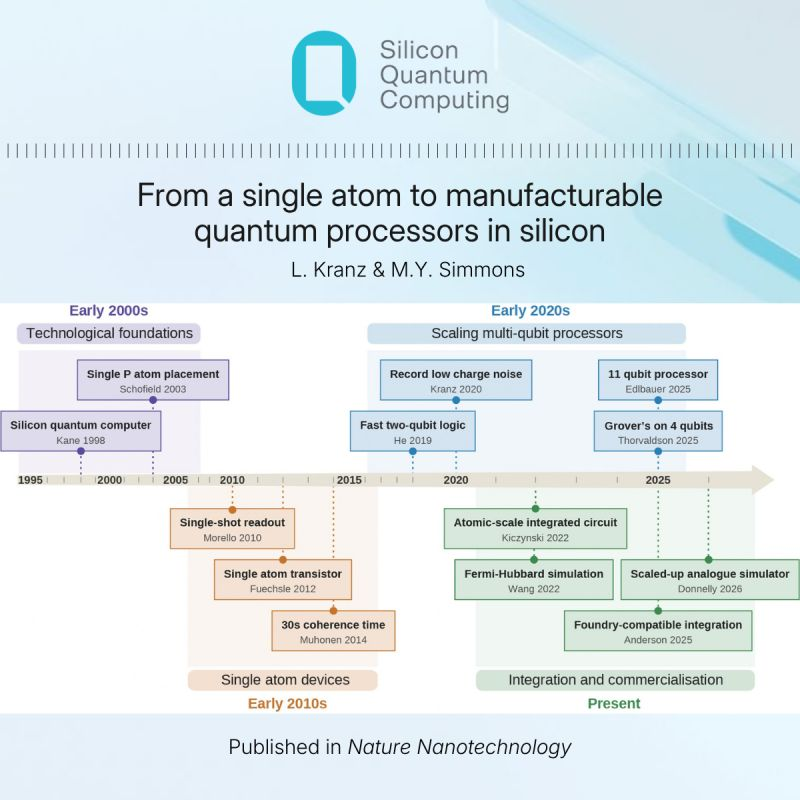
Silicon Quantum Computing (SQC) of Australia published a 25-year comprehensive technology roadmap for atomic-scale manufacturing in Nature Nanotechnology, systematically charting developmental milestones from single-atom transistors to commercial atomic-precision processors [23].

Progress made: SQC previously achieved high single-qubit gate fidelity in December 2025, matching the highest publicly reported gate precision record of trapped-ion systems; however, in terms of array scale, its public demonstrations remain at the laboratory prototype level of under ten qubits, lagging substantially behind superconducting 100-qubit chips and neutral-atom 1,000-qubit physical arrays [23]. What remains lacking: The critical engineering bottleneck of the silicon phosphorus donor architecture lies in its reliance on ultra-low-temperature scanning tunneling microscopy for atom-by-atom chemical placement, resulting in extremely low single-chip fabrication throughput; additionally, gate operation times range from tens to hundreds of nanoseconds (allowing operation counts of only 10² to 10³, among the lowest tier of mainstream platforms), and there is currently no industrial-scale mass production solution for on-chip 3D interconnects and electromagnetic crosstalk [23].

This technical route directly affects the semiconductor quantum computing startup ecosystem and specialized micro/nano-fabrication equipment manufacturers; its high barriers to entry imply that its commercial scaling cycle is expected to take more than 10 years [23].

Cavity Quantum Electrodynamics and Modular Interconnects

An international collaborative experimental team trapped a single neutral atom inside a high-finesse optical microcavity to construct a near-deterministic photon-atom controlled-phase gate (CZ gate, a two-qubit logic gate that flips the phase of a target qubit), achieving for the first time modular processor entanglement distribution rates that scale linearly with photon arrival probability rather than exhibiting traditional quadratic decay [36].

Progress made: This study shifts the rate-loss scaling of entanglement distribution between modular nodes from quadratic O(η²) to linear O(η), markedly boosting long-distance communication throughput within high-loss optical fiber windows; however, benchmarked against fiber-chip interconnect SOTA (such as PsiQuantum's 99.72% interconnect fidelity across 42 meters of fiber), the absolute entanglement fidelity and generation rate of the single cavity atom remain constrained by fiber coupling losses [36]. What remains lacking: High-finesse microcavities impose extremely stringent mechanical resonance stability requirements; physical gaps remain in single-atom trapping duty cycles and reloading; and the end-to-end photon collection loss budget has not been completely closed [36].

This result establishes a critical physical layer protocol for distributed quantum computing cluster interconnects, directly influencing standard evolution for cross-chassis distributed quantum hardware over the next 5 to 8 years [36].

Entanglement Storage in Trapped-Ion Networks

A research team utilized dual-species mixed trapped-ion technology combining Strontium-88 and Calcium-40 to achieve high-fidelity entanglement storage of heterogeneous qubits across distributed nodes, extending network entanglement lifetimes to over 100 times their generation time [37].

Progress made: Surpassing the 100x threshold for the entanglement storage-to-generation time ratio overcomes the positive temporal margin requirement for performing entanglement swapping in distributed quantum repeater networks; however, compared to the longest coherence time SOTA in trapped-ion platforms (such as Quantinuum achieving minute-scale T₂ coherence times using clock states), the absolute coherence retention of this heterogeneous ion storage node still lags by nearly two orders of magnitude [37]. What remains lacking: Optical calibration complexity for dual-wavelength laser control systems increases drastically, and the latency and repetition rate bottlenecks introduced by ion shuttling and transport remain unresolved [37].

This technology will accelerate the hardware finalization of quantum repeaters and long-haul quantum-resistant secure networks, driving quantum communication nodes toward multi-species collaborative architectures within 3 to 5 years [37].

Superconducting-Magnon Hybrid Systems

Argonne National Laboratory and the University of Illinois Urbana-Champaign demonstrated unidirectional, controlled transmission of spin waves (magnons) into superconducting quantum circuits in a solid-state micro/nano device, opening a chiral one-way channel free from reverse electromagnetic backaction disturbance [11].

Progress made: This achieves the first elimination of spin fluctuation backscattering disturbances on superconducting resonant circuits in a solid-state microwave hybrid system; however, compared to the mature strong-coupling SOTA benchmarks of superconducting transmon architectures, the interaction strength between microwave photons and magnons still exhibits a notable deficit [11]. What remains lacking: Interfacial dielectric loss and phonon energy dissipation between magnetic insulators and superconducting niobium-titanium thin films under ultra-low temperatures and high magnetic fields have yet to be effectively mitigated [11].

This progress offers a new pathway for designing high-density on-chip spin memory cells for superconducting chips, with technology readiness remaining at the laboratory proof-of-concept stage more than 5 years out [11].

Precision Optimization of Adiabatic State Transfer

Researchers used stimulated Raman adiabatic passage (STIRAP, a laser-driven adiabatic quantum state transfer technique) to optimize state transfer protocols, successfully reducing the lower bound of state transfer infidelity to the quadratic order of the product of characteristic pulse parameters and spontaneous emission, O((γτ)²) [26].

Progress made: This breaks the theoretical limit of conventional adiabatic evolution where error scales linearly with system decay rate; however, benchmarked against cross-platform two-qubit gate SOTA levels of 99.99% fidelity, actual transfer fidelity remains limited by laser pulse amplitude jitter and high-frequency phase noise [26]. What remains lacking: The protocol has not yet demonstrated crosstalk suppression and real-time pulse shaping capabilities within large-scale, parallel physical qubit arrays [26].

This achievement will directly empower cold-atom and trapped-ion control and readout systems as low-level control firmware, with relevant pulse compilation schemes expected to be adopted by hardware vendors within 1 to 2 years [26].

03Algorithms

Algorithms and Software

Classical Compute Accelerates Quantum Error Correction Calibration

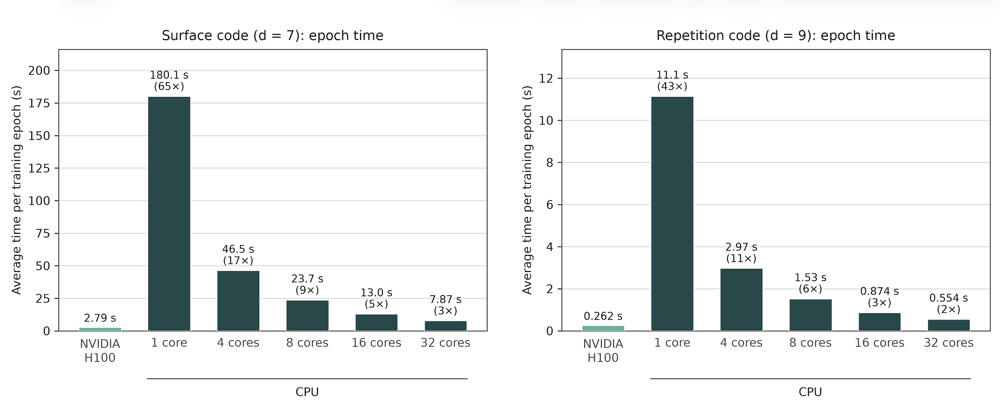
Quantum error correction specialist Riverlane and NVIDIA conducted a deep technical collaboration, successfully porting Riverlane's proprietary local cluster decoder (an algorithm that rapidly corrects errors using topological proximity) to the H100 GPU architecture, achieving up to a 71x leap in raw data throughput and compressing decoder recalibration training cycles from minutes down to seconds [18].

This milestone demonstrates for the first time the engineering feasibility of high-frequency online error correction calibration on general-purpose commercial GPU clusters, resolving the problem of error correction decoder failure caused by low-frequency parameter drift of physical hardware over time [18]. NVIDIA thereby cements its role as a pivotal hub in quantum-classical co-processing, with this scheme expected to become standard configuration for fault-tolerant superconducting control systems exceeding 100 qubits within 2 years [18].

Hardware Interconnect Bus Enables Real-Time Cat-Qubit Error Correction

French superconducting cat-qubit developer Alice & Bob established a microsecond-scale low-latency data transmission link via NVIDIA's NVQLink high-speed communications bus, demonstrating microsecond-level real-time dynamic error correction using classical GPUs under a low-density parity-check (LDPC, an error-correcting code featuring high code rates and sparse parity checks) architecture [24].

This system breaks through the critical communication latency deadline between quantum measurement acquisition and external co-processors for the first time, allowing complex non-local topological error-correcting codes to solve error parity-check equations within the extremely tight coherence time window of superconducting qubits [24]. This development branches away from traditional control system vendors that rely solely on FPGAs (field-programmable gate arrays, specialized hardware for high-speed parallel digital signal processing), and is poised to reshape quantum control hardware link standards within 1 to 3 years [24].

Three-Logical-Qubit Fault-Tolerant Search Algorithm Executed

Theoretical physicists devised an innovative fault-tolerant code-switching protocol, successfully executing the full workflow of Grover's search algorithm with 3 logical qubits in a hybrid architecture combining the [[8,3,2]] error-detecting code and the surface code [28].

This work marks the first demonstration of efficient switching between transversal and non-transversal gates on a small-scale code, entirely bypassing the engineering constraints of conventional high-overhead magic state distillation (a technique that purifies high-fidelity fault-tolerant logic gates by consuming ancilla qubits) [28]. This achievement offers a low-qubit-overhead algorithm validation template for near-term small-to-medium-scale fault-tolerant quantum chips, actively steering logical algorithm prototyping over the next 2 years [28].

Neutral-Atom Gate-Depth Algorithm Compilation Optimization

Quantum advanced software developer Classiq partnered with neutral-atom hardware leader QuEra to comprehensively re-architect compiler layers tailored to the laser-excitation characteristics of neutral-atom processors, substantially cutting the continuous laser pulse counts and circuit gate depths required to execute two-qubit controlled-phase gates [29].

Addressing the physical lifetime bottleneck of neutral-atom high-energy Rydberg states (highly interacting states where outer electrons are excited to high principal quantum numbers), which is limited to roughly the millisecond scale, the algorithm consolidates underlying operations to significantly reduce physical atom exposure time, clearing the engineering hurdle of rapid fidelity degradation for complex topological circuits on neutral-atom hardware [29]. This partnership directly enhances available circuit depths on QuEra's cloud platform, with commercial benefits expected to materialize within 1 year [29].

Conventional Hardware Runs Supercomputer-Class Quantum Simulations

A computational physics research team introduced a classical algorithm based on multi-dimensional tensor network contractions and subspace truncations, allowing standard commercial computers to simulate complex, highly entangled quantum many-body dynamics that previously required top-tier national supercomputers [9].

The algorithm achieves dimensionality reduction breakthroughs in classical memory footprint and matrix dimension mapping, dramatically lowering the cost of classical benchmark validation for medium-scale noisy quantum circuits [9]. This advance enables academic research teams and small-to-medium startups to validate chip designs without purchasing expensive compute, accelerating the adoption of classical verification toolchains within 1 year [9].

Cross-Backend Universal Open-Source Quantum SDK Released

Software provider EigenOrbit officially released the open-source library eigenkit 1.0, enabling quantum algorithms written by users to be dispatched directly across classical simulators and physical quantum computers from diverse hardware vendors—including superconducting and trapped-ion systems—without altering underlying code logic [22].

The toolkit unifies the instruction set calling abstraction layer across heterogeneous hardware backends and integrates cost and error-rate estimation features tailored to the noise characteristics of various hardware [22]. This lowers algorithm developers' platform lock-in risks while intensifying direct competition among hardware manufacturers on low-level gate fidelity, expected to produce ecosystem fragmentation among developers over the next 6 to 12 months [22].

Automotive Paint Operations Gain Quantum Algorithmic Advantage

An operations research team designed a specialized quantum graph optimization algorithm for the Binary Paint Shop Problem (a combinatorial optimization challenge aimed at minimizing paint-color switch flushes) on modern automotive assembly lines, outperforming existing classical heuristics across composite benchmarks of computation speed and flush loss [31].

The solution establishes a qualitative advantage over classical operations research algorithms on a specific industrial manufacturing NP-hard problem, providing concrete evidence of the feasibility of applying quantum combinatorial optimization to high-end manufacturing [31]. This will spur traditional automotive giants such as BMW and Volkswagen to increase engineering validation investments in shop-floor discrete optimization algorithms over the next 2 to 3 years [31].

04Industry

Industry and Ecosystem

Trapped-Ion Leader Prices $2 Billion High-Premium Private Placement

US-listed trapped-ion company IonQ officially announced pricing for a $2 billion private equity placement fully subscribed by Heights Capital Management, consisting of common stock and pre-funded warrants issued at a 15% market premium, alongside seven-year additional warrants with an exercise price 100% above market price [21][55].

Commercial significance: This transaction sets an all-time record for a single financing round by a full-stack quantum computing developer globally, locking in long-term institutional capital at a steep premium amid broader industry valuation pressures and completely funding its capital expenditure requirements for high-density trapped-ion chip iterations and commercial production facility buildouts over the next 5 to 7 years [21].

Landscape impact: The massive $2 billion liquidity reserve widens the cash reserve disparity between IonQ and listed rivals such as Rigetti and D-Wave, forcing second-tier competitors into strategic defensive postures or M&A consolidation [21].

New York City Invests $284 Million to Build Quantum Fab

The City of New York and New York University (NYU) jointly announced a $284 million investment to establish the Quantum Fabrication Facility (QFab) at 770 Broadway in Manhattan, with full project completion and commissioning slated for 2030 [19].

Commercial significance: The initiative pioneers a public-equity governance model, where New York City holds a 15% equity stake in intellectual property generated by municipally funded equipment in exchange for infrastructure and financial backing, while leveraging the City University of New York (CUNY) and public education systems to deliver a specialized workforce in micro/nano-fabrication and superconducting processing [19].

Landscape impact: QFab will fill the East Coast's void in open pilot fabrication and foundry lines for wide-bandgap semiconductors and superconducting quantum chips, lessening hardware startup reliance on overseas foundries and restructuring regional quantum supply chains [19].

UK Commits £50 Million to Satellite-Free Quantum Navigation

UK Research and Innovation (UKRI) awarded £50 million in targeted funding to accelerate nationwide quantum technology commercialization, focusing on quantum inertial and gravity navigation systems in environments where GPS and BeiDou satellite signals face electronic countermeasure jamming or subterranean blockage; within this initiative, the MoniRail project received dedicated backing to build a high-precision track defect positioning system in GPS-denied environments like high-speed rail tunnels and signal dead zones [27].

Commercial significance: Demonstrates validated willingness-to-pay for high-precision cold-atom quantum sensing in defense electronic warfare resilience and critical rail infrastructure security, establishing a vital commercial market independent of satellite timing [27].

Landscape impact: Accelerates the operational engineering deployment of portable cold-atom interferometers and atomic gyroscopes, with vehicular prototypes expected to enter comprehensive testing on national trunk railways within 2 to 3 years [27].

European Union Grants €47.5 Million for Quantum Network Prototype

The Quantum Internet Alliance (QIA) secured a major €47.5 million R&D contract from the European Commission to build a full-stack pan-European quantum internet prototype; as a critical node, the University of Innsbruck in Austria will lead trapped-ion repeater development, receiving a €5.4 million direct grant allocation [32].

Commercial significance: Underscores Europe's strategic commitment to building sovereign, self-reliant quantum-encrypted and distributed computing networks, utilizing public procurement to foster a domestic supply chain for core electro-optic modulation chips and single-photon detectors [32].

Landscape impact: Solidifies Europe's early-mover advantage in physical layer standards and interface protocols for transnational quantum repeater networks, with planned prototype systems targeted for cross-border live network interconnection around 2028 [32].

Spanish Defense Giant Leads Round in Analog Quantum Startup

IndraMind, the venture capital arm of Spanish multinational defense and IT giant Indra Group, led an approximately €20 million Series A funding round for analog quantum computing company Qilimanjaro, contributing €10 million alongside co-investment from Spain's National Technology Transformation Fund (SETT) [35][55].

Commercial significance: Represents a defense conglomerate's strategic investment in superconducting analog quantum annealing, aiming to directly embed tailored annealing chips into mission-critical applications such as complex anti-air fire control allocation, military communication frequency-hopping scheduling, and battlefield logistics planning [35].

Landscape impact: Strengthens Southern Europe's quantum ecosystem positioning within European defense innovation, accelerating the engineering deployment of dedicated analog quantum co-processors into specialized rackmount industrial systems, with pilot hardware slated within 2 years [35].

Strontium Optical Clocks Enter Data Centers for Nanosecond Synchronization

UK quantum firm Quantum Fabrix (QFX) secured a £6.8 million commercial procurement contract from Innovate UK to accelerate its SrROCK project, developing miniaturized strontium optical atomic clocks specifically for clock synchronization in next-generation hyperscale data centers and deep-space exploration spacecraft [33].

Commercial significance: Miniaturizes laboratory-grade, ultra-high-precision optical atomic clocks into rack-mountable form factors, directly addressing a multi-billion-dollar industrial clock replacement market across high-frequency algorithmic trading nanosecond timing and compute cluster synchronization [33].

Landscape impact: Establishes a physical time standard for ultra-low-jitter optical-electronic hybrid communication architectures, driving supply chains for high-stability semiconductor lasers and ultra-high-vacuum microcavity components within a 24-month delivery window [33].

Alzheimer's Drug Screening Taps Quantum Optimization System

Nasdaq-listed biopharmaceutical firm INmune Bio entered into a commercial agreement with Quantum Computing Inc. (QCi) to process clinical and preclinical biochemical data from its lead neuroinflammatory and neurodegenerative drug candidate XPro on QCi's Dirac-3S quantum optimization machine [6][55].

Commercial significance: Marks QCi's first paid commercial use case in Phase 2 clinical biopharma, signaling the expansion of quantum combinatorial optimization services into hundred-billion-dollar target drug pipelines such as Alzheimer's disease [6].

Landscape impact: Validates the computational utility of optical coherent optimization machines in high-dimensional receptor-ligand binding affinity analysis; verified drug activity could prompt multinational pharmaceutical companies to allocate dedicated quantum optimization outsourcing budgets over the next 1 to 2 years [6].

Quantum-Enhanced MRI System Deployed at European Medical Center

German quantum medical technology developer NVision announced that its POLARIS quantum-enhanced MRI pre-polarization system has completed installation and commissioning at the Catholic University of Louvain (UCLouvain) in Belgium, formally launching clinical studies on early metabolic profiling of malignant melanoma [30].

Commercial significance: Following deployments at the Institute for Bioengineering of Catalonia and the University of Antwerp, this latest delivery signals that quantum hyperpolarized molecular metabolic imaging equipment is moving from technological validation into standard procurement channels at European healthcare institutions [30].

Landscape impact: Boosts MRI signal sensitivity by more than four orders of magnitude, enabling non-invasive dynamic monitoring of minute metabolic anomalies in early-stage tumors in vivo, with relevant quantum-enhanced diagnostic standards projected to enter the European Medicines Agency (EMA) review pipeline within 3 years [30].

Canadian Quantum Security Vendor Acquires Key Platform Assets

Canadian publicly traded quantum security firm Quantum eMotion announced the complete acquisition of the SecureKey quantum-resistant authentication platform and its underlying intellectual property developed by Jet Lab Technologies, via a 100% equity acquisition of SKV Technology [34].

Commercial significance: Rapidly completes a full-stack software service pipeline spanning low-level quantum random number generator (QRNG) hardware up to financial-grade endpoint authentication through external asset acquisition, expanding the share of recurring subscription revenue [34].

Landscape impact: Accelerates post-quantum end-to-end encryption adoption across smart wearables and cross-border financial settlement, while catalyzing horizontal consolidation among small-to-midsize North American quantum cybersecurity providers, with integration synergies anticipated within 1 year [34].

Quantum Geoscientific Prospecting Platform Secures Early VC Backing

Canadian mineral exploration startup Quminex closed a CAD 1.5 million venture funding round led by Quantacet, with participation from specialized quantum venture funds and angel investors, to build a cloud platform for critical and strategic mineral discovery driven by quantum geological data processing algorithms [53].

Commercial significance: Applies quantum computing simulation and high-precision magnetic/gravitational data processing to strategic metal prospecting (e.g., lithium, cobalt, and rare earths) via an asset-light SaaS model for the first time, substantially mitigating capital expenditure risks in exploratory drilling [53].

Landscape impact: Establishes a commercialization benchmark for quantum algorithms in energy and upstream raw material exploration, with early project commercial return cycles projected at 2 to 3 years [53].

Regional Quantum Application Innovation Center Established in Romania

Quantum software firm Classiq and FreeYa Mind Campus entered into a strategic framework agreement to co-found a Quantum Application Innovation Center in Romania, designed to train advanced algorithmic talent for Eastern European universities and incubate vertical industry use cases in logistics and finance with local enterprises [1].

Telecom Giant Highlights Transition to Post-Quantum Cryptography Enters Deep Operational Phase

Kenneth Hwang, Vice President of Platforms and Solutions at Singtel, publicly stated that post-quantum network defense is no longer a theoretical issue confined to long-term horizon scanning, but a multi-cycle systems engineering endeavor spanning core network routers, underlying optical transport protocols, cloud providers, and third-party software vendors, where full migration typically requires years of system-wide hardware and software restructuring [39].

Chip Side-Channel Attacks Threaten Post-Quantum Cryptographic Standard Implementation

Nasdaq-listed post-quantum semiconductor firm SEALSQ published peer-reviewed research revealing a novel physical side-channel attack targeting the encoding stage of ML-KEM, the official post-quantum lattice-based key encapsulation mechanism standardized by NIST [54][55].

Commercial significance: Proves that even when quantum-resistant mathematical algorithms are theoretically sound, physical chips executing specific computations can leak private keys via electromagnetic emissions or micro-transient power consumption fluctuations, establishing a significant technology premium for hardened physical security silicon [54].

Landscape impact: Compels commercial cryptographic chip designers and Hardware Security Module (HSM) vendors to redesign side-channel masking circuitry in upcoming tape-outs, directly shaping physical security certification standards for post-quantum chips over the next 18 to 24 months [54].

Debate on Bitcoin's Quantum Threat Sparks Industry Scrutiny of Hard Fork Timelines

Following MicroStrategy Executive Chairman Michael Saylor's controversial remarks on October 14 suggesting Bitcoin should delay upgrades until the quantum threat becomes imminent, industry technical analysts—benchmarking against Bitcoin's historical code upgrade record, SegWit and Taproot activation timelines, block space constraints, and SEC risk disclosure filings—noted that given network-wide hard-fork coordination friction (an incompatible, historic consensus rule change among decentralized nodes) and massive overhead for legacy cold-wallet signature upgrades, failure to complete the migration years before quantum machines break elliptic curve cryptography exposes the Bitcoin network to systemic risks of involuntary halts or the ransacking of dormant assets [14].

This engineering audit has prompted crypto asset funds and regulated custodians to reassess their post-quantum migration roadmaps for long-term cold-storage reserves, expected to elevate post-quantum signature upgrade proposals to top priority among core developers over the next 6 to 12 months [14].

05Other

Academic Frontiers

Rigorous Criterion Established for Genuine Continuous-Variable Quantumness

Research published in npj Quantum Information shows that theoretical physicists have derived a rigorous mathematical necessary and sufficient criterion for certifying multipartite genuine nonclassicality in infinite-dimensional continuous-variable Hilbert spaces, complete with an operational quantifiable metric [5].

Technical significance: The theoretical advance decisively rules out the possibility of explaining specific continuous optical-field correlations with classical statistical mixture models, establishing an unfalsifiable benchmark for macroscopic boson sampling and continuous-variable optical systems crossing the classical threshold [5].

Landscape impact: Delivers a foundational evaluation toolkit for research institutions developing continuous-variable photonic quantum computers and precision interferometry, profoundly shaping criteria for certifying photonic quantum advantage over the next 3 to 5 years [5].

Ultrafast Laser Pulses Directly Probe Electron Quantum Geometric Phases

Physicists from the University of Jena and the University of Regensburg developed an ultrabroadband ultrafast femtosecond laser probing technique that exploits nonlinear microscopic light-matter interactions to perform direct high-precision optical mapping of electron Berry curvature (a core physical quantity characterizing the geometric topology of quantum states) in solid-state crystals for the first time [7].

Technical significance: Bypasses the historical constraint of inferring materials' quantum geometric phases indirectly through complex ultra-low-temperature electronic transport experiments, overcoming the barrier to direct in situ characterization of the micro-dynamics of non-trivial topological band structures in condensed matter at room temperature [7].

Landscape impact: Provides a non-destructive femtosecond optical characterization tool for screening novel 2D topological insulators, Majorana zero-mode host materials, and dissipationless superconducting devices, impacting the entire lifecycle of topological hardware development over the next 5 years [7].

Magnetic Micro-Vortex Memory-Compute Approaches Thermodynamic Physical Limit

Condensed matter physicists precisely manipulated micro-vortex resistance states (magnetic skyrmion quasiparticles) within magnetic thin films to demonstrate data writing and erasing at ultra-low energy dissipation, approaching the classical Landauer limit (the minimum thermodynamic energy required to erase a single bit of information) for the first time [10].

Technical significance: Validates ultra-low thermal dissipation non-volatile memory in artificially controlled nanoscale spin microstructures for the first time, circumventing the physical bottleneck where traditional computer memory cannot scale down indefinitely due to excessive Joule heating [10].

Landscape impact: Provides a foundational blueprint for ultra-low-power proximal control memory placed directly adjacent to quantum processors inside dilution refrigerators, with commercial translation anticipated within 5 to 10 years [10].

Phase-Change Flow in Strongly Correlated Quantum Materials Yields Built-In Memory

By precisely tuning cooperative electronic and lattice structural phase transitions in transition metal oxides, a research team discovered that plastic deformations induced by artificially arresting phase-change dynamic flow endow the material with long-lived physical state memory [12].

Technical significance: Uncovers non-equilibrium dynamical hysteresis laws during multi-degree-of-freedom coupled quantum phase transitions, overcoming the technical constraint of purely electronic phase-change memory requiring continuous bias voltage to preserve states [12].

Landscape impact: Expands the candidate materials library for zero-standby-power, high-efficiency non-volatile quantum simulation devices and cryogenic neuromorphic computing synapses, with an exploratory cycle of 3 to 5 years [12].

Device-Independent Self-Testing Validates Network Node Entanglement

A quantum communication experimental team implemented and validated a novel entanglement verification protocol, achieving high-confidence end-to-end quantum entanglement verification between communicating endpoints without trusting the intermediate transmission fiber channel or the internal physical makeup of terminal detectors [13].

Technical significance: Eliminates security loopholes arising from physical detector manufacturing flaws or adversary-crafted side-channel photons at both theoretical and hardware execution levels, realizing the highest security tier of device-independent entanglement self-testing [13].

Landscape impact: Establishes a new protocol standard for zero-trust cross-border quantum secure backbone networks and decentralized secure key distribution, with integration testing on advanced backbone testbeds expected within 4 years [13].

Optimal Transport Theory Extended to Quantum State Evolution

In a study published in Quantum, researchers started from the bilinear functional properties of quantum states under continuous-time evolution to fully reconstruct Monge's classical optimal mass transport theory within non-commutative operator algebra spaces [25].

Technical significance: Derives analytical lower bounds for the minimal theoretical geometric cost and energy overhead required to evolve a many-body quantum state from an initial to a target configuration, resolving a long-standing foundational challenge in rigorously quantifying state transfer efficiency in quantum thermodynamics [25].

Landscape impact: Supplies a unified mathematical toolbox for optimal quantum control pulse design, state preparation path planning, and error correction compilation optimization, offering long-term foundational guidance for compiler architectures [25].

Macroscopic Diamond Spin Interferometry Probes Equivalence Principle Limits

High-energy physicists designed a quantum interferometer based on diamond microparticles levitated in high vacuum, using long-lived internal nitrogen-vacancy (NV) center spin entanglement to construct macroscopic spatial mass superpositions to sensitively probe gravity-induced decoherence and the boundaries of Einstein's equivalence principle at microscopic scales on a tabletop setup [50].

Technical significance: Extends single-quantum coherent control into the centimeter-scale macroscopic spatial interference regime, creating the first viable tabletop platform for testing unified theories of general relativistic gravity and quantum mechanics [50].

Landscape impact: Advances technological capabilities in high-sensitivity quantum gravity gradiometers and autonomous inertial navigation gyroscopes for deep-space spacecraft, serving as a dual-use foundational science and specialized sensing reserve for the next decade [50].

06Other

Key Takeaways

  1. Commercial GPUs Enter the Real-Time Quantum Error Correction Loop, Triggering Bus-Level Racks Re-Engineering: Riverlane and NVIDIA leveraged H100 GPUs to achieve a 71x speedup in error correction decoding throughput [18], combined with Alice & Bob establishing microsecond-level low-latency bus communications via NVQLink [24], upending the legacy belief that real-time error correction decoding strictly requires expensive custom FPGAs. This allows superconducting, cat-qubit, and trapped-ion hardware developers to tap into mature commercial GPU and data center infrastructure, shortening fault-tolerant development cycles. High-end FPGA control hardware vendors and full-stack quantum hardware teams face the most direct disruption. Critical watchpoint: Whether major system vendors broadly adopt high-speed direct GPU buses in next-generation control racks before 2027 and demonstrate fully closed-loop logical gates on physical qubit arrays [18][24].
  2. Single Financing Rounds Breach $2 Billion, Driving Sharp Capital Stratification Across the Quantum Industry: IonQ's $2 billion capital raise via a 15% high-premium private placement [21], paired with New York City's $284 million fab investment [19] and the EU's ~€50 million network prototype award [32], confirms that global quantum capital is rapidly concentrating around leaders with pilot fabrication facilities and public market access. Ample liquidity enables front-runners to navigate market cycles through multi-year tape-outs, fab expansions, and M&A consolidation, squeezing valuations and operating space for second-tier private startups. Critical watchpoint: Whether unlisted unicorns like Quantinuum and PsiQuantum seek liquidity parity over the next 6 to 12 months through US IPO pathways or large sovereign wealth fund rounds [21].
  3. Defense Anti-Jamming and Critical Infrastructure Urgency Rises, Positioning Quantum Sensing for Commercial Monetization Ahead of Computing: UKRI's £50 million allocation for GPS-denied quantum navigation and rail defect detection [27], alongside Quantum Fabrix's £6.8 million optical atomic clock contract for data center and deep-space timing [33], demonstrates that quantum precision sensing is becoming a cornerstone for governments and industry seeking resilience against satellite denial and subterranean blind spots. Ahead of fault-tolerant quantum computing hardware, autonomous quantum navigation and optical atomic clocks are capturing early public procurement demand. Critical watchpoint: Field-testing data from the MoniRail project delivering centimeter-level spatial positioning at full operational speeds on national trunk railways [27].
  4. Post-Quantum Cryptographic Defense Shifts to Physical Silicon, Narrowing Decentralized Asset Migration Windows: SEALSQ's successful side-channel attack on the encoding stage of the NIST-standardized ML-KEM algorithm [54] proves that theoretical mathematical robustness does not prevent compromise via transient power analysis and electromagnetic leakage in semiconductor hardware; concurrently, Singtel stressed that full network migration demands multi-year systems overhauls [39], while rigorous mathematical analyses outline hard limits on Bitcoin's hard-fork window [14]. This warns financial institutions and crypto asset holders that software-level protocol patches alone are insufficient; planning must address underlying secure silicon and cross-protocol hard forks. Critical watchpoint: Whether international security evaluation bodies institute mandatory physical side-channel testing for post-quantum standards, and how Bitcoin developer communities advance hard-fork upgrade initiatives amid governance disputes [14][54].
07Other

Editorial Commentary

The boundary between quantum information science and classical engineering is undergoing a profound reconfiguration. For years, academia and industry often viewed quantum hardware and classical computers as parallel tracks, or framed them as an either-or replacement race for computational dominance. Yet as today's collaborative error-correction breakthroughs from Riverlane, Alice & Bob, and semiconductor giants demonstrate, high-bandwidth, low-latency classical GPUs are stepping to the forefront as an indispensable digital life-support system for quantum processors crossing the fault-tolerance threshold. The avalanche of syndrome measurement data generated by physical qubit arrays must be decoded and calibrated in real time by external classical supercomputing power within microsecond-scale physical decoherence windows; otherwise, microscopic superpositions—regardless of physical gate fidelity—cannot coalesce into stable logical qubits. Physical co-integration between heterogeneous classical computing and quantum systems has evolved from an auxiliary peripheral into the core engineering hub governing the viability of fault-tolerant computing.

Mirroring this technological convergence is a stark divergence in global capital allocation cycles. IonQ's single $2 billion long-term capital infusion at a steep premium, alongside dedicated multi-million-dollar commitments from US and European governments for wafer fabrication foundries, anti-jamming autonomous navigation, and sovereign communication networks, cleanly delineates the market's new reality: the era of broad-brush early proof-of-concept funding has drawn to a close, and the industry has entered an intensive second phase marked by capital-heavy fabrication, deep technical standard rivalries, and long-cycle supply chain positioning. For research institutions and startups, the window for whitepaper narratives and noisy analog simulation circuits is closing quickly. In this period of capital consolidation, durable competitive moats will belong exclusively to teams that can drive baseline physical fidelity toward fault-tolerant thresholds, integrate architectures into established classical computing fabrics, or demonstrate unambiguous commercial utility in targeted verticals like specialized navigation sensing and oncology metabolism.