Oct 12, 2026 – Oct 13 · Daily Brief

Post-quantum cryptography shows cracks, but remains far from practical compromise

63 items · 16 sourcesPDFThis issue's roundup is free
02Hardware

Hardware Frontiers

Neutral Atoms

Neutral-atom (laser-controlled uncharged atoms) quantum processors have achieved a two-qubit controlled-Z (CZ) gate fidelity (gate operation accuracy) of 99.941(3)%, with the entire entanglement circuit maintaining stable continuous operation for a full ten hours[44].

[SOTA Benchmark] Specific comparative data against public baselines for this metric was not disclosed; the claim asserts exceeding the public SOTA level and awaits independent verification[44]. Two critical bottlenecks still separate this modality from practical fault tolerance: its cycle repetition rate remains constrained by a hard ceiling of 1 to 10 Hz, and mid-circuit non-destructive readout carries massive overhead, with high-fidelity non-destructive re-readout yet to be demonstrated over extended runs[44].

If independently confirmed by peer replication, this result signifies that neutral atoms are closing in on the trapped-ion camp (up to 99.99%) in physical two-qubit gate fidelity, accelerating the diversion of industrial capital previously committed to superconducting modalities[44].

Full-stack neutral-atom system manufacturer QuEra announced an in-depth partnership with software control vendor Q-CTRL to co-develop a full-stack low-level simulation and compiler stack tailored for neutral-atom architectures, spanning from physical pulses to error-correction compilation[40]. This initiative aims to eliminate conventional pulse overhead at the low level of geometric atomic rearrangement and optical tweezer shuttling, directly addressing the engineering shortfall of neutral-atom hardware long relying on third-party generic toolchains[40]. This synergy marks a critical step for neutral atoms toward industrial-grade commercial deployment, though specific timelines and execution efficiency gains were not disclosed[40].

Superconducting & Topological

(Follow-up report) Following the October 11 (Beijing Time) report that D-Wave unveiled a dual-rail qubit architecture (converting errors using two physical states) achieving approximately 90% physical hardware error detection and localization, the company further disclosed technical roadmap details for its expansion into gate-model fault-tolerant quantum computing[30]. The roadmap requires that for each single-unit increase in code distance (the metric of an error-correcting code's capability), the logical error rate must achieve a tenfold suppression equivalent to one-tenth of its predecessor (reaching an error suppression factor of 10)[30].

[SOTA Benchmark] The superconducting surface code's public gold-standard baseline is currently held by Google's Willow chip with an error suppression factor of 2.14x (code distances 3 to 7); D-Wave's claimed 10x suppression metric is currently based entirely on internal numerical simulations and has yet to be experimentally validated on multi-qubit physical chips[30]. The superconducting modality remains plagued by coherence time fluctuations (varying by 2x to 3x) caused by microscopic two-level system (TLS) defects in materials, and D-Wave's dual-rail approach still lacks direct hardware data demonstrating the mitigation of large-scale multi-qubit microwave crosstalk and dielectric loss toward physical viability[30].

This aggressive metric showcases the immense potential of Yale-spinout dual-rail technology to the secondary market; however, if physical devices subsequently fail to deliver on the tenfold suppression promise, it will introduce revaluation risks to the $550 million consideration D-Wave paid to acquire Quantum Circuits[30].

A research collaboration between Rutgers University and IBM demonstrated that superconducting quantum computers can read out microscopic states in real time during dynamic circuit execution, while executing cyclic resets and decoherence steering on localized hardware units[9]. This marks the first time superconducting hardware has transcended the boundary of static preset compilation mid-circuit, equipping researchers with the capability to perform adaptive error correction on microsecond timescales[9]. This directly accelerates the implementation progress of IBM's active quantum error correction (QEC) roadmap, though the deployment timeline on commercial superconducting cloud systems was not disclosed[9].

A research team discovered a hidden internal field within odd-parity magnets, stably inducing topological superconducting states without the need for strong external magnetic fields[43]. This discovery overcomes the physical bottleneck in topological quantum computing where reliance on strong applied magnetic fields compromised the superconducting phase at material interfaces[43]. Consequently, the complexity of electromagnetic shielding inside dilution refrigerators for topological quantum computing chips will be reduced, opening a brand-new material pathway for miniaturized topological qubit validation[43].

New progress has been achieved in the development of superconducting microwave circuit transducer-repeaters, increasing the entanglement distribution rate by 63% in long-distance quantum entanglement distribution tests[37]. This technology closes the efficiency gap in converting microwave quantum states into telecom-band photons with high efficiency and low loss, paving the way for inter-chip cryogenic quantum interconnect networks[37].

The Fermi National Accelerator Laboratory in the United States officially launched MAGNES, a superconducting magnet simulation and testing platform[2]. The platform will directly support performance verification of specialized superconducting high-field components required for future controlled nuclear fusion[2].

Photonics & Spin

A research team from the University of Pennsylvania published a paper in Nature Physics, demonstrating for the first time the on-chip low-loss transfer of topological photonic structures—quantum skyrmions—from single photons to entangled states on an integrated nanophotonic chip[28].

[SOTA Benchmark] Photonic architectures hinge on photon indistinguishability and device loss budgets (the current leading photonic SOTA benchmark is a two-qubit fusion fidelity of 99.22%); while this experiment leverages topological invariance to resist fabrication imperfections, it cannot yet be factored directly into universal fault-tolerant computing benchmarks without providing an end-to-end full-link loss budget table[28]. The modality still acutely lacks industrial-grade breakthroughs in superconducting nanowire single-photon detector (SNSPD) integration and on-chip ultra-low-loss optical switch arrays to achieve practical fault tolerance[28].

This advance offers a physical scheme for highly robust state transfer in photonic quantum computing chips under harsh thermal noise and fabrication tolerances, and will inform design standards for modular optically interconnected photonic chips[28].

At IEEE Quantum Week 2026, French photonic quantum computer manufacturer Quandela systematically expounded on modular photonic interconnects and hardware-aware compilation frameworks[13]. Industry discourse has distinctly shifted from competing over mode counts on monolithic photonic quantum processors toward high-fidelity inter-chip interconnects and heterogeneous HPC cluster integration[13].

Quantum Sensing & Metrology

A team of physicists at TU Wien (Vienna University of Technology) successfully developed the world's first self-stabilizing nuclear clock prototype system (an ultra-high-precision clock based on nuclear energy level transitions), achieving continuous, autonomous, stable operation for over 24 hours without human intervention[39].

This achievement marks a milestone transition in timekeeping technology from electronic transitions in outer atomic shells to intranuclear transitions; the nuclear clock's immunity to stray external electromagnetic fields exceeds that of state-of-the-art optical atomic clocks by several orders of magnitude[39].

Over the next two to three years, this breakthrough will profoundly reshape extreme defense navigation, deep-space exploration, and precision geophysical survey infrastructure in GPS/satellite-denied timing environments[39].

03Algorithms

Algorithms & Software

In the realm of fault-tolerant quantum error correction, the Google Quantum AI team introduced "Virtual Error Cancellation" (VEC), a classical post-processing technique that uses statistical reweighting across dual decoders (a pairing of a fast, lightweight runtime decoder with an ultra-high-accuracy offline decoder) to suppress experimentally measured logical circuit error rates by more than 1,600x on universal logical circuits[27].

This represents the world's first demonstration on universal fault-tolerant circuits that pure classical post-processing can boost logical fidelity by over three orders of magnitude without adding any physical qubits or hardware overhead, substantively crossing the low-error-rate threshold for logical circuits[27]. This paradigm partially shifts the competitive focus of quantum error correction from purely fabricating microscopic hardware to the offline decoding and data reweighting capabilities of classical supercomputers, presenting a major boon for tech giants equipped with massive high-performance computing clusters[27].

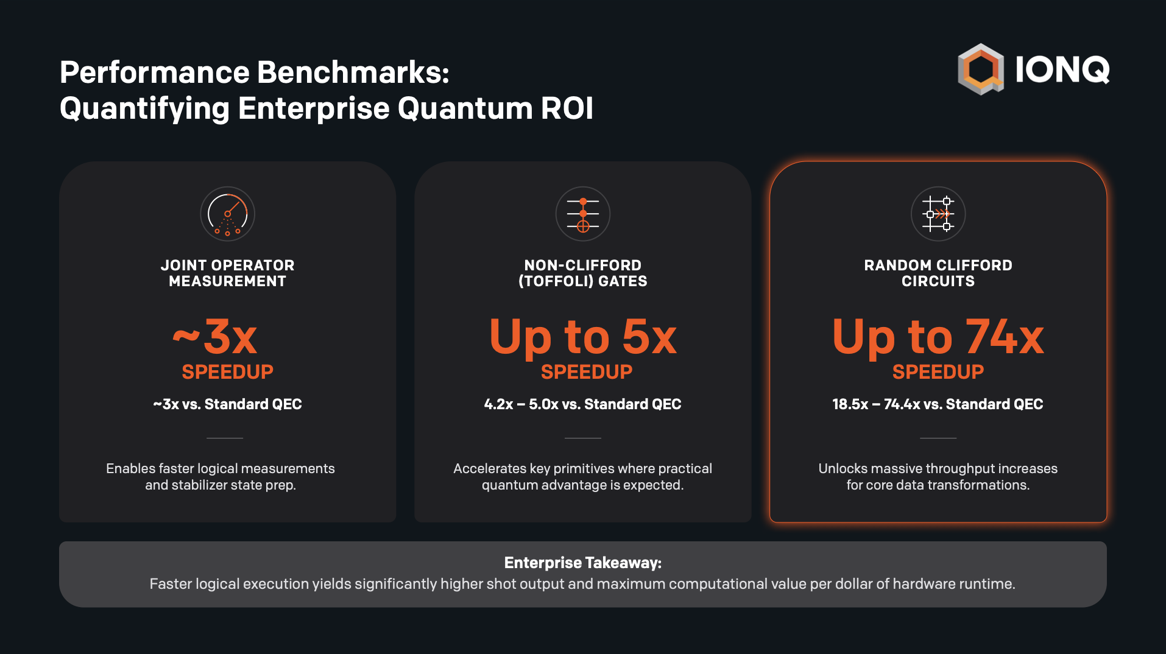
Researchers at trapped-ion hardware vendor IonQ released a new preprint on arXiv detailing a synergistic architecture combining scheduled quantum low-density parity-check (qLDPC) codes with an improved Logical Clifford Noise Reduction (CliNR), accelerating fault-tolerant quantum gate execution by up to 74x[25]. This algorithm overcomes the trapped-ion system's bottleneck of excessive logical gate latency caused by long-distance mechanical ion shuttling, crossing the practical threshold for low-latency execution of high-rate codes on trapped ions for the first time[25]. This progress directly narrows the clock throughput gap between trapped ions and superconducting systems, and is poised to reshape the economic evaluation of fault-tolerant architectures on long-coherence hardware over the next 12 to 18 months[25].

Photonic quantum computing vendor Xanadu achieved an algorithmic breakthrough by introducing dense coding and select-swap techniques, reducing the compilation cost of non-Clifford gates (costly, critical quantum gates) in Quantum Read-Only Memory (QROM, a core subroutine for encoding classical data into quantum states) to one-fourth of previous requirements (an ~4x reduction)[22]. This algorithm substantially compresses the logical runtime and ancilla qubit count required to load classical chemistry and materials data, overcoming the hardware barrier where high-precision molecular Hamiltonian simulations were hindered by excessive QROM gate overhead[22]. This directly accelerates timelines for quantum chemistry and battery materials discovery in the early fault-tolerant era, drastically lowering the hardware barrier for pharmaceutical and chemical enterprises deploying quantum simulation[22].

Researchers at the University of Saskatchewan designed geometrically optimized hyperbolic surface codes that, under the strict constraint of keeping the physical qubit count constant, double the code distance and quadruple the error-correction encoding efficiency by optimizing periodic boundary conditions[23]. This achievement breaks through the geometric area law limitation of planar Euclidean surface codes, offering a highly attractive high-density encoding scheme for distributed error-corrected interconnects across modular chips[23].

In qiskit-ibm-runtime v0.50.0, IBM Quantum officially released the directed execution model and the Executor primitive, fully opening error mitigation and circuit transformation controls directly to the local client[19]. This mechanism ends the previous black-box cloud optimization model, allowing researchers to author custom error-correction logic and dynamic circuit scheduling pipelines with nanosecond-level precision[19]. This significantly deepens the stickiness of world-leading research institutions to IBM's hardware platform, directly squeezing the market space of competing closed-source hardware cloud platforms[19].

Concurrently, IBM announced native C API bindings to Qiskit's core architecture for Fortran, C++, and Julia[20]. This interface completely eliminates cross-language glue-code and Python interpreter latency, enabling zero-overhead direct invocation of quantum circuits within low-level scientific computing workloads on legacy supercomputers[20]. This move will accelerate the transition of national supercomputing centers into hybrid classical-quantum HPC facilities[20].

A research team proposed a continuous-time noise cancellation framework for analog quantum simulation, mathematically proving the exact cancellation of continuous dissipative noise[35]. This method extends the high-fidelity effective runtime of analog quantum simulators by several-fold, providing a more reliable mathematical tool for simulating quantum magnetic materials[35].

A new theoretical study published in npj Quantum Information proved an exponential quantum advantage over classical statistical learning in continuous-variable quantum state learning tasks, establishing a new theoretical limit for sample complexity in continuous-variable quantum sensing and precision metrology[4].

Amazon Web Services (AWS) announced a deep integration of its Amazon Braket quantum computing service with AWS Batch, enabling large-scale automated elastic orchestration of heterogeneous hybrid classical-quantum algorithms in the cloud[1].

04Industry

Industry & Ecosystem

On October 12 (Beijing Time), publicly traded trapped-ion quantum computing firm IonQ formally announced a definitive agreement to acquire zero-trust cybersecurity vendor Elisity in an all-stock transaction valued at up to $1.3 billion, with the deal expected to close in Q4 2026[26][54].

[Commercial & Industrial Implications] This represents the largest acquisition in quantum computing history; IonQ's business model pivots from standalone compute R&D directly into enterprise cybersecurity cash flows, leveraging Elisity's asset microsegmentation architecture in tandem with its own post-quantum cryptography (PQC) technology to capture compliance budgets from Fortune 500 enterprises and the US Federal Government guarding against "harvest now, decrypt later" (HNDL) attacks[26][54]. This move restructures public-market valuation logic for quantum hardware firms, forcing capital to re-evaluate self-sustaining, vertically integrated hardware-software security entities, while traditional pure-play software PQC startups face an increasingly constrained fundraising window under cross-sector pressure from incumbents[26][54].

Global quantum public finance monitoring data indicates that official quantum technology investments announced or budgeted annually by governments worldwide hold steady at approximately $3.3 billion per year, with the United States, Germany, and the United Kingdom ranking as the top three in public expenditure[32].

An annual sovereign fiscal backstop of $3.3 billion serves as the single most critical pillar supporting frontier hardware across the R&D "valley of death"[32]. Against a backdrop of conservative venture capital sentiment, the capacity to secure sovereign procurement contracts and national defense validation orders has emerged as a hard metric for evaluating a quantum enterprise's resilience against cyclical downturns[32].

A traceability report on South Korean quantum investments disclosed that the South Korean government has established a medium-to-long-term public-private joint investment target of 3 trillion KRW (approximately $2.2 billion), with a dedicated budget of 198 billion KRW in 2025, and has executed official full-stack procurements of 5 quantum computers at undisclosed transaction prices[31]. This indicates that key Asia-Pacific industrial economies are leveraging sovereign procurement to rapidly build computational sovereignty, establishing clear order expectations for global system exports[31].

The European Quantum Industry Consortium (QuIC) officially released an industry white paper regarding the European Chips Act 2.0 proposal, issuing a strong call for the EU to establish dedicated infrastructure for quantum chip industrialization and volume foundry fabrication[21]. The white paper explicitly notes that Europe acutely lacks pathways to translate chip prototypes into industrial-scale wafer manufacturing, warning that core intellectual property and critical assets face severe risks of attrition via foreign acquisitions[21]. This signals that European industry demands are shifting from pure scientific R&D subsidies toward capital-intensive investments in wafer-scale foundry capacity and fabrication equipment[21].

Analysis from specialized post-quantum cybersecurity consultancies indicates that over the next decade, the vast majority of revenues for Managed Security Service Providers (MSSPs) and consulting firms will concentrate in Public Key Infrastructure (PKI) overhaul, legacy system migration, and multi-vendor compliance governance, rather than preliminary automated discovery/scanning tools[11]. Enterprise clients will enforce rigorous look-through security audits of vendors' own post-quantum cryptographic posture during procurement[11].

Semiconductor and secure element manufacturer SEALSQ announced on Nasdaq the launch of its next-generation VaultIC409 post-quantum secure element chip[53][54]. Designed for IoT and hardware device manufacturers, the chip provides physically hardened quantum-resistant key storage and hardware-level digital signature verification[53][54].

Low-Earth-orbit satellite communications provider WISeSat.Space unveiled an implementation plan to fully integrate post-quantum cryptography across its next-generation satellite communications network and IoT links, strictly aligning with cryptographic security mandates under US Executive Order 14412 for critical space infrastructure[52][54].

Quantum software vendor Classiq is officially supplying a comprehensive advanced quantum synthesis software stack to Israel's newly established Israel Quantum Computing Center (IQCC), bridging high-performance classical computing clusters with quantum hardware spanning multiple physical modalities[34].

The organizing committee of the World Quantum Congress Cannes announced it will convene a global industry summit on November 17–18, 2026, expected to assemble approximately 1,200 global industry leaders, sovereign wealth fund delegates, and premier scholars—including Alain Aspect—to focus on commercial industrialization pathways as quantum tech exits the laboratory[56].

05Other

Academic Frontiers

Recent cryptographic preprint findings reveal that a novel mathematical distinguisher has been constructed against the Classic McEliece post-quantum cryptographic algorithm, precipitating a steep drop in the computational cost of key recovery from the previously claimed theoretical 2^143 to 2^272 operations down to 2^94 to 2^102 operations[42].

As the oldest, code-based authoritative candidate standard recognized globally for possessing the highest mathematical security in the post-quantum transition, its theoretical security margin has plummeted by a factor equivalent to 2^49 (over 14 orders of magnitude); while 2^94 operations remains cost-prohibitive for conventional adversaries, it enters for the first time a hazardous theoretical regime susceptible to brute-force probing by future distributed supercomputing clusters under extreme resource mobilization[42]. This precipitous drop in security shakes the international cryptographic community's long-standing consensus regarding the algorithm as an "ultraconservative safe haven," compelling standards bodies such as the US National Institute of Standards and Technology (NIST) to urgently reassess its public-key size specifications and security category classifications[42].

Wall Street financial institution JPMorgan Chase, in collaboration with Quantinuum, achieved a major experimental milestone in fault-tolerant algorithms: utilizing the Steane code (encoding 1 logical qubit into 7 physical qubits), they successfully executed the Quantum Approximate Optimization Algorithm (QAOA) and the algorithm for solving linear systems of equations (HHL) on 97-physical-qubit trapped-ion hardware[36].

This study moves past the industry's prior limitation of demonstrating only single-step logical state preparation or static error detection, validating for the first time the feasibility of end-to-end execution of two practical algorithms—combinatorial optimization and matrix inversion—under full error-correcting code protection on physical hardware approaching 100 qubits[36]. The result establishes a scalability benchmark for fault-tolerant hardware in financial derivatives hedging and portfolio optimization, poised to prompt more tier-one quantitative funds to increase exploratory technical budgets for trapped-ion fault-tolerant platforms[36].

A research team at Purdue University completed stress-testing of quantum-secure communications and control for nuclear reactors, confirming that for reactor remote-control links within a physical transmission distance of 95 kilometers, the system achieves high-fidelity end-to-end key negotiation and preemptive security responses within 10 minutes[38]. This experiment delineates, for the first time, a strict operational engineering distance boundary for real-time quantum-secured control of critical industrial infrastructure—such as nuclear power plants and critical energy pipeline networks—under anti-hijacking and electromagnetic interference conditions[38]. The resulting metrics establish hard design standards for physical-layer quantum cryptographic communication specifications in future smart grids and extreme industrial control systems[38].

Theoretical chemical physics research proposed a novel quantum mapping framework that mathematically establishes a robust quantum speedup for universal quantum simulators in strongly correlated electronic structure simulations where heuristic multireference coupled-cluster classical algorithms perform robustly, broadening the theoretical landscape of quantum chemistry supremacy[33].

npj Quantum Information published a quantitative evaluation model for embedding post-quantum secure communications into Industrial Control Systems (ICS), providing a standardized mathematical toolkit for evaluating communication autonomy, throughput latency, and network topological robustness in critical industrial control networks[5].

Many-body physicists discovered a non-ergodic long-range memory physical signature termed "quantum birthmarks" in microscopic quantum systems, demonstrating that certain quantum systems robustly preserve physical imprints of their initial conditions even after prolonged complex evolution, upending conventional statistical mechanics tenets regarding the rapid thermalization and erasure of microscopic initial states[6].

Theoretical physicists successfully derived the Einstein field equations via rigorous mathematical variations of entanglement entropy in quantum field theory, confirming from foundational information geometry an exact intrinsic equivalence between macroscopic spacetime curvature and microscopic quantum entanglement structure[7].

An experimental physics team demonstrated a high-precision mathematical shaping technique for single-source magnetic fields that modulates the spatial magnetic field generated by a single magnetic source into arbitrary preset geometries without relying on bulky, complex coil arrays, opening a minimalist engineering route for quantum chip addressing and chip-scale atomic clock magnetic shielding[8].

Juan Ignacio Cirac, one of the founding pioneers of quantum information, was formally awarded the 2026 Isaac Newton Medal and Prize in recognition of his landmark theoretical contributions to trapped-ion quantum computing physical scheme proposals and quantum information science[10].

06Impact

Today's Impact

  1. Global Post-Quantum Cryptography Standards Bodies and Enterprise Chief Information Security Officers (CISOs): Who is affected: Decision-makers responsible for long-term security compliance across multinational finance, defense communications, and data centers. What changed: The security margin of the Classic McEliece algorithm plunged by over 14 orders of magnitude to 2^94 operations, completely shattering the cryptographic community's blind faith in the impregnability of the code-based route[42]; concurrently, IonQ's massive $1.3 billion acquisition of Elisity and partnership with chipmakers such as SEALSQ to advance edge-device hardware implementation are driving cybersecurity defense from pure algorithmic replacement toward a physical hard-binding of "zero-trust microsegmentation plus chip-level post-quantum protection"[26][53]. What to watch next: Monitor closely whether NIST issues an emergency revision announcement for Classic McEliece algorithm parameters, and whether sectoral compliance frameworks adjust their algorithm adoption lists.
  1. Fault-Tolerant Quantum Computing Hardware R&D Teams and Systems Architects: Who is affected: All hardware engineers and compiler teams dedicated to transitioning from noisy systems to fault-tolerant logical qubit systems. What changed: Google's demonstration of dual-decoder Virtual Error Cancellation proves that pure classical post-processing alone can suppress logical errors by 1,600x[27]; IonQ's scheduled qLDPC boosts gate execution speed by up to 74x[25]; and Xanadu's dense coding slashes non-Clifford gate overhead in QROM to one-fourth of its previous requirement[22]. The R&D paradigm is decisively shifting from isolated physical hardware fabrication to composite systems engineering that tightly couples low-level physics with classical algorithms. What to watch next: Watch whether other major hardware vendors rapidly adopt dual-decoder classical compute reweighting architectures, and track experimental validation of physical gate savings via dense coding in actual molecular benchmarks.
  1. Hardware Modality Investors and Systems Selection Engineers: Who is affected: Industrial capital and technical evaluation divisions deploying heavy capital into superconducting, neutral-atom, and trapped-ion tracks. What changed: Neutral atoms reported a 99.941% fidelity maintained stably for ten hours, surpassing public SOTA levels[44]; meanwhile, D-Wave in the superconducting camp presented an aggressive tenfold error suppression target that currently remains confined to internal simulations[30]. Fidelity barriers between modalities are being rapidly breached by neutral atoms, while controversies over the physical overhead of superconducting multi-qubit scaling continue to escalate. What to watch next: Third-party independent replication data for neutral-atom 99.941% fidelity, and initial benchmark results for D-Wave's dual-rail qubits on physical lattices.
  1. Financial Engineering and National Critical Infrastructure Operators: Who is affected: Quantitative hedge trading divisions at major banks, as well as ultra-high-voltage grid and nuclear safety communications executives. What changed: JPMorgan Chase executed fault-tolerant financial algorithms (QAOA and HHL) end-to-end on 97 physical qubits under Steane code error correction protection[36], and Purdue University established a 95 km physical security perimeter for quantum-secured remote control of nuclear reactors[38]. Quantum technology is transitioning from laboratory theoretical demonstrations into rigorous field testing across high-value vertical domains. What to watch next: Whether JPMorgan Chase discloses absolute benchmark comparisons of fault-tolerant algorithms against classical Monte Carlo simulations in runtime latency and total energy consumption.
07Other

Editorial Commentary

The industrial competitive gravity of quantum computing is undergoing a profound displacement. The era of vying for public attention purely by manufacturing more physical qubits has come to an absolute close; the entire industry has entered the deep waters of systems engineering, where success is judged by genuine error-corrected output and logical clock efficiency. From Google leveraging pure classical dual decoders to suppress logical errors by over a thousandfold, to IonQ dramatically compressing ion-transport latency via scheduled qLDPC, to Xanadu slashing costly non-Clifford gate overhead multifold through dense coding, these technical realities repeatedly demonstrate: practical fault tolerance in the future will not be achieved by isolated physical hardware fighting alone, but through the seamless, nanosecond-scale interlocking of microscopic physical devices, advanced coding geometries, and massive classical supercomputing power. Pure hardware manufacturers that lack low-level compilation and scheduling capabilities and cannot orchestrate synergies with classical compute will find their commercial viability sharply curtailed by system-level platforms capable of full-stack integration.

Along the commercialization vector, capital markets are demonstrating a pragmatic, clear bidirectional convergence. On one hand, high-net-worth vertical clients represented by Wall Street financial institutions are no longer satisfied with toy demonstrations on noisy hardware; they are beginning to demand empirical scalability testing of core production algorithms under authentic error-correcting codes on nearly 100 physical qubits. On the other hand, hardware leaders are no longer passively waiting for universal machines to mature a decade from now; instead, through billion-dollar horizontal acquisitions, they are aggressively crossing industry boundaries to swallow zero-trust cybersecurity vendors, capitalizing on stringent sovereign post-quantum compliance timelines and national defense budgets to unlock vast software-subscription cash flows in today's commercial landscape. The entire narrative logic of the quantum industry is executing a hard-nosed pivot: from pitching distant concepts to safeguarding critical assets in the present day.