Oct 1, 2026 – Oct 2 · Daily Brief

Flaws Detected in Mainstream Post-Quantum Cryptography Defenses; Germany Halts Deployment

41 items · 9 sourcesPDFThis issue's roundup is free
02Hardware

Hardware Frontiers

Trapped-Ion and Superconducting Engineering Deployments

The Electric Power Board of Chattanooga (EPB) in Tennessee, USA, officially installed and accepted delivery of a complete IonQ Forte Enterprise commercial trapped-ion quantum computer on-site at its quantum network facility [39].

In terms of technical specifications, this model represents progress in integrating commercial trapped-ion systems into standard data center racks. However, compared with current trapped-ion SOTA (state-of-the-art) benchmarks: the commercial Quantinuum Helios system has already achieved 98 all-to-all connected qubits, with two-qubit gate fidelity (F₂Q) across all qubit pairs reaching 99.921%, while the record for a single physical trapped-ion pair stands at 99.99% on the IonQ EQC prototype; Forte Enterprise remains in a tier trailing Helios in system-level multi-qubit gate fidelities and logical error correction encoding capabilities. What is still needed for fault-tolerant practical utility: Constrained by the inherent ion-shuttling transport overhead of trapped ions, the circuit cycle repetition rate of such rack-mounted systems remains limited to the millisecond regime. Coordinated addressing of multi-ion chains and long-term thermal drift suppression in cooling optical paths remain key engineering bottlenecks toward continuous operation at hundreds of physical qubits.

This deployment advances quantum hardware from national laboratory basements into regional utility sites, accelerating localized computing power testing cycles for small- and medium-sized power and energy enterprises.

Neutral Atoms and Precision Optical Clocks

The Wolf Foundation announced the winners of the Wolf Prize in Physics, awarding quantum simulation pioneers Immanuel Bloch and Jun Ye jointly for their foundational contributions to the precision control of ultracold atoms and the establishment of experimental paradigms for quantum simulation [13]. Columbia University physicist Sebastian Will received a $1.35 million grant (approximately 9.5 million RMB) from the Gordon and Betty Moore Foundation specifically to develop compact, portable optical lattice atomic clocks [24]. In microscale sensing, quantum sensing probes were successfully extended to non-destructive micro-region magnetic resonance imaging inspection inside electronic devices, achieving non-destructive micro-region physical analysis akin to electronic NMR [1].

The optical lattice and ultracold neutral-atom manipulation technologies pioneered by Ye and Bloch directly laid the groundwork for today's neutral-atom roadmap. Compared to hardware SOTA benchmarks: neutral atoms have reached 1,180 physical qubits in physical scale (Atom Computing) and lead the industry in logical qubit count with 96 logical qubits (QuEra based on the [[16,6,4]] code, 448 physical qubits, Nature 2026), with single-qubit gate fidelities reaching 99.9% and parallel two-qubit gate fidelity across 60 atoms reaching 99.5%. The Will lab's miniaturization of optical lattice clocks represents a pivotal leap in transitioning large-scale laboratory precision optical clocks toward autonomous timing in GPS/GNSS-denied field environments. What is still needed for fault-tolerant practical utility: While the neutral-atom roadmap excels in physical qubit count and encoding ratio (approx. 4.7:1 for QuEra), its full-system cycle repetition rate remains stuck in the extremely slow regime of 1 to 10 Hz. Furthermore, mid-circuit non-destructive measurement and atom reloading loss rates remain key physical limitations standing before thousand-qubit-scale deep logical error correction circuits.

This progress provides scientific endorsement for neutral-atom computing and precision measurement startups, driving military inertial navigation in GNSS-denied environments and microsecond-level financial timing devices from custom setups toward engineering integration.

Quantum Networks and Photonic Interconnects

A research team at Imperial College London proposed a new hybrid quantum network topology protocol that, under extreme conditions tolerating up to a 50% transmission photon loss threshold, doubles the physical distance of reliable entanglement connections between quantum processing units from d+1 units to 2d+1 units, and fully restores vertical connectivity from floor(d+1)/2 to d (where d is the topological code distance) [16]. Dutch fiber infrastructure operator Eurofiber, in collaboration with Delft Networks, announced the successful deployment of a closed-loop dark fiber (unlit spare telecom fiber) network between the cities of Delft and Rotterdam, field-validating an intercity physical link for long-distance entanglement distribution [26].

The Imperial College approach theoretically overcomes the topological disconnection limit of distributed nodes across heavily lossy channels. Compared to photonic roadmap SOTA benchmarks: the highest physical hardware benchmark is Canada-based Xanadu Aurora's demonstration of a 35-chip, 12-qubit, 13-kilometer fiber-interconnect system, and US-based PsiQuantum Omega's measured 99.72% inter-chip interconnect fidelity and 99.22% two-qubit fusion fidelity across 42 meters of fiber; however, all reported fidelities across photonic platforms are strictly conditioned on post-selection upon photon detection, lacking end-to-end full-link loss budgets. By raising tolerable loss to the 50% threshold, the Imperial College protocol provides theoretical headroom to eliminate expensive cryogenic repeaters in realistic lossy fibers. What is still needed for fault-tolerant practical utility: Although the intercity dark fiber network is deployed, the system still lacks high-speed deterministic entangled photon sources and low-noise room-temperature single-photon frequency converters, leaving distributed computing networks with round-the-clock online error correction at least one hardware engineering generation away.

This study significantly relaxes optical cable engineering requirements for interconnecting intercity distributed quantum computers, accelerating the construction of terrestrial secure communication backbones in Europe and North America that do not rely on quantum satellites.

03Algorithms

Algorithms and Software

Scientific Computing and Fluid Simulation Algorithms

Researchers at Oak Ridge National Laboratory (ORNL) utilized the Frontier classical exascale supercomputer to develop a hybrid quantum algorithm named LuGo, slashing total quantum logic gate operations by over 95%, from 2 million down to 91,000, when solving computational fluid dynamics (CFD, which uses numerical analysis to solve fluid flow equations) problems [9]. By completely delegating heavy-workload initial state preparation and mesh initialization routines to the Frontier classical supercomputer for precomputation, the algorithm compresses the circuit depth required on quantum hardware [9].

This marks the first engineering validation of offloading compute-heavy initialization routines to heterogeneous supercomputers to compress the gate count for discretized non-linear partial differential equations by more than an order of magnitude, bypassing the bottleneck where near-term physical hardware coherence times cannot support millions of logic gates.

Software developers in aerospace fluid simulation and automotive aerodynamic styling gain an actionable hybrid computing paradigm, expected to advance the validation timeline for industrial-scale turbulence simulation on early fault-tolerant hardware by 3 to 5 years.

A research team employed Variational Imaginary-Time Majorana Evolution (VIME, a fermionic algorithm using imaginary-time projection to solve ground states) to simulate a 52-qubit ruthenium complex molecular system, cutting required quantum logic gate operations to one-twenty-sixth of the original (a 26-fold reduction) while improving molecular ground-state energy calculation precision by 400 times compared to prior analogous methods [15].

This method avoids expensive conventional Trotterized product formula expansions and leverages the low commutation overhead of Majorana operators to capture high-order correlation energies with high accuracy on shallow circuits, breaking the tradeoff constraint between gate overhead and energy accuracy in complex transition-metal chemical simulations.

Multinational pharmaceutical enterprises and battery chemical synthesis laboratories will directly benefit, obtaining a standardized algorithmic stack combining shallow depth with high accuracy for the virtual screening of multi-center transition-metal catalysts.

Physics Simulation and PDE Solvers

Targeting a 108-qubit strongly correlated quantum system simulating the iron-molybdenum cofactor (FeMoco, the catalytic active center structure of industrial nitrogenase for ammonia synthesis), researchers proposed a novel randomized Hamiltonian sampling method based on typical-distribution optimization, reducing cumulative computational error by 5.65-fold compared to the previously mainstream qDRIFT randomized algorithm [22].

This work contracts the error bounds of Hamiltonian evolution simulation from an overly conservative L1-norm worst-case bound to typical dynamically generated distributions that physically occur, doubling the effective coherent operation depth under the same circuit budget.

Fertilizer manufacturers and nitrogen-fixation catalyst R&D institutions move away from an over-reliance on waiting for ideal fault-tolerant logical hardware, accelerating hundred-qubit-scale superconducting and trapped-ion hardware into the real-world value evaluation phase for industrial chemical simulations.

A research team at Université Paris-Saclay constructed a quantum physics-informed computational architecture combining rigorous physical symmetrization and randomized encoding, achieving the lowest average computational error rate on public record when solving the 2D screened Poisson equation and the steady-state viscous Hamilton-Jacobi equation [14]. The method exponentially bounds Fourier coefficient deviations [14].

The architecture eliminates reliance on additional ancilla qubits or multiplicative increases in quantum circuit complexity found in traditional numerical solving, demonstrating exponentially convergent analytical stability in solving rigorous partial differential equations.

The technology roadmaps of industrial simulation solver software giants receive direct momentum, opening an upgrade window for numerical solver algorithm libraries for high-dimensional, complex control systems.

Toolchains and Ecosystem Surveys

The Unitary Foundation officially launched its 2026 Quantum Open Source Software (QOSS) global industry survey, collecting open-source ecosystem data from global developers across multiple dimensions, including low-level compilers, error correction toolkits, cloud platform access interfaces, and developer demographics [7].

As the open-source software stack undergoes a critical transition from physical-qubit control-level frameworks to logical-qubit error correction compilers, this survey serves as a central yardstick for measuring the pace of global developer migration.

The survey results will provide objective metrics for evaluating the moats of quantum software startups, guiding open-source ecosystem capital toward urgently needed R&D in logical-layer error correction and synthesis compiler tools.

04Industry

Industry and Ecosystem

Cybersecurity and National Strategic Roadmaps

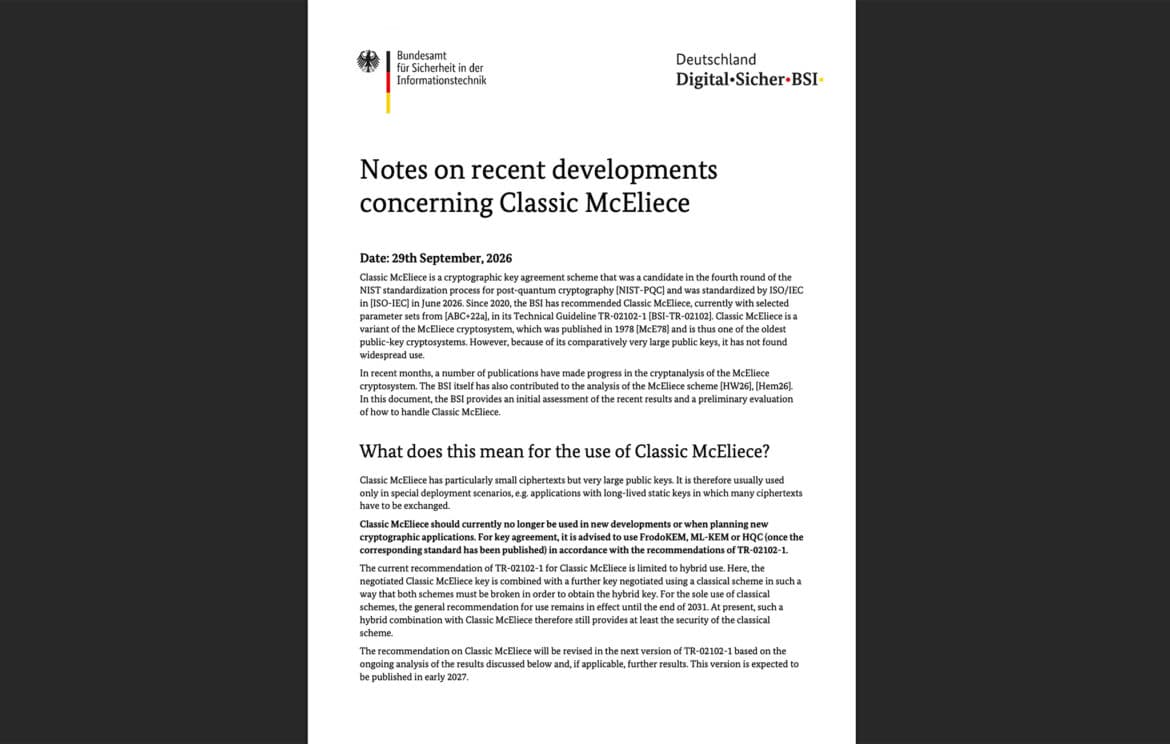
The German Federal Office for Information Security (BSI) issued a new security advisory officially recommending halting the deployment of Classic McEliece in all new IT projects [4]. In the preceding two months, new distinguishers against the algorithm were discovered internationally, and three independent research teams calculated that its actual key-recovery hardness has fallen across the board below its nominal security strength levels; although a practically feasible fast-break attack has not yet materialized, German authorities were first to hit the pause button on deployment [4].

As an historically conservative, code-based candidate widely recognized in the post-quantum cryptography community, Classic McEliece was previously shortlisted for primary consideration by the U.S. National Institute of Standards and Technology (NIST); this calculation indicating degraded security margins, coupled with the sovereign cybersecurity agency's warning, deals a major blow to commercial deployment confidence in code-based cryptographic algorithms.

This decision compels financial core systems, cross-border bank clearing networks, and government classified communications across Europe and globally to accelerate their pivot toward lattice-based cryptography, while prompting the cryptographic community to step up development of hybrid encryption protocols that do not rely on a single mathematical hardness assumption.

The U.S. Department of Energy (DOE) officially released its National Quantum Roadmap, establishing fault-tolerant quantum computing milestones anchored to 2028 as a critical target timeline [8]. The roadmap explicitly de-emphasizes metrics centered on physical qubit counts, pivoting entirely toward demonstrating tangible scientific utility as the benchmark, and outlines a modality-neutral development framework spanning superconducting, trapped-ion, neutral-atom, and other physical modalities to deeply integrate quantum processing units (QPUs) into national classical high-performance computing clusters and existing compute infrastructure across three phases [8].

Top-level strategy officially departs from the publicity cycle of simply stacking physical qubit counts, anchoring 2028 as the acceptance milestone for delivering the first error-corrected logical qubit systems with practical scientific simulation utility.

This policy forces hardware manufacturers reliant on U.S. federal funding and national laboratory contracts to restructure engineering teams, pivoting R&D focus away from merely scaling physical chip sizes toward error correction code rates and full-stack system integration.

Following the review and adoption of NATO's first quantum technology roadmap by allied nations this July, tangible procurement budgets under the initiative have now surfaced: NATO's latest public procurement notice shows an estimated budget of €8 million (approximately 62 million RMB) for its post-quantum cryptography (PQC) proof-of-concept pilot project, setting a pre-2030 milestone for the pilot. Timelines for underwater quantum sensor sea trials and the development of NATO cryptographic interoperability standards were already outlined in the July roadmap public summary, though no public deadline was provided for full PQC migration across its internal core systems [5].

The multinational military alliance has focused its quantum technology push on two key battlegrounds: precision deep-sea gravitational and magnetic positioning sensing independent of satellite navigation, and hardening defense communication channels against future decryption risks.

European domestic quantum communication and deep-sea sensing defense contractors will directly capture the first batch of dedicated NATO contracts, and the establishment of NATO standards will become a mandatory technical barrier to entry enforced across Western defense supply chains.

Supply Chains and Commercial Monetization

Results from an in-depth supply chain survey jointly conducted by six quantum industry associations across 160 quantum computing enterprises globally were announced. The data reveals that up to 90% of quantum enterprises rely on cross-border procurement for core components, and approximately 25% source critical components or raw materials directly from China [3].

The survey results uncover the objective reality of the global quantum hardware supply chain, showing deep cross-border industrial division of labor and dependence on Chinese manufacturing in cryogenic plumbing and components, high-purity specialty materials, precision optical assemblies, and microwave components.

Geopolitical compliance costs and spare-parts inventory pressures are mounting sharply for global quantum hardware startups, as uncertainties in cross-border export control policies force hardware vendors to re-evaluate bill-of-materials costs and lead-time risks.

Nasdaq-listed Swiss quantum security vendor WISeKey released its latest financial report, posting H1 2026 revenue of approximately $11.4 million against a net loss of $36.4 million—a loss exceeding three times its operating revenue [39]. Concurrently, startup Quanome's CEO is providing up to $15 million in non-dilutive capital [39].

The inverted financial figures expose the heavy R&D expenditure and substantial resistance post-quantum security chips face when penetrating conventional consumer electronics and automotive-grade markets; meanwhile, the prevalence of non-dilutive capital injections reflects a defensive mindset among founding teams striving to avoid equity dilution during secondary market downturns.

This trend cautions secondary market investors to remain prudent regarding the revenue conversion pace of quantum security pure-plays, while primary market funding windows will narrow further toward high-certainty targets backed by explicit government subsidies and industrial capital safety nets.

The collaborative project between Silicon Quantum Computing (SQC) and global energy technology giant Schneider Electric officially advanced to Phase 2 of the Australian Government's Critical Technologies Challenge Program (CTCP), securing AU$3.6 million (approximately $2.5 million) in dedicated funding alongside the University of New South Wales [36]. Leveraging SQC's proprietary Watermelon silicon-based atomic-scale manufacturing quantum hardware system, the two parties achieved a 20% improvement in forecasting accuracy over conventional baselines in actual power grid energy consumption forecasting models [21][36].

This achievement confirms the economic value of quantum hardware transitioning from pure theoretical validation to empirical energy dispatch scenarios in the industrial utility sector, establishing a mature deployment model that unites technology providers, vertical industry leaders, and government R&D subsidies.

This benchmark incentivizes more grid dispatch operators and renewable energy asset management firms to allocate dedicated innovation budgets for quantum forecasting services, accelerating the industrial adoption of silicon-based donor qubit chips in specific operations research and optimization domains.

Boston Consulting Group (BCG) published a dedicated industry study noting that as hardware scales, quantum computing enabled industrial decarbonization is projected to abate substantial industrial carbon emissions, while total system power consumption remains low and flat as compute capacity rises—avoiding the power load surges typical of conventional massive, dense compute clusters [37]. In addition, a commercial quantum conference hosted by the Electric Power Board of Chattanooga attracted over 450 multinational executives and policy officials, while the National Metrology Institute of Estonia (Metrosert) fully opened registration for the enterprise track of the QEst Hack quantum hackathon [34][35].

This conclusion relieves large enterprises of power load and environmental compliance concerns that might arise from adopting quantum compute, clearing policy obstacles for institutional investors connecting quantum computing infrastructure at the utility distribution edge.
05Other

Academic Frontiers

Quantum Error Correction and Fault-Tolerant Memory Theory

Theoretical physicists proposed a construction scheme for quantum error-correcting amplified codes based on recursive expansion; by nesting only 4 error-correction amplifiers on top of base logical units, the architecture pushes the entire circuit code distance (the minimum number of gate operations required to protect against physical errors) to an ultra-high fault-tolerant level of d≥48, while strictly constraining physical check weights (the number of qubits associated with a single syndrome check) within a constant bound [20].

This scheme resolves the theoretical challenge where physical topological overhead scales explosively when expanding the protection capability of quantum codes. Compared to current experimental QEC SOTA benchmarks: Google Willow using surface codes has verified only up to code distance d=7 (measuring an error suppression factor Λ≈2.1), and QuEra verified 96 logical qubits based on the [[16,6,4]] code (code distance d=4); this theoretical design directly provides a viable pathway toward ultra-high fault-tolerant quantum memory at d≥48, far surpassing current experimental levels. What is still needed: This scheme currently remains a pure topological error-correction theoretical design; implementing multi-layer amplifier nesting on 2D superconducting grids or trapped-ion shuttling architectures still faces extremely complex, high-dimensional, long-range coupling routing challenges.

This achievement provides a novel theoretical scaffold for chip design teams pursuing general-purpose quantum memory with ultra-long coherence lifetimes, influencing the design of quantum repeaters and long-runtime algorithm architectures.

A major breakthrough was achieved in error correction theory: researchers proved that any standard CSS (Calderbank-Shor-Steane)-type QLDPC (quantum low-density parity-check) code can undergo a topological algebraic transformation that leaps its physical error suppression capability from scaling as Ω(n^β) to Ω(m^α n^β), while maintaining a global constant decoding threshold and requiring only O(log m) runtime for the accompanying local parallel decoder [25].

This marks the first time that the inherent ceiling of QLDPC code error-correcting efficacy scaling near-linearly with physical size has been broken without compromising the efficiency of local parallel decoding, achieving polynomial-scale error suppression enhancement.

This theory rewrites error-correction resource overhead budget models for very-large-scale logical processors, enabling fault-tolerant chip architectures based on high-rate QLDPC codes to demonstrate potential exceeding conventional planar surface codes in both software decoding speed and physical qubit overhead.

Physical System Fault-Tolerance Thresholds and Dynamical Limits

By establishing rigorous mathematical mappings, a research team demonstrated that fermionic quantum computing circuits can tolerate local depolarizing noise (the decoherence mixing of quantum states induced by environmental noise) up to an upper limit of approximately 62% while preserving overall fault tolerance [12].

This finding pushes the fault-tolerance boundary of quantum circuits exhibiting fermionic antisymmetric statistics to a new theoretical high, significantly outperforming the widely accepted fault-tolerance threshold limit of around 45% in conventional spin or superconducting circuits utilizing non-Clifford gates (such as T gates). However, this theory operates within a purely fermionic operator algebra space and cannot be naively equated with measured gate fidelities on physical devices; the physical two-qubit gate fidelity SOTA on real production chips in superconducting and trapped-ion systems (e.g., 99.921% on Helios and 99.99% on SQC donors) still corresponds to physical error rates in the 0.1% to 0.01% range. What is still needed: How to translate this ultra-high noise-tolerant fermionic model into a low-overhead physical error correction scheme on real physical hardware still lacks actionable experimental architectural support.

This research strengthens confidence in the technical roadmaps of dedicated quantum hardware teams worldwide focusing on quantum chemistry and strongly correlated materials simulations.

Quantum State Tomography and System Learning Complexity

An interdisciplinary team spanning statistical physics and quantum information achieved two fundamental complexity breakthroughs: For testing whether an unknown quantum state exhibits fermionic Gaussianity (free fermionic state identification), theory proved that collecting only Θ(ε⁻²) state copies is sufficient for decision-making, overturning earlier literature values that progressed from O(n⁵/ε⁴) to O(n²/ε²) and then to O(n/ε²), completely decoupling decision overhead from the system's spatial mode count n for the first time [17]; for the learning and tomography of n-qubit stabilizer states (discrete foundational quantum states jointly defined by Pauli operators), researchers demonstrated that only Θ(n) single-copy projective measurements are needed for exact reconstruction, resolving the long-standing theoretical bottleneck where non-adaptive measurements required Ω(n²) samples [19].

At the information-theoretic limit, these two works eliminate the curse of dimensionality in mode numbers for characterizing many-body fermionic systems and the quadratic measurement overhead in extracting multi-qubit error-correcting states, proving that with appropriate projective measurements and sampling strategies, quantum state feature extraction can reach mathematical lower bounds under single-copy conditions.

This drastically streamlines measurement runtime for on-chip fast calibration, high-throughput syndrome extraction, and continuous-variable quantum system verification in quantum processors, laying mathematical foundations for compressing physical calibration routines from hours down to milliseconds.

For the Sachdev-Ye-Kitaev (SYK, a non-local toy model used in theoretical physics to simulate holographic duality and quantum black holes) Hamiltonian—characterized by all-to-all strong entanglement and interaction terms growing densely as Θ(n³) with system size—researchers successfully accomplished full-parameter learning and reconstruction of this dense Hamiltonian with polynomial sample complexity for the first time, starting from its thermal equilibrium Gibbs state at constant temperature [23].

This achievement overcomes the strict prerequisites where past Hamiltonian learning algorithms had to rely on geometric locality or bounded interaction strengths, breaking the mathematical barrier against efficient reconstruction of non-local, strongly correlated, all-to-all connected systems.

This breakthrough provides high-energy physicists and condensed matter theorists with a standardized learning algorithm protocol to reverse-engineer black hole information paradoxes and holographic gravity models using quantum hardware.

06Impact

Today's Impact

  1. Post-Quantum Cryptography Standardization Re-enters Turbulence, Forcing Global Infrastructure into Secondary Algorithm Reselection

Who is affected: Global core banking systems, sovereign digital currency networks, cloud security infrastructure providers, and multinational defense communications procurement agencies [4][5][39].

What changed: Germany's cybersecurity agency (BSI) issued a deprecation advisory against the classical code-based benchmark algorithm Classic McEliece, shattering the prior security consensus that code-based algorithms were sufficiently conservative and mature, requiring only the tradeoff of large public key sizes [4]; concurrently, NATO initiated an €8 million PQC pilot procurement [5], while publicly traded quantum security firm WISeKey reported an inverted net loss triple its revenue [39]. This highlights that the transition from finalized theoretical algorithms to deployment in real-world commercial and defense infrastructure is fraught with mathematical uncertainties and accompanied by severe cash burn.

What to watch next: Watch closely whether NIST formally downgrades Classic McEliece's security level in the final release of Round 4 standards, and whether major financial institutions re-evaluate and halt migration roadmaps reliant on a single algorithm.

  1. Scientific Computing Enters the Supercomputer Preprocessing Gate-Reduction Era, Drastically Lowering Barriers for Near-Term Industrial Simulation

Who is affected: CFD software vendors, aerospace aerodynamic design teams, and transition-metal materials and pharmaceutical molecular R&D laboratories [9][15][22].

What changed: ORNL developed the LuGo algorithm on the Frontier supercomputer to slash CFD quantum logic gates by over 95% [9]; the VIME algorithm reduced gate operations for 52-qubit ruthenium molecular simulations by 26-fold while boosting precision 400-fold [15]; and sampling optimization decreased simulation error for the 108-qubit FeMoco nitrogenase by 5.65-fold [22]. The algorithmic layer is no longer waiting idly for long-term hardware with millions of physical qubits; instead, by having exascale supercomputers take over heavy initial state preparation, it compresses the quantum circuit depth needed for industrial computing into the physical window of early hundred-qubit fault-tolerant hardware.

What to watch next: Watch closely for actual hardware execution data from research consortia such as ORNL performing real-world, closed-loop fluid and molecular simulations on mainstream superconducting chips (e.g., IBM Heron r2) or trapped-ion chips (e.g., Quantinuum Helios).

  1. Top-Level Roadmaps Shed Qubit Hype as Global Quantum Hardware Enters the 2028 Practical Delivery Countdown

Who is affected: Quantum hardware startups, national laboratory R&D consortia, and government-backed venture capital funds [3][8].

What changed: The U.S. Department of Energy formally released its roadmap, explicitly de-emphasizing evaluation metrics based on blindly stacking physical qubit numbers, anchoring 2028 as the fault-tolerant error correction and scientific utility delivery milestone, and promoting modality-neutral integration [8]; meanwhile, a global supply chain survey revealed that 90% of quantum enterprises are subject to cross-border component procurement, with 25% dependent on Chinese suppliers [3]. The industry has moved past the early narrative phase of merely stacking physical qubits, transitioning into a life-or-death race over true error correction efficiency, supply chain resilience, and system-level delivery capabilities.

What to watch next: Keep a close eye on public, independent third-party verification data from major hardware vendors on logical qubit encoding ratios (benchmarking Quantinuum's 2:1 or QuEra's 4.7:1) and fault-tolerance thresholds (such as Google Willow's measured Λ≈2.1).

  1. Utilities Carve Out Real-World Deployment Foothold as Quantum Algorithms Shift from Abstract Benchmarks to Power Grid Economics

Who is affected: National grid operators, regional microgrid asset management service providers, and silicon-based quantum computing hardware vendors [21][36][37].

What changed: Schneider Electric and SQC utilized an atomic-precision manufactured silicon quantum system to achieve a 20% precision improvement in actual power grid energy consumption forecasting, securing AU$3.6 million in Australian government funding to advance to Phase 2 [21][36]; in addition, BCG noted that scaling quantum hardware will not impose heavy power load burdens [37]. The value of quantum computing has finally translated from artificial, abstract benchmarks into practical efficacy that directly curtails curtailment rates and dispatch losses for energy utilities.

What to watch next: Watch closely for industrial-grade stress test reports on the joint Schneider Electric-SQC system transitioning from isolated microgrid trials to load dispatch on high-density urban backbone grids.

07Other

Editorial Commentary

Quantum computing is undergoing a profound deflation of hype and a pragmatic convergence. The publicity battles of recent years centered on physical qubit counts in the hundreds or thousands are rapidly ebbing away, replaced by a new hybrid computing paradigm in which classical supercomputers proactively intervene to offload overhead and slash circuit gate counts by more than an order of magnitude. International top-level roadmaps establishing 2028 as the milestone for fault-tolerant practical utility are, in essence, an ultimatum from capital and policymakers against long-idling physical qubit metrics. With classical supercomputers fully capable of handling front-end initialization, the raison d'être of quantum chips is to demonstrate indispensable quantum interference advantages across critical logical qubits. This pivot will accelerate the shakeout of teams that merely expand chip footprints without suppressing physical gate errors; hardware evaluation logic has definitively shifted to core, hard metrics: physical-to-logical qubit encoding ratios and real-time error-correction decoding latency.

Parallel to the pragmatic convergence on the compute side is the severe turbulence shaking security foundations and supply chain ecosystems under real-world scrutiny. The warning downgrading security margins for a leading post-quantum cryptography candidate exposes systemic risks in the global migration toward quantum resistance caused by over-betting on a single mathematical hardness assumption. Meanwhile, a staggering 90% reliance on cross-border supply chains and concerns over critical component supply disruptions declare the fragility of closed technological loops. In capital markets, normalized revenue inversions and mounting losses among early quantum-safe pure-plays are forcing industrial capital and sovereign wealth funds toward highly defensive non-dilutive capital injections or joint procurement models deeply tied to industry incumbents. The watershed over the next two years will be clear: only those who can navigate supply chain headwinds while embedding real fault-tolerant logical circuits into industrial closed loops with tangible returns—such as grid dispatch and molecular catalysis—will survive the impending industry shakeout.