Capital Moves & Sovereign Funding: Germany Launches €640M Competition; Drug Simulation Startup Closes Seed Round
The German Federal Ministry of Research, Technology and Space established a dedicated quantum computing competition fund totaling €640M, aiming to build at least two fault-tolerant, error-corrected quantum computers before 2030. In the initial round of selections, a seven-party industry-academia consortium led by QUDORA was awarded €122M in funding to pursue the NFQC-1k full-stack system [46], while startup planqc and the LOGIQC consortium were also selected among the six final contending finalists [28].
This sovereign-level direct grant for fault-tolerant quantum hardware establishes Europe's strategic resolve to break away from North American monopolies in superconducting and trapped-ion systems and build an autonomous, controllable high-end quantum hardware supply chain, locking in a 2030 full-system delivery milestone [28][46].
Quantum algorithm startup Azulene Labs, focused on high-precision microscopic simulation for pharmaceuticals and advanced materials, announced the closing of a $3.4M Pre-Seed financing round led by Ground State Ventures, with participation from Entrada Ventures and several angel investors [51].
Despite the widespread macro slowdown in deep-tech venture capital deployment, vertical software teams focused on mapping quantum chemistry Hamiltonians onto early quantum hardware can still command angel-round premiums via ultra-asset-light models, as capital markets accelerate their pivot toward application targets with clear paying pharmaceutical customer scenarios [51].
According to public statistics from equity platform Carta, the median waiting period for global startups between a seed round and closing a Series A round has stretched to 774 days. In quantum computing and deep tech, however, certain startups lacking any physical product validation continue to close large funding rounds within days, raising serious concerns among specialized institutions regarding the lack of technical due diligence on underlying physics principles and engineering veracity [18].
Due to the absence of specialized physical auditing regarding fidelity definitions, coherence decay, and end-to-end loss budgets, bubbles accumulated from inflated valuations are compounding the risks of down-rounds in late-stage M&A and secondary-market public listing busts [18].
Commercial Integration & Cross-Sector Deployment: Cisco Routers Embed Quantum Chips; Gas Distribution Network Completes Real-Hardware Optimization
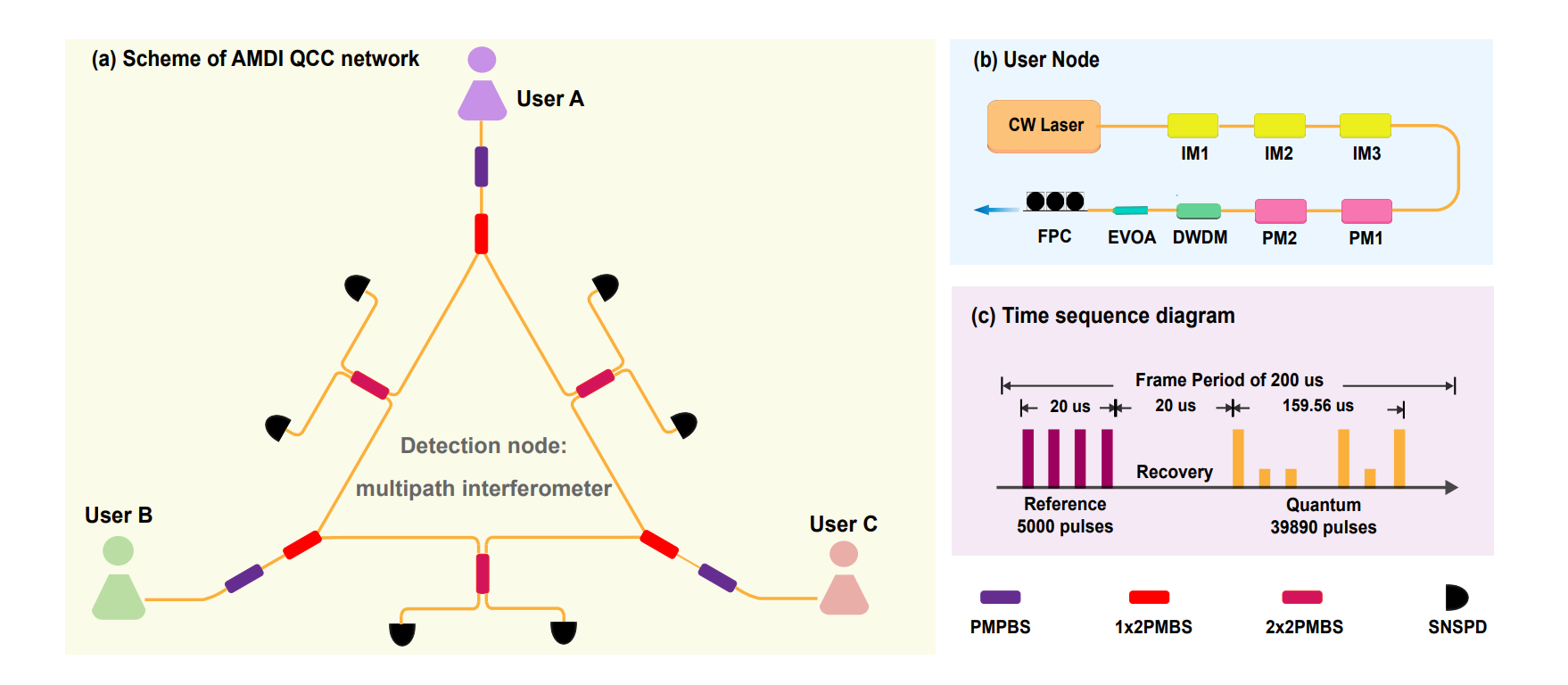
Cisco and UK quantum-safe communications company KETS announced a system-level integration breakthrough, successfully embedding a photonic integrated chip-based quantum key distribution (QKD, encryption based on physical principles) hardware module directly into commercial carrier-grade core router systems running Cisco IOS XR [53].
Previously, quantum key distribution relied heavily on bulky, expensive standalone external chassis, creating severe protocol and operational silos with deployed network routing equipment. This on-chip integration spans the engineering chasm from dedicated external appliances to native integration inside core network devices, directly empowering enterprises and critical infrastructures worldwide running Cisco backbones to deploy physical-layer defenses without retrofitting server rooms, and pushing quantum-resistant technologies formally into mainstream enterprise procurement catalogs [53].
Israel Natural Gas Lines, in partnership with quantum software platform Classiq and trapped-ion hardware vendor IonQ, announced the successful modeling of flow scheduling across a complex long-distance natural gas transmission pipeline using quantum combinatorial optimization algorithms, successfully executing reduced-dimension benchmark runs on the IonQ Forte-1 quantum computer [50][2].
Long-distance gas transmission networks face complex non-linear fluid pressure constraints and dynamic supply-demand balancing challenges. This project demonstrates for the first time the feasibility of solving critical logistics dispatching for national energy utility infrastructure on today's noisy quantum hardware, providing a quantifiable algorithmic optimization pathway for asset-heavy energy networks [50][2].
Global independent IT and business consulting provider CGI signed a strategic partnership agreement with quantum computing vendor D-Wave to jointly promote combined application services spanning quantum annealers and gate-model quantum systems to multinational corporations worldwide [44].
CGI's extensive enterprise client network will serve as a commercialization distribution channel for D-Wave, accelerating the penetration of quantum annealing into tangible operations such as smart manufacturing, supply chain logistics, and daily production scheduling for multinational corporations [44].
Marist College and IBM renewed and upgraded their long-standing partnership, establishing a new innovation incubator to specifically research quantum financial algorithms and risk-control models leveraging the newly deployed IBM z17 mainframe platform [30].
This promotes deep preparatory interfacing between the back-end architectures of major financial institutions and cutting-edge quantum algorithm libraries, building a hybrid computing foundation for future millisecond-level pricing of high-frequency derivatives and anti-fraud transaction processing [30].
Geopolitics & Industry Standards: Global Supply Chain Vulnerabilities Exposed; Post-Quantum Cryptography Shifts to Mandatory Baseline
A comprehensive global quantum supply chain survey report recently conducted jointly by six international industry consortia shows that among 160 surveyed quantum companies across 15 nations, supplier bases span 36 countries, with as many as 90% of quantum enterprises explicitly reporting that they source at least one component from abroad [47][56].
The survey data indicates that core components—such as high-purity Helium-3 for dilution refrigerators, cryogenic coaxial cables, RF integrated chips, and precision lasers—rely heavily on international division of labor; tightening geopolitical export controls will directly decelerate full-stack R&D progress globally [47][56].
The U.S. Federal Information Processing Standard FIPS 140-2 officially transitioned to historical archive status on September 21, 2026, with subsequent federal procurement mandating full migration to FIPS 140-3 certification. At this milestone, Lattice Semiconductor released the Mach-N2 secure control FPGA featuring up to 220,000 system logic cells, marking the industry's first compact device fully compliant with the National Security Agency's Commercial National Security Algorithm Suite 2.0 (CNSA 2.0, a quantum-resistant cryptographic standard) [17][29].
Post-quantum cryptography has completely shifted from theoretical discussion to a mandatory qualification threshold for government procurement; communication module vendors failing to secure timely FIPS 140-3 compliance certification face the direct risk of losing North American public-sector and enterprise contracts [17][29].
Within just three days of China announcing its first round of candidate post-quantum cryptography designs, public evaluation reports collected 104 review submissions targeting the 65 candidate algorithms, with researchers announcing algorithmic cryptanalyses against 5 of the designs as early as the second day [19].
This process exemplifies the high-intensity stress-testing dynamics of open cryptographic evaluations, where automated code-assisted review tools and theoretical cryptanalytic offensives are eliminating structurally flawed early candidate algorithms at a rapid pace [19].
Anthropic engineer Stephen Weis used the automated code-migration program Claude to successfully port the classical number field sieve tool CADO-NFS to an idle GPU compute cluster, factoring an 896-bit RSA public key [16].
This milestone still faces a mathematical complexity barrier of approximately 35 billion times compared to cracking commercial 2048-bit RSA keys; the complete upending of public-key cryptographic systems in the post-quantum era remains strictly contingent upon the physical realization of universal quantum computers [16].
The International Semiconductor Industry Group (ISIG) established the Global Quantum Industry Group, scheduling its inaugural European Summit for October 1–2, 2026, at imec in Belgium, restricted to C-level executives to interface foundry and supply chain pipelines [54]; concurrently, Quantum World Congress 2026 opened in College Park, Maryland, with international error-correction hardware vendors such as Riverlane establishing a full presence in the regional industrial cluster [55][20]; quantum computing company QCi unveiled an integrated security platform combining high-dimensional QKD with quantum authentication at the ECOC 2026 exhibition [22]; and Yenepoya University in India partnered with Edutecnicia to launch a Quantum AI Catalysis Lab [21].