Sep 22, 2026 – Sep 23 · Daily Brief

Running Error-Correction Decoding on Standard Chips Brings Quantum Computers One Step Closer

51 items · 15 sourcesPDFThis issue's roundup is free
02Hardware

Hardware Frontiers

Neutral Atoms

QuEra has partnered with Hewlett Packard Enterprise (HPE) to advance on-premises integration between neutral-atom fault-tolerant machines and exascale supercomputing infrastructure[37][43]. Under this strategic collaboration, QuEra’s fault-tolerant neutral-atom quantum computer will connect directly into on-premises high-performance computing (HPC) environments powered by the HPE Cray supercomputing platform, delivering hybrid heterogeneous compute to national supercomputing centers and major research institutions[37].

Technically, the neutral-atom modality currently leads the industry in validated logical qubit count, with the public gold standard being QuEra’s 96 logical qubits (using [[16,6,4]] high-rate codes on 448 physical qubits, published in Nature). Its published two-qubit gate fidelity records stand at 99.5% measured by a Harvard team (across 60 atoms in parallel) and 99.6% disclosed by Atom Computing[37]. While this partnership focuses on on-premises integration between cold-atom arrays and classical supercomputers, underlying low-level communication protocols remain undisclosed[37]. Compared against hardware baselines, neutral-atom platforms still face inherent bottlenecks for practical utility: their cycle repetition rates remain extremely low (typically just 1 to 10 Hz, constrained by optical-tweezer atom reloading and laser-cooling physics), and mid-circuit quantum non-demolition (QND) measurements easily induce atom loss. Until thousand-qubit-scale lossless replenishment is realized, establishing ultra-high-speed closed-loop error correction remains a formidable challenge.

Industry-wide, while quantum cloud access previously relied entirely on remote calls over the public internet, this on-premises physical integration model has officially taken shape, directly prompting supercomputing centers to upgrade from pure classical architectures to integrated quantum-classical clusters[37]. Separately, Pasqal confirmed it will report its H1 2026 financial results ahead of the US market open on the evening of September 24, 2026 (Beijing Time) and participate in an investor conference[22].

Superconducting

A four-qubit system has mitigated qubit decay without measurement feedback by leveraging pre-programmed, fixed pulse sequences[15]. On a superconducting transmon circuit, a research team successfully suppressed state decoherence induced by Pauli-X (bit-flip) noise without real-time syndrome extraction, relying solely on fixed microwave pulse cyclic compilation, and validated this approach in a four-qubit repetition code[15].

Technically, compared to the sub-threshold surface code benchmark achieved by Google’s Willow chip (code distance d=7, error suppression factor Λ≈2.1, featuring a full real-time closed-loop QEC system), this experiment targets only single-axis bit-flip noise: it cannot correct Pauli-Z (phase-flip) errors, does not surpass the 100-to-500-microsecond coherence limit of superconducting platforms, nor does it resolve the two-to-three-fold coherence lifetime fluctuations caused by two-level system (TLS) defects in materials[15]. Its technical breakthrough, however, lies in eliminating low-latency readout feedback loops between cryogenic microwave cabling and room-temperature high-speed electronics, drastically simplifying error correction into forward microwave control[15].

Industry-wide, this scheme provides a cost-effective noise-mitigation paradigm for near-term superconducting prototypes with modest physical qubit counts that cannot tolerate the thermal load of complex microwave coaxial cabling, easing thermal overhead in cryogenic dilution refrigerators[15].

Fermi National Accelerator Laboratory (Fermilab) and Microsoft have co-founded a quantum research center in the University of Maryland Discovery District[3][32]. Spanning 15,000 square feet, the facility focuses on building a quantum hardware maker-space and extensively expanding the capabilities of Fermilab’s open-source Quantum Instrumentation Control Kit (QICK), an FPGA-based quantum control platform[3][32]. Backed by a US national laboratory, this initiative directly reduces development costs for open-source microwave control toolchains, driving co-opetition with commercial proprietary quantum control vendors[3].

Trapped Ions

IonQ is supplying South Korea with its first complete Superion 256 system and a silicon-vacancy (SiV) quantum memory module[42][43]. Designed to support South Korea’s 2029 dual-track qubit development targets, this procurement marks the first deployment of 256-physical-qubit trapped-ion hardware alongside a diamond-defect-based solid-state quantum repeater interface within an Asia-Pacific sovereign research ecosystem[42][43].

Technically, the current commercial record for trapped-ion all-to-all two-qubit gate fidelity is held by Quantinuum Helios at 99.921% (across 98 fully connected physical qubits), while the laboratory single-pair fidelity record was pushed to 99.99% by IonQ prototypes and Oxford Ionics[42]. Although IonQ’s planned 256-qubit system doubles physical ion count, operational clock speeds remain capped in the hundreds-of-hertz range due to ion transport latencies and phonon heating from multi-zone shuttling; the accompanying SiV quantum memory module aims to boost remote ion-photon entanglement conversion efficiency, shoring up physical bottlenecks in distributed ion interconnects[42][43].

Industry-wide, South Korea becomes the first Asia-Pacific nation after the US and UK to acquire a commercial hundred-physical-qubit trapped-ion system, pressuring other Asian economies to accelerate sovereign quantum compute procurement[42].

Topological and Emerging Modalities

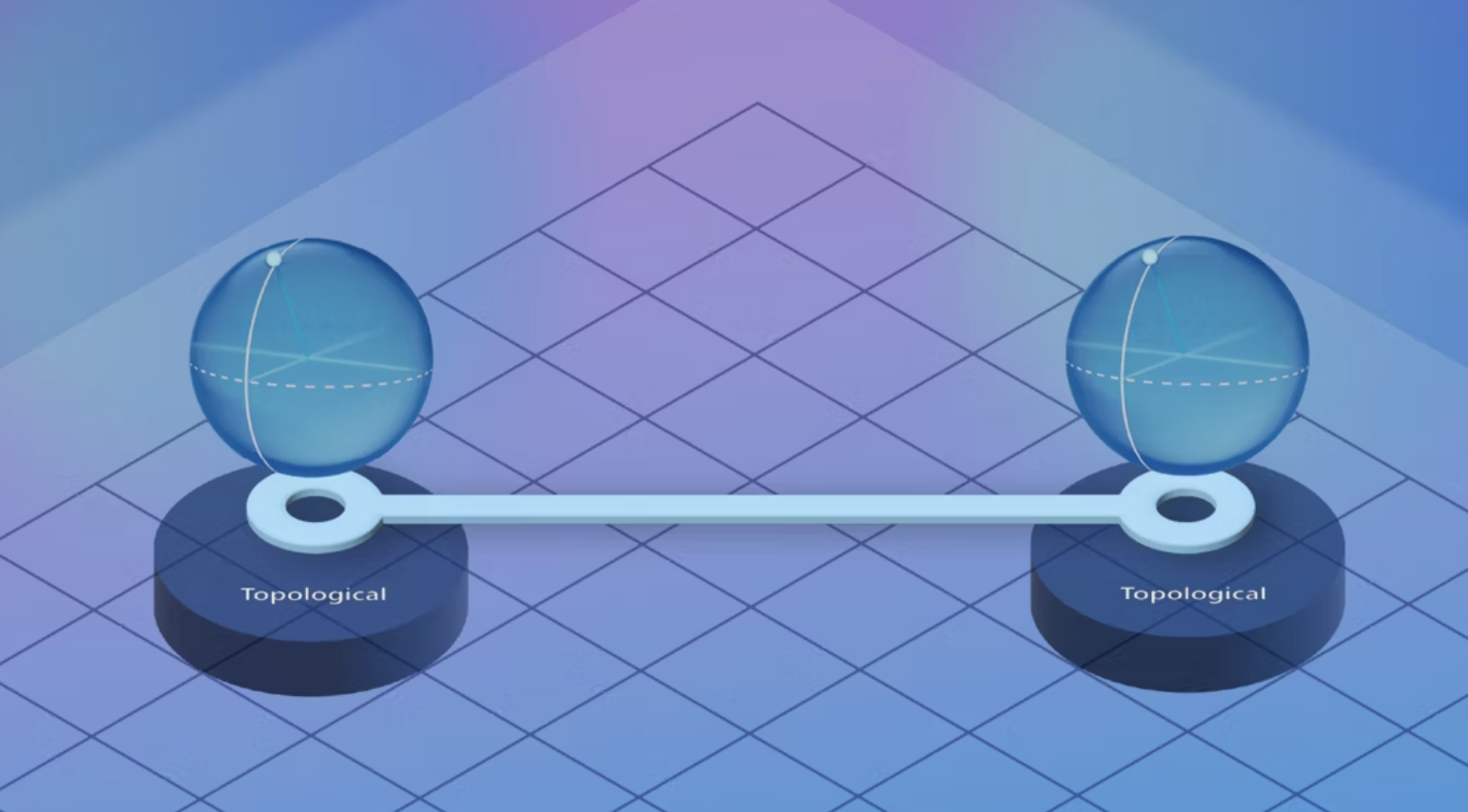
Microsoft has delivered a Majorana chip to the Defense Advanced Research Projects Agency (DARPA) for official independent evaluation[32][43]. Microsoft deployed its second-generation Majorana topological quantum chip at its newly inaugurated Maryland facility, where an independent DARPA expert panel is embedded to verify its underlying topological physics and scaling potential[32][43].

Technically, while superconducting and trapped-ion gate fidelities routinely exceed 99.9%, the topological route has long been mired in condensed matter physics disputes over single-particle signatures, with no published demonstration to date of any non-trivial two-qubit entangling gate[32]. The core benchmark for this evaluation is physically verifying the non-Abelian braiding statistics of Majorana zero modes (MZMs) at the device level, confirming whether they deliver the theoretically anticipated, hardware-intrinsic noise protection[32]. If it fails to show intrinsic stability superior to classical superconducting circuits, its commercial thesis will face severe reassessment.

Industry-wide, direct intervention by the top US defense R&D agency for objective benchmarking means these findings will heavily dictate over the next 12 to 18 months whether Western defense capital continues to bet heavily on the topological route[32].

UK Research and Innovation (UKRI) and the Leverhulme Trust have jointly funded the development of a superfluid helium-3 oscillator qubit[21]. The project awards a £1.3 million fellowship to Dr. Priya Sharma to develop a novel superfluid quantum device dubbed SHOQ[21]. Currently at an early conceptual stage of Technology Readiness Level (TRL) 2–3, the architecture aims to leverage the ultra-pristine macroscopic quantum ground state of topological superfluids to bypass solid-state material interface losses, though it remains a substantial R&D distance away from single-qubit gate fidelity benchmarking[21].

Photonics and Acoustics

Stanford University has achieved the first real-time observation of single-phonon quantum transitions[23]. Coupling a micro-nanoscale piezoelectric resonator to a superconducting circuit, the research team directly recorded instantaneous transition trajectories of single phonons between discrete quantum energy levels in the time domain for the first time[23]. Acoustic quantum devices possess spatial mode densities orders of magnitude higher than microwave photons; this breakthrough overcomes technical hurdles in in-situ non-destructive phonon detection, providing a physical foundation for ultra-dense solid-state acoustic quantum memories and ultra-sensitive mechanical sensing[23].

Poland’s Creotech Quantum has secured a project from the European Space Agency (ESA) to develop high-sensitivity single-photon detectors[17]. Valued at €2.33 million, Creotech has been subcontracted for a core €1.2 million work package to develop high-efficiency single-photon detection payloads tailored for harsh space radiation and cryogenic environments[17]. The objective is to push space payload detection efficiency closer to ground-based superconducting nanowire single-photon detectors (SNSPDs, with commercial baseline efficiencies of at least 95%), providing critical components for Europe’s space-based quantum communication backbone[17].

Following reports on the launch of the UK silicon photonics integration platform C-PIC, the project has officially opened for applications. A £750,000 funding pool established jointly by the UK Quantum Communications Hub and the Centre for Biomedical Sensing will select a new cohort of early-to-mid-career research leaders between January 12 and 14, 2027, to tackle scalable silicon photonic chips for fault-tolerant architectures[18].
03Algorithms

Algorithms and Software

IonQ has completed testing of the first end-to-end, real-time quantum error correction decoder running on a single commercial CPU[41][43]. Test results demonstrate that using only a single off-the-shelf commercial CPU, the software decoder can process error syndrome measurement data streams generated concurrently across 408 logical qubits in real time within a millisecond-scale physical decoherence window, meeting closed-loop QEC throughput standards[41][43].

Technically, this upends long-standing industry assumptions that large-scale fault-tolerant decoding must rely on massive classical supercomputing clusters (such as Quantinuum’s solution paired with NVIDIA GB200 platforms) or highly customized ASICs/FPGAs[41]. A concurrent throughput capacity of 408 logical qubits not only exceeds the largest published physical logical qubit scale (QuEra’s 96 logical qubits) purely in compute dimension, but also proves that standard commercial CPU compute is sufficient to handle syndrome graph-matching algorithms for current intermediate-distance surface codes[41][43]. It must be clarified, however, that this demonstration was a pure compute throughput stress test using synthetic noise data and was not run on an integrated physical machine hosting 408 real QEC logical qubits.

Industry-wide, this breakthrough significantly drives down classical control hardware costs and power consumption for fault-tolerant systems, freeing small-to-midsize hardware developers from absolute dependency on power-hungry heterogeneous compute and potentially eroding the valuation moats of startups developing dedicated QEC decoding hardware chips[41].

Microsoft Quantum and QOLAB have formally introduced a new industry benchmark for "Scalable Logical Qubits"[39]. Microsoft lead architects Matthias Troyer and Chetan Nayak, alongside superconducting quantum pioneer John Martinis, published a theoretical framework on arXiv urging the industry to move away from absolute logical qubit counts as a single performance metric, advocating instead for a standardized assessment framework centered on "net error-correction gain" (where logical error rates must decay exponentially with code distance) and "fault-tolerant gate cascading capability" (where logical gate error remains consistently below physical gate error)[39]. This proposal directly targets industry hype where vendors inflate logical qubit numbers using error-detecting codes or post-selection (discarding erroneous runs), establishing clear technical bars for commercial fault-tolerant delivery[39].

Researchers have discovered that noise criticality can induce a transition in quantum circuits into a classically polynomial-time simulable phase[14]. The study pinpoints the disentangling phase transition boundary governed jointly by noise strength p and non-Clifford gate density Nt/N (non-Clifford gates being the critical resource for universal quantum advantage), proving that once this critical threshold is crossed, quantum circuits of arbitrary depth can be efficiently and accurately simulated on classical computers using Clifford operations[14]. This work provides a quantitative mathematical ruler to assess whether noisy quantum hardware delivers genuine physical advantage, imposing stringent theoretical constraints on algorithms claiming classical supremacy in NISQ-era materials or molecular simulations[14].

Magic state distillation—the core protocol for purifying non-Clifford resource gates in fault-tolerant computing—suffers major efficiency penalties under measurement noise[20]. Theoretical derivations show that when accounting for finite measurement fidelity on realistic hardware, the required number of ancilla physical qubits and distillation rounds grow superlinearly, placing far stricter requirements on readout fidelity (with current superconducting state-of-the-art median fidelities between 98% and 99.5%) than previously anticipated and cautioning that fault-tolerant compiler designs must overhaul their measurement error-tolerance models[20].

Zapata Quantum has launched early access for its hardware-agnostic platform, Quantum Pilot, providing enterprise customers with diagnostic tools to quantitatively evaluate quantum acceleration potential across business use cases[33][44]. French silicon quantum startup Quobly announced the integration of its proprietary Alloy Forge development environment into the qBraid cloud platform, opening simulation interfaces for low-level silicon spin qubit dot parameters to developers[34]. Denmark’s Kvantify broke down the limitations of using classical servers to simulate the Variational Quantum Eigensolver (VQE, a hybrid algorithm for finding ground-state energies) on 60 to 80 physical qubits in a podcast feature, highlighting its proprietary toolsets for quantum chemistry compute[4].

04Industry

Industry and Ecosystem

IBM has committed $2 billion to fortify its domestic advanced-node wafer manufacturing supply chain[19]. IBM announced it will split the $2 billion investment between internal direct R&D funding and establishing a joint manufacturing venture named Anderon, fully securing domestic, sovereign foundry access and high-end micro-nano packaging capacity for advanced semiconductor wafers[19].

Commercially, following reports on September 20 of IonQ acquiring SkyWater Technology’s foundry to build vertically integrated manufacturing, IBM’s massive capital deployment definitively pushes industry competition into a capital-heavy manufacturing phase[19]. Superconducting quantum chips are rapidly migrating away from academic, cleanroom-style boutique fabrication toward industrial-grade 300 mm (12-inch) wafer production lines; processing uniformity on underlying high-purity silicon or sapphire wafers has become the hardware lifeblood dictating whether two-qubit gate fidelities can surpass 99.9%[19]. This move marks the start of compute giants erecting exclusive moats across the advanced semiconductor manufacturing chain.

Oxford Quantum Circuits (OQC), Citi, and the UK’s National Quantum Computing Centre have completed live testing for financial derivatives pricing[8]. Leveraging the SparQ industry enablement program, the trio deployed hybrid quantum-classical algorithms for derivatives valuation on OQC’s superconducting quantum computer, completing backtests on live market data for high-frequency volatility surface fitting and risk exposure calculations[8]. This marks the first time a tier-one international investment bank has deeply integrated live derivatives business logic onto sovereign European superconducting hardware, validating the compute convergence advantages of hybrid architectures in high-dimensional asset pricing and accelerating the migration timeline of core Wall Street and City of London risk-management modules to quantum environments[8].

Babcock International and Arqit have demonstrated quantum-safe encrypted transmission in a defense communications scenario[36]. The UK defense engineering giant used Arqit’s proprietary symmetric key agreement encryption system to successfully achieve secure, confidential data transmission at a single site during the Millbrook DVD defense event, validating the solution’s plug-and-play compatibility across existing military legacy network infrastructure to counter intercept-and-decrypt threats[36].

Post-Quantum Cryptography (PQC) enterprise and government adoption accelerates across the board:

QuSecure’s QuProtect R3 platform was named a 2026 Gartner Cool Vendor in Data Security; leveraging automated cryptographic asset discovery and dynamic algorithm orchestration, it helps enterprises transition smoothly toward FIPS and NSA CNSA 2.0 compliance without re-architecting underlying communications[13].

Quantum XChange entered a master distributor agreement with Carahsoft, leveraging the latter’s public-sector procurement network in North America to market the Phio TX post-quantum crypto management platform across US federal agencies[35].

Aviatrix introduced a software-defined post-quantum defense solution incorporating communications governance policies, pairing quantum-resistant encryption with access restrictions on compromised workloads through a unified control plane[38].

IonQ published a post-quantum migration whitepaper introducing four uncoordinated "migration clocks"—regulatory compliance, cyberattack evolution, vendor delivery, and enterprise execution—warning organizations not to passively wait for a target year when fault-tolerant cryptanalytic machines emerge, but to benchmark defense upgrades against "net cryptographic progress"[6].

The Korea Institute of Science and Technology Information (KISTI) and SK Telecom have built a digital twin system for testing quantum-secure communications networks, enabling operators to fully evaluate secret key rate fluctuations and disaster recovery topologies for QKD networks in a virtual simulation environment before deploying costly optical fiber and repeater hardware[40].

Following reports on September 20 of IonQ acquiring a foundry and issuing aggressive revenue guidance, IonQ further emphasized at its 2026 NYSE Investor Day that the company has transformed into a vertically integrated full-stack platform spanning compute, sensing, networking, and quantum security. Its 10 peer-reviewed papers and four awards at IEEE QCE26 highlight operational progress in delivering hybrid workflows to enterprise clients[5][7].

05Other

Academic Frontiers

A secure quantum position verification (QPV) protocol across a 2-kilometer urban distributed base station network has been demonstrated[11]. Operating between real-world geographical base stations spaced 2 km apart, the research team leveraged the quantum no-cloning theorem to implement a collusion-resistant QPV protocol that completely thwarted attacks by multiple malicious relay nodes colluding to spoof physical coordinates under rigorous conditions of finite channel noise and speed-of-light propagation delays[11]. This work brings trusted location verification from theoretical proposals into intermediate-to-long-range metropolitan environments for the first time, delivering protection rooted purely in the laws of physics for high-value cross-border settlement terminals, top-secret database access, and unforgeable anti-hijack tracking for autonomous systems[11].

Discrete-modulated continuous-variable quantum key distribution (CV-QKD) has broken through a rigorous security proof against coherent attacks beyond 70 km[16]. For over two decades, continuous-variable quantum communication has offered exceptionally low hardware upgrade costs by reusing standard telecom coherent optical detectors, but rigorous mathematical security proofs against real-world, highly complex coherent attacks had been missing beyond 70 km[16]. Researchers have now provided a complete, loophole-free mathematical proof against arbitrary coherent attacks, bridging a vital gap between theoretical security and long-haul fiber backbones and clearing theoretical barriers for low-cost, dedicated high-security government/enterprise networks that operate without single-photon detectors[16].

Physicists at the University at Buffalo (SUNY Buffalo) have resolved a mathematical correspondence between frustrated quantum magnets and black hole holographic physics[9]. The team discovered an exact analytical mathematical solution proving that spin systems exhibiting extremely slow relaxation kinetics in frustrated quantum magnets can undergo an abrupt transition under specific interactions into an ultra-fast, highly entangled state reminiscent of a black hole horizon[9]. This work establishes a rigorous mapping between condensed matter frustrated spin models and high-energy black hole holographic entanglement scrambling, opening the door for experimentalists to simulate information scrambling and quantum chaos of microscopic black holes directly on solid-state quantum magnetic chips on a laboratory benchtop[9].

Light beams have been observed propagating upstream against a quantum fluid, breaking Newton’s third law symmetry[10]. In a moving non-Hermitian superfluid, researchers observed photon beams traveling backward against the fluid medium without any external macroscopic thrust, exhibiting unidirectional non-reciprocal transport that violates the action-reaction balance of Newton’s third law[10]. This unidirectional topological state of matter, induced by dissipation in open non-Hermitian systems, carves out a new microscopic physical pathway for designing magnet-free optical isolators, on-chip unidirectional backflow-resistant photonic quantum routers, and other critical photonic computing components[10].

Backlash and ethical scrutiny mount over zero-knowledge proofs in commercial quantum confidentiality[25]. The scientific and mathematical communities are voicing deep concern over Google’s approach following a major technical milestone, where it sought to apply zero-knowledge proofs (providing mathematical verification proofs without disclosing physical circuit parameters) to prevent intellectual property misuse, pointing out that such extreme black-box obscurity obstructs peer replication and independent academic verification, ultimately backfiring[25].

06Other

Today's Implications

  1. Fault-Tolerant System Developers and Control Chip Vendors: Impacted by IonQ’s benchmark demonstrating real-time decoding across 408 logical qubits on a single CPU[41] and Microsoft-QOLAB’s proposed scalable logical qubit standards[39], startups betting on dedicated FPGA/ASIC hardware decoding acceleration face pressure to re-evaluate their product roadmaps and valuation models; next, they must closely watch empirical end-to-end latency figures when this decoding algorithm runs in closed loops on real superconducting or neutral-atom multi-qubit hardware.
  2. Semiconductor Foundries and Sovereign Strategic Capital: Driven by IBM’s $2 billion investment into the Anderon joint venture for advanced manufacturing[19] and IonQ securing foundry capacity[19], quantum chip R&D is shifting decisively from university cleanrooms to industrialized, mature foundry lines, turning high-purity substrate materials and manufacturing uniformity into the decisive competitive high ground; next, track process yield reports on 300 mm silicon and superconducting wafers from GlobalFoundries, SkyWater, and Anderon.
  3. Traditional Supercomputing Centers and Large Financial Institutions: Spurred by QuEra’s on-premises neutral-atom integration with the HPE Cray supercomputing platform[37] and OQC’s derivatives pricing validation with Citi[8], supercomputing procurement priorities are expanding from pure classical GPU clusters to on-premises quantum accelerators, dramatically compressing evaluation cycles for heterogeneous hybrid compute in financial institutions; next, monitor delivery timelines and live benchmark performance of the first embedded on-premises quantum-supercomputing nodes.
  4. Enterprise IT Departments and Critical Infrastructure CISOs: Catalyzed by the 2 km quantum position verification demonstration[11], the full security proof for 70 km continuous-variable secure communications[16], and QuSecure’s recognition in industry analyst reports[13], migrations away from legacy public-key infrastructure are shifting from architectural validation to budget execution; next, closely track post-quantum compliance rollouts across financial settlement protocols and critical network access control points.
07Other

Editorial Commentary

The quantum computing industry is currently undergoing a profound paradigm shift: transitioning from a "qubit metrics race" to "system engineering consolidation." For years, industry discourse was held captive by the unilateral expansion of physical qubit numbers. Yet, absent effective error correction and practical peripheral control, expanding isolated physical qubits can no longer sustain market enthusiasm. From top researchers jointly establishing benchmark standards for scalable logical qubits to a single standard processor handling decoding stress tests for hundreds of logical qubits, this wave of developments makes one thing clear: evaluation criteria are being pulled squarely back to industrial-grade metrics—underlying signal-to-noise ratios, verifiable fault-tolerant capacity, and system energy efficiency. The window for vanity metrics is closing; only entities that withstand independent external scrutiny and demonstrate sustained net error-correction gains will earn the right to define the rules of the next phase.

At the same time, hardware competition is descending fully into heavy manufacturing and sovereign production. Multi-billion-dollar wafer commitments and foundry acquisitions underscore that industry frontrunners recognize a hard truth: devices confined to boutique, lab-scale prototyping cannot support the tens of thousands—or millions—of physical elements required for universal fault tolerance. Yield ramp-up across superconducting, spin, and photonic platforms on industrial production lines will dictate which modalities survive over the next five years. For strategic capital, the premium on pure algorithmic frontrunners has narrowed. Instead, the players anchoring foundational wafer fabrication, high-precision open-source control ecosystems, and quantum-safe infrastructure upgrades are erecting the most resilient and indispensable moats in the industry.