Network Communications and Post-Quantum Migration
Oracle Corporation officially released the enterprise development platform Java 27, fully introducing a post-quantum hybrid key exchange mechanism into the core TLS (Transport Layer Security) 1.3 communications module [57].
[Commercial Significance] As the underlying runtime environment powering mainstream global commercial banks, payment gateways, and enterprise backend systems, Java 27 packages the NIST-standardized post-quantum cryptography scheme (ML-KEM) alongside classical elliptic-curve key exchange, enabling default protection against "harvest now, decrypt later" attacks [57].
[Landscape Impact] This directly impacts tens of millions of enterprise servers and communication relays operating worldwide, compelling IT departments across financial, governmental, and enterprise sectors to initiate mandatory network protocol stack security audits and library upgrades over the next 12 to 18 months [57].
Cisco Systems and UK quantum-safe communications firm KETS announced the completion of hardware and driver integration between chip-scale QKD (Quantum Key Distribution) technology and Cisco’s IOS XR backbone router operating system [34].
[Technical Significance] It successfully overcomes past deployment barriers where physical encryption equipment required bulky external optical racks, integrating miniaturized photonic key chips directly into standard network blade slots [34].
[Landscape Impact] It signals that physical-layer quantum-secure solutions are now ready for seamless embedding into global core communication backbones, severely squeezing the market survival space for startups peddling premium standalone encryption appliances [34].
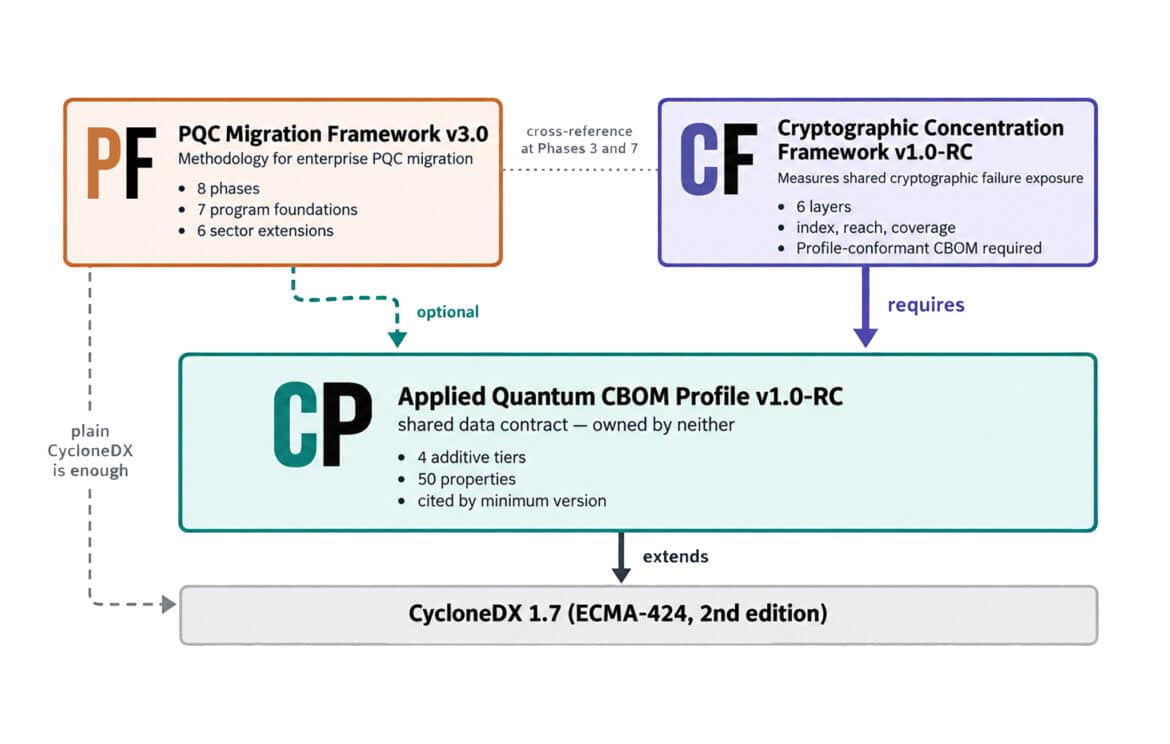
UK post-quantum cryptography provider Post-Quantum released version 3.0 of its migration framework, concurrently introducing a standard configuration specification for Cryptography Bill of Materials (CBOM) to inventory cryptographic assets [11].
[Commercial Significance] It establishes cryptographic agility—the capacity of a system to rapidly swap underlying cryptographic algorithms within a chosen timeframe—as a mandatory acceptance criterion for enterprise security compliance [11].
[Landscape Impact] It drives post-quantum budgets at multinational banks and defense contractors to transition from ad-hoc proof-of-concept projects into recurring, permanent information security expenditures [11].
Dutch quantum-security startup Q*Bird announced a rebrand to Falqon Systems and secured €2.5 million in funding to advance the deployment of its dedicated secure network infrastructure [25][56].
[Commercial Significance] The company’s strategy has officially pivoted from point-solution R&D to turnkey commercial quantum-secure metropolitan area network (MAN) infrastructure [25][56].
[Landscape Impact] It strengthens the pilot network density of physical-layer quantum-safe protections across Western Europe's critical infrastructure communication nodes [25][56].
Industry Applications and Capital Dynamics
North Wales Police in the UK deployed a D-Wave quantum annealing system to optimize emergency dispatch across its jurisdiction, aiming to halve average emergency response times for 500,000 rural residents from 10 minutes to 5 minutes [30].
[Commercial Significance] This represents the world's first benchmark in real-world operations where a public safety department deployed quantum annealing compute to solve dynamic patrol routing and achieved quantifiable operational gains [30].
[Landscape Impact] It forcefully refutes skepticism that quantum annealing cannot generate economic returns in real-world commercial scenarios, earning D-Wave a compelling credential in procurement markets for government, military, and police logistics dispatch [30].
Applications for Innovate UK’s £14.3 million (~$19.3 million) dedicated funding competition for quantum sensing and PNT (Position, Navigation, and Timing) officially closed on September 16, 2026, Beijing Time [66].
[Commercial Significance] The UK government initiated Phase 2 targeted financial support for satellite-denied autonomous navigation and high-sensitivity gravimetry, with individual project grants ranging between £1 million and £3 million over a 12- to 24-month execution timeline [66].
[Landscape Impact] It will directly catalyze commercialization for UK domestic startups developing marine-grade atomic gyroscopes and underground mapping equipment, erecting a strategic supply-chain moat in non-GPS navigation [66].
Japan's TOYO Corporation announced it is opening access to two superconducting quantum computers it procured—the previously acquired 20-qubit IQM Radiance system and the newly ordered full-stack IQM Spark—to Japanese academia and industry [36].
[Commercial Significance] Both hardware systems are scheduled to become fully operational in early 2027, directly aligning with metrics in Japan's National Quantum Strategy to cultivate 10 million domestic users and generate 50 trillion yen in economic value [36].
[Landscape Impact] This deepens the foothold of Nordic superconducting full-stack hardware vendor IQM in the Japanese research market, creating a competitive and cooperative dynamic with indigenous initiatives from Fujitsu and RIKEN [36].
Anyon Computing released an open-source real-time quantum control plane architecture that leverages the NVIDIA NVQLink interface to directly interconnect microwave hardware, superconducting chips, and GPU clusters, compressing the measurement-and-control feedback loop down to microseconds [23][60].
[Technical Significance] By employing RDMA-over-Ethernet protocols, it eliminates data movement bottlenecks between host controllers and heterogeneous compute nodes, providing hardware-level low-latency interconnects for active error correction resets on superconducting qubits [23][60].
[Landscape Impact] It breaks the monopoly of proprietary protocols held by a few instrumentation giants over large-scale quantum control hardware, accelerating the transition of full-stack manufacturing into an era of modular assembly [23][60].
French photonic quantum computing firm Quandela and NVIDIA co-published a technical white paper detailing an integrated architecture that directly connects photonic quantum processing unit (QPU) controllers with GPU servers via the low-latency NVQLink bus [22].
[Technical Significance] It establishes a standard communications conduit for photonic quantum systems to harness external GPU clusters for microsecond-scale error-correction decoding and high-speed electro-optic switch routing control [22].
[Landscape Impact] It tightens the physical integration distance between photonic computing hardware and existing supercomputing center servers, laying down a de facto standard for the scaled deployment of hybrid photonic-quantum cloud nodes [22].
Quantum cloud platform BlueQubit, in partnership with Amazon Web Services (AWS), IBM, and NVIDIA, launched a $150,000 Flywheel Quantum Compute Credit Program to provide hybrid hardware resources to algorithm development and error-mitigated/QEC simulation teams [21].
[Commercial Significance] By bundling pooled compute credits, it locks in early-stage algorithm startups and builds a unified developer traffic gateway across cloud hardware providers [21].
[Landscape Impact] It strengthens stickiness to cross-platform development environments, preventing developers from becoming locked into proprietary software APIs of a single tech giant [21].
University of Sydney spinout Emergence Quantum partnered with major Asia-Pacific data center operator AirTrunk to explore engineering solutions that leverage deep cryogenic quantum technology to curb energy and water consumption in conventional data centers [35].
[Commercial Significance] It laterally transfers cryogenic thermodynamic techniques developed for quantum chip cooling to heat dissipation in conventional high-density server clusters, exploring new pathways to lower Power Usage Effectiveness (PUE) [35].
[Landscape Impact] It establishes a new business model for reverse technology spillover from frontier quantum cryogenics into the trillion-dollar general-purpose data center infrastructure market [35].