Sep 14, 2026 – Sep 15 · Daily Brief

Underlying Systems of Major Global Online Banks Gain Quantum-Resistant Security Locks

67 items · 16 sourcesPDFThis issue's roundup is free
02Hardware

Hardware Frontiers

Superconducting and High-Dimensional Architectures

A team from the University of Southern California and Quantum Elements published results in Nature Communications, demonstrating error correction gain scaling for the surface code—a quantum error correction technique that detects and corrects bit-flips and phase-flips—on a non-square lattice using an IBM Heron quantum processor [61].

[Technical Significance] This study provides the first demonstration of surface code scaling on a non-square geometric topology. Benchmarked against the current superconducting surface code state-of-the-art (SOTA) baseline (Google’s Willow system achieving a below-physical-threshold factor of $\Lambda \approx 2.1$, demonstrating exponential suppression of logical error rates as code distance scales $d = 3 \to 5 \to 7$), the heavy-hexagonal lattice of IBM Heron possesses a physical connectivity of only 2 to 3, necessitating reliance on additional auxiliary circuits for long-range measurements when mapping the surface code. Although the study confirms that increasing code distance yields improved error suppression, it does not provide an effective quantified $\Lambda$ across continuous multi-scale scaling, remaining constrained by gate duration delays and phase crosstalk introduced by auxiliary qubits [61].

[Landscape Impact] This validation provides interim feasibility for superconducting hardware vendors with fixed, low-connectivity layouts to run error-correcting algorithms on existing chip floorplans. However, due to the lack of regular 2D nearest-neighbor coupling, achieving fully fault-tolerant logical operations on heavy-hexagonal topologies is expected to require 2 to 3 years of architectural evolution [61].

An international research team achieved an error-mitigated fidelity exceeding 97.5% in a multi-level system featuring 9 computational states per qubit [24].

[Technical Significance] This approach extends the quantum error detection workflow to the nine-dimensional Hilbert space of a single qudit (a quantum information unit comprising more than two discrete energy levels) for the first time. However, benchmarked against current two-level hardware SOTA baselines (the trapped-ion Quantinuum Helios commercial all-to-all two-qubit gate fidelity $F_{2\mathrm{Q}}$ of 99.921%, and silicon spin prototypes reaching 99.99% two-qubit gate fidelity), the 97.5% reported here represents a single-qudit multi-state fidelity obtained via post-processing mathematical error mitigation; its physical-layer gate error (~2.5%) remains two orders of magnitude higher than mainstream platforms and has not undergone end-to-end fault-tolerant threshold verification via two-qubit entangling operations [24].

[Landscape Impact] High-dimensional encoding can theoretically reduce chip wiring density and boost single-particle information throughput; however, the phase crosstalk induced by multi-level microwave manipulation is notoriously difficult to suppress, making it unlikely to challenge the mainstream industry trajectory of 2D surface codes dominated by superconducting and neutral-atom architectures in the near term [24].

Trapped Ions and Neutral Atoms

Pranav Gokhale, CTO and co-founder of neutral-atom quantum computing and sensing vendor Infleqtion, was awarded the 2026 IEEE Quantum Community Outstanding Early Career Award [3].

[Technical Significance] The award recognizes his early contributions to neutral-atom hardware-software co-design and quantum algorithm compilation. In cross-platform hardware benchmarking, the current SOTA anchors for neutral atoms include the Harvard University team's 99.5% two-qubit CZ gate fidelity across 60 parallel atoms, and QuEra's realization of 96 error-corrected logical qubits via $[[16,6,4]]$ encoding. Nonetheless, the core bottlenecks of neutral-atom systems remain cycle repetition rates (currently hovering typically in the 1 to 10 Hz range) and atom loss during mid-circuit non-destructive measurements [3].

[Landscape Impact] The award reflects growing recognition of the maturity of the neutral-atom roadmap among Western academia and industry consortia [3].

IonQ presented nine peer-reviewed papers at IEEE Quantum Week 2026, demonstrating acceleration enabled by its trapped-ion hardware in multiphysics simulations, including up to a 14.6% computational speedup on an engineering simulation task with 35 million mesh cells [16].

[Technical Significance] This progress demonstrates the hybrid acceleration capability of high-fidelity trapped ions in discretizing and solving complex partial differential equations. Compared with current trapped-ion SOTA levels (isolated two-qubit gate fidelity of 99.99% and commercial full-system fidelity of 99.921%), this application still relies on error mitigation techniques to suppress accumulated phase drift over circuit depth [16].

[Landscape Impact] This reinforces the commercial appeal of full-stack trapped-ion systems for customers in aerospace fluid dynamics and heavy structural engineering simulations, spurring enterprise data centers to pilot the integration of QPU co-processing units alongside classical HPC clusters [16].

Photonic Quantum and Solid-State Spin

Mitsubishi Electric’s ME Innovation Fund announced an investment in Japanese photonic quantum computing hardware startup OptQC, marking the fund’s 16th technology investment since inception [37][65].

[Technical Significance] OptQC focuses on continuous-variable photonic quantum computing based on optical cavities and squeezed states of light. Compared to the current photonic quantum SOTA baseline (PsiQuantum's Omega system achieving a 99.22% two-qubit fusion fidelity and 99.98% state preparation and measurement (SPAM) efficiency on GlobalFoundries' 300 mm production line), OptQC has not yet disclosed an end-to-end loss budget covering on-chip indistinguishable photon generation, waveguide coupling, and superconducting nanowire single-photon detector (SNSPD) detection losses [37][65].

[Landscape Impact] Japanese manufacturing capital is accelerating domestic positioning in photonic quantum hardware that offers the potential to operate at room temperature and ambient pressure, hedging against geopolitical supply chain risks associated with dilution refrigerators for superconducting qubits; however, the timeline for industrial validation of its first engineering prototype remains undisclosed [37][65].

Following reports on September 15 that Iceberg Quantum and Diraq validated the Pinnacle error-correction architecture on silicon spin qubits, the two teams have further completed microscopic noise simulations within NVIDIA's logical-layer tooling [58].

[Technical Significance] The scheme validates the logical mapping advantages of quantum low-density parity-check (qLDPC) codes on spin transistors. However, regarding hardware physical limits, while the silicon spin platform has achieved a record 99.99% fidelity on an isolated electron-spin pair and exceeded 99% in spot checks on 300 mm wafers, current device-level scale remains constrained to approximately 12 physical qubits due to dense gate electrode wiring. Furthermore, the number of gate operations (the ratio of coherence time to gate time, $N_{\mathrm{ops}}$) is only 100 to 1,000, leaving a multi-year R&D cycle before achieving the long-range electron shuttling and kilobit interconnects required for fault tolerance [58].

03Algorithms

Algorithms and Software

Fault-Tolerant Compilation and Control Optimization

NVIDIA officially launched CUDA-Q Logical, an open-source platform extension module; using this platform, a research team at Fermi National Accelerator Laboratory compressed the development cycle for fault-tolerant quantum algorithms from 5 months to 3 weeks, achieving a 7x acceleration in R&D [2][14].

[Technical Significance] This software architecture establishes, for the first time, full-stack collaborative resource co-derivation spanning high-level algorithm description, error-correcting code compilation, and underlying microarchitectures, bridging the historical interface disconnect between algorithm design teams and underlying physical noise modeling [2][14].

[Landscape Impact] NVIDIA is rapidly replicating its consolidating dominance from classical computing networks into the quantum control layer, pressuring hardware developers across the industry to standardize on its ecosystem at the logical layer and eroding the proprietary walled-garden barriers of single-vendor in-house software stacks [2][14].

UCLA, Caltech, and NVIDIA jointly developed an inverse pulse design framework based on Fourier Neural Operators (FNO, a mathematical operator for solving complex dynamical equations), achieving a 10-million-fold computational speedup and slashing single quantum control pulse waveform synthesis times from 10 hours down to 10–20 minutes [19].

[Technical Significance] This marks the industry's first use of neural operators to achieve instantaneous inverse pulse waveform solutions across continuous Hamiltonian parameter spaces. While ensuring leakage suppression, it definitively overcomes the computational hurdle that previously prevented real-time, on-the-fly generation of high-fidelity microwave control pulses [19].

[Landscape Impact] Daily waveform calibration downtime for superconducting and semiconductor spin hardware will shrink from days to minutes, clearing a major control computing barrier to routine, high-duty-cycle operation of systems with over 100 qubits [19].

Fault-tolerant quantum design automation company QC Design announced the integration of its Plaquette error-correction platform with the CUDA-Q Logical framework, enabling hardware-realistic quantum error correction (QEC) simulation [17][59].

[Technical Significance] This integration enables developers to simulate the execution of lattice surgery—the mechanism of performing logical gates between surface codes via merging and splitting—directly on realistic chip models with continuous physical noise backgrounds, eliminating the unrealistic distortion of prior QEC simulations that relied strictly on depolarizing white-noise assumptions [17][59].

[Landscape Impact] It provides multinational foundries and quantum chip startups with industrial-grade EDA tools to quantitatively evaluate fault-tolerant yields prior to tape-out, mitigating trial-and-error costs on multi-million-dollar chip pilot fabrications [17][59].

Austrian quantum architecture design firm ParityQC officially launched its commercial compiler software, Parity Twine Optimizer, and made it available as an add-on extension on the IBM Qiskit service platform [62].

[Technical Significance] Based on the proprietary Parity architecture, this compiler specifically optimizes long-range entanglement routing on chips with constrained physical connectivity, substantially reducing physical gate depth for Quantum Fourier Transform (QFT) circuits [62].

[Landscape Impact] It directly provides thousands of IBM cloud-based research clients worldwide with a circuit-compression plugin that lowers noise susceptibility, establishing a commercial monetization path for low-level compilation IP on mainstream cloud platforms [62].

Fujitsu fully open-sourced its quantum software toolkit OpenQARP, comprising over 100 core components, opening the codebase to more than 80 industry, academic, and research partners worldwide [38].

[Technical Significance] It covers a full suite of standard algorithm components ranging from mathematical modeling of industrial optimization problems to noisy hybrid circuit decomposition, eliminating wheel-reinvention in enterprise algorithm development [38].

[Landscape Impact] The Japanese computing giant is attempting to leverage open-source toolchains to contest standard-setting leadership in next-generation enterprise hybrid computing, creating a regional counterweight to IBM's Qiskit ecosystem [38].

QCentroid integrated its QuantumOps platform into CUDA-Q and validated dynamic workload boundary partitioning between classical high-performance computing and quantum processing units in molecular simulations of catalyst materials [20].

[Technical Significance] It achieves automated identification and isolation of matrix subtasks suited for quantum co-processor acceleration within composite generative algorithm workflows [20].

[Landscape Impact] It provides chemical and renewable energy materials enterprises with standardized cloud development interfaces, shortening deployment and tuning cycles for complex molecular orbital simulations [20].

A research team refined near-term variational quantum algorithms, successfully boosting the modeling accuracy for complex elastic materials such as rubber and biological soft tissues by 6% [29].

[Technical Significance] It breaks through the limitation of conventional variational algorithms that could only simulate idealized hyperelastic materials, integrating nonlinear constitutive models such as Ogden and Mooney-Rivlin into noisy near-term quantum optimization loops for the first time [29].

[Landscape Impact] It demonstrates the incremental commercial value of near-term quantum algorithms in biomechanical devices and automotive tire composite design [29].

04Industry

Industry and Ecosystem

Network Communications and Post-Quantum Migration

Oracle Corporation officially released the enterprise development platform Java 27, fully introducing a post-quantum hybrid key exchange mechanism into the core TLS (Transport Layer Security) 1.3 communications module [57].

[Commercial Significance] As the underlying runtime environment powering mainstream global commercial banks, payment gateways, and enterprise backend systems, Java 27 packages the NIST-standardized post-quantum cryptography scheme (ML-KEM) alongside classical elliptic-curve key exchange, enabling default protection against "harvest now, decrypt later" attacks [57].

[Landscape Impact] This directly impacts tens of millions of enterprise servers and communication relays operating worldwide, compelling IT departments across financial, governmental, and enterprise sectors to initiate mandatory network protocol stack security audits and library upgrades over the next 12 to 18 months [57].

Cisco Systems and UK quantum-safe communications firm KETS announced the completion of hardware and driver integration between chip-scale QKD (Quantum Key Distribution) technology and Cisco’s IOS XR backbone router operating system [34].

[Technical Significance] It successfully overcomes past deployment barriers where physical encryption equipment required bulky external optical racks, integrating miniaturized photonic key chips directly into standard network blade slots [34].

[Landscape Impact] It signals that physical-layer quantum-secure solutions are now ready for seamless embedding into global core communication backbones, severely squeezing the market survival space for startups peddling premium standalone encryption appliances [34].

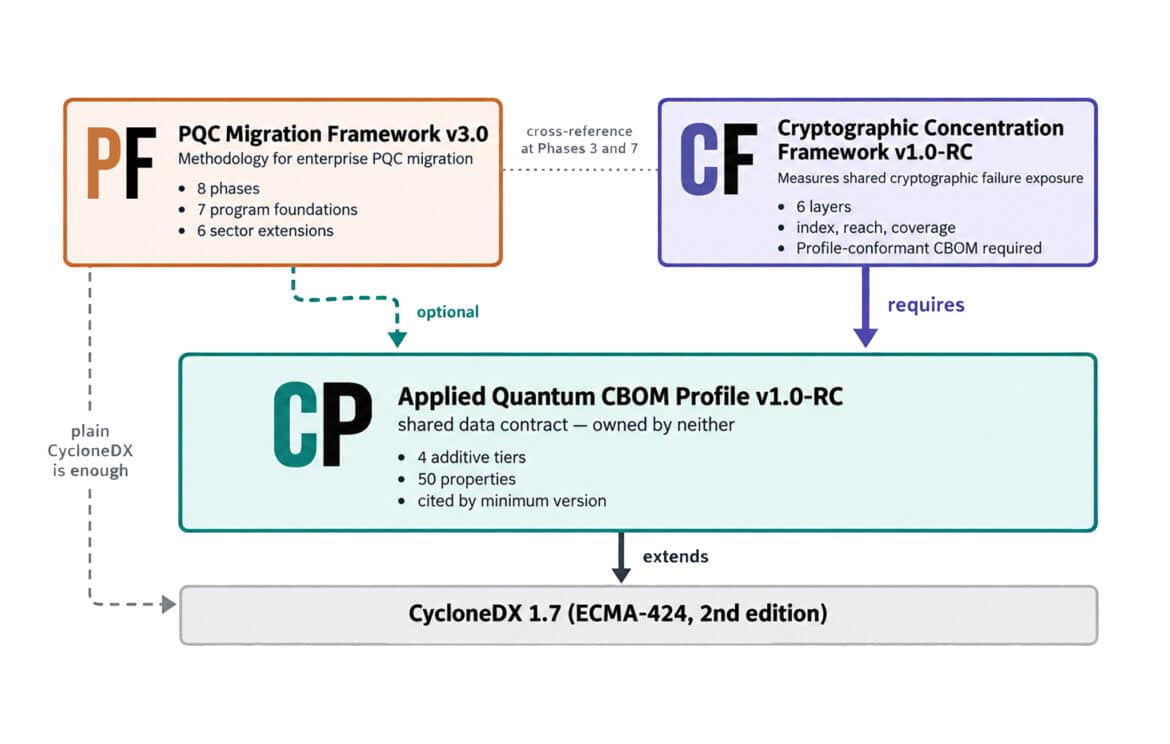
UK post-quantum cryptography provider Post-Quantum released version 3.0 of its migration framework, concurrently introducing a standard configuration specification for Cryptography Bill of Materials (CBOM) to inventory cryptographic assets [11].

[Commercial Significance] It establishes cryptographic agility—the capacity of a system to rapidly swap underlying cryptographic algorithms within a chosen timeframe—as a mandatory acceptance criterion for enterprise security compliance [11].

[Landscape Impact] It drives post-quantum budgets at multinational banks and defense contractors to transition from ad-hoc proof-of-concept projects into recurring, permanent information security expenditures [11].

Dutch quantum-security startup Q*Bird announced a rebrand to Falqon Systems and secured €2.5 million in funding to advance the deployment of its dedicated secure network infrastructure [25][56].

[Commercial Significance] The company’s strategy has officially pivoted from point-solution R&D to turnkey commercial quantum-secure metropolitan area network (MAN) infrastructure [25][56].

[Landscape Impact] It strengthens the pilot network density of physical-layer quantum-safe protections across Western Europe's critical infrastructure communication nodes [25][56].

Industry Applications and Capital Dynamics

North Wales Police in the UK deployed a D-Wave quantum annealing system to optimize emergency dispatch across its jurisdiction, aiming to halve average emergency response times for 500,000 rural residents from 10 minutes to 5 minutes [30].

[Commercial Significance] This represents the world's first benchmark in real-world operations where a public safety department deployed quantum annealing compute to solve dynamic patrol routing and achieved quantifiable operational gains [30].

[Landscape Impact] It forcefully refutes skepticism that quantum annealing cannot generate economic returns in real-world commercial scenarios, earning D-Wave a compelling credential in procurement markets for government, military, and police logistics dispatch [30].

Applications for Innovate UK’s £14.3 million (~$19.3 million) dedicated funding competition for quantum sensing and PNT (Position, Navigation, and Timing) officially closed on September 16, 2026, Beijing Time [66].

[Commercial Significance] The UK government initiated Phase 2 targeted financial support for satellite-denied autonomous navigation and high-sensitivity gravimetry, with individual project grants ranging between £1 million and £3 million over a 12- to 24-month execution timeline [66].

[Landscape Impact] It will directly catalyze commercialization for UK domestic startups developing marine-grade atomic gyroscopes and underground mapping equipment, erecting a strategic supply-chain moat in non-GPS navigation [66].

Japan's TOYO Corporation announced it is opening access to two superconducting quantum computers it procured—the previously acquired 20-qubit IQM Radiance system and the newly ordered full-stack IQM Spark—to Japanese academia and industry [36].

[Commercial Significance] Both hardware systems are scheduled to become fully operational in early 2027, directly aligning with metrics in Japan's National Quantum Strategy to cultivate 10 million domestic users and generate 50 trillion yen in economic value [36].

[Landscape Impact] This deepens the foothold of Nordic superconducting full-stack hardware vendor IQM in the Japanese research market, creating a competitive and cooperative dynamic with indigenous initiatives from Fujitsu and RIKEN [36].

Anyon Computing released an open-source real-time quantum control plane architecture that leverages the NVIDIA NVQLink interface to directly interconnect microwave hardware, superconducting chips, and GPU clusters, compressing the measurement-and-control feedback loop down to microseconds [23][60].

[Technical Significance] By employing RDMA-over-Ethernet protocols, it eliminates data movement bottlenecks between host controllers and heterogeneous compute nodes, providing hardware-level low-latency interconnects for active error correction resets on superconducting qubits [23][60].

[Landscape Impact] It breaks the monopoly of proprietary protocols held by a few instrumentation giants over large-scale quantum control hardware, accelerating the transition of full-stack manufacturing into an era of modular assembly [23][60].

French photonic quantum computing firm Quandela and NVIDIA co-published a technical white paper detailing an integrated architecture that directly connects photonic quantum processing unit (QPU) controllers with GPU servers via the low-latency NVQLink bus [22].

[Technical Significance] It establishes a standard communications conduit for photonic quantum systems to harness external GPU clusters for microsecond-scale error-correction decoding and high-speed electro-optic switch routing control [22].

[Landscape Impact] It tightens the physical integration distance between photonic computing hardware and existing supercomputing center servers, laying down a de facto standard for the scaled deployment of hybrid photonic-quantum cloud nodes [22].

Quantum cloud platform BlueQubit, in partnership with Amazon Web Services (AWS), IBM, and NVIDIA, launched a $150,000 Flywheel Quantum Compute Credit Program to provide hybrid hardware resources to algorithm development and error-mitigated/QEC simulation teams [21].

[Commercial Significance] By bundling pooled compute credits, it locks in early-stage algorithm startups and builds a unified developer traffic gateway across cloud hardware providers [21].

[Landscape Impact] It strengthens stickiness to cross-platform development environments, preventing developers from becoming locked into proprietary software APIs of a single tech giant [21].

University of Sydney spinout Emergence Quantum partnered with major Asia-Pacific data center operator AirTrunk to explore engineering solutions that leverage deep cryogenic quantum technology to curb energy and water consumption in conventional data centers [35].

[Commercial Significance] It laterally transfers cryogenic thermodynamic techniques developed for quantum chip cooling to heat dissipation in conventional high-density server clusters, exploring new pathways to lower Power Usage Effectiveness (PUE) [35].

[Landscape Impact] It establishes a new business model for reverse technology spillover from frontier quantum cryogenics into the trillion-dollar general-purpose data center infrastructure market [35].


05Other

Academic Frontiers

Metrology Standards and Topological Physics

Quantinuum and Sandia National Laboratories jointly released QUOPS (Quantum Operations per Second), a universal benchmark establishing a two-dimensional performance evaluation model centered on computational scale $Q$ and operations per second $\Omega$ [28].

[Technical Significance] It thoroughly abandons isolated point metrics that rely solely on physical qubit counts or gate fidelities in isolation, integrating for the first time physical error-correction compilation overhead, system coherence time consumption, and true hardware clock speeds into a unified formula. Benchmarked against prevailing industry metrics such as Quantum Volume (QV, where Quantinuum Helios previously set a record of $\mathrm{QV} \approx 33.5\text{M}$) and Circuit Layer Operations Per Second (CLOPS), QUOPS bridges physical gate discrepancies across superconducting, trapped-ion, and neutral-atom architectures, offering an absolute ruler to measure net logical operations produced per second when systems execute practical, useful logical tasks [28].

[Landscape Impact] It fundamentally punctures capital bubbles driven by gimmicks of stacking low-quality physical qubits, providing specialized investors and national procurement laboratories with a standardized due-diligence yardstick agnostic to underlying hardware modalities [28].

A research team from TU Wien (Vienna University of Technology), utilizing Quantum Fisher Information theoretical methods, directly detected higher-order macroscopic quantum entanglement within a centimeter-scale strange-metal crystal for the first time [31].

[Technical Significance] This discovery builds a new bridge between solid-state condensed matter physics and quantum information science, confirming that long-range entanglement—previously controllable only in ultracold microscopic atomic gases—can also stably persist in high-temperature, strongly correlated bulk solid-state materials [31].

[Landscape Impact] It provides crucial experimental evidence for exploring non-Fermi liquid superconductivity mechanisms and promises to illuminate new synthesis pathways for novel solid-state topological quantum materials unconstrained by harsh cryogenic environments [31].

npj Quantum Information published a research team's latest security analysis, systematically revealing for the first time a latent security vulnerability induced by the luminescence effect of variable optical attenuators (VOAs) in integrated photonic QKD chips [5].

[Technical Significance] The study demonstrates that integrated optical devices in high-attenuation states produce faint backward spontaneous luminescence, which eavesdroppers could exploit via side channels to deduce internal single-photon modulation states, compromising physical-layer unconditional security [5].

[Landscape Impact] It sounds an immediate alarm for side-channel defenses in chip-scale quantum secure communications hardware globally, compelling international QKD chip testing standards currently under development to incorporate luminescence side-channel leakage detection clauses [5].

A theoretical study published in the same journal derived the distinctive quantum Coulomb drag transport signatures of Majorana bound states—the foundational quasiparticles for constructing topologically protected qubits—on nanowires [7].

[Technical Significance] It establishes steady-state electrical criteria in non-local transport models to differentiate true topological zero-energy modes from trivial disorder-induced Andreev bound states [7].

[Landscape Impact] It provides R&D organizations deeply invested in topological superconductivity, such as Microsoft, with definitive, low-noise electrical testing targets, reducing the risk of squandering R&D budgets on false-positive pseudo-topological signatures [7].

A research team from ETH Zurich and the Paul Scherrer Institute developed a novel particle beam generation scheme, marking a key milestone toward precisely measuring acceleration differences between exotic matter and ordinary matter under gravity [10].

[Technical Significance] The scheme aims to test whether Einstein's equivalence principle still holds in extreme quantum systems composed of antimatter or exotic leptons, probing the theoretical boundary where quantum field theory meets general relativity at microscopic scales [10].

[Landscape Impact] While this fundamental physics experiment represents frontier exploration, its derivative ultra-precision lepton beam modulation technology can directly feedback into engineering high-precision microscopic quantum sensing probes [10].

Researchers constructed an experimental quantum field theory simulation system based on superfluid helium thin films to probe the conditions satisfying the entanglement area law in surface phonon excitations [8].

[Technical Significance] It provides a tunable, tabletop physical platform for simulating black hole event horizon entropy growth and entanglement information dynamics within macroscopic condensed matter fluids [8].

[Landscape Impact] It enriches the arsenal of analogue quantum simulation tools based on macroscopic cryogenic physical phenomena and expands experimental verification methods for many-body entanglement theory [8].

06Impact

Today's Impact

  1. Global Chief Information Security Officers (CISOs) and Core Financial System Developers:

Oracle officially implemented post-quantum hybrid key exchange for TLS 1.3 in Java 27 [57], while Cisco concurrently provided native integration for QKD chip drivers in its backbone router OS, IOS XR [34]. This signifies that post-quantum security is no longer merely a conceptual discussion confined to academic papers and standards bodies; it has transformed into a default, mandatory feature across enterprise runtime software and telecom backbone routing. Affected organizations must immediately initiate comprehensive audits of internal networking libraries and cryptographic assets, with next steps focused on monitoring upgrade-patch handshake latencies under real-world transaction loads and backward compatibility with legacy certificate chains [11][57].

  1. Fault-Tolerant Algorithm Researchers and Quantum EDA System Architects:

The debut of NVIDIA's CUDA-Q Logical platform directly compressed Fermilab's fault-tolerant algorithm design iteration cycle by 7x (from 5 months down to 3 weeks) [2][14], while FNO neural operators accelerated inverse pulse sequence solving by 10 million times [19]. This software-hardware acceleration combination signals that quantum error correction development has formally graduated from artisan trial-and-error into fully automated, end-to-end simulation. Next, hardware labs must closely monitor how accurately this logical platform models their specific underlying physical noise, and whether it risks locking low-level instruction sets into long-term path dependency on specific compute accelerator cards [17][59].

  1. Quantum Hardware Investors and National Industry Fund Analysts:

The QUOPS benchmark jointly advanced by Quantinuum and Sandia National Laboratories [28] establishes a dual-track evaluation framework centered on computational scale $Q$ and operations per second $\Omega$, stripping away the fig leaf of valuation hype based solely on physical qubit counts and isolated pair fidelities. Previously overlooked factors—such as logical qubit error-correction overhead and actual hardware clock cycle rates—will become core variables in due-diligence evaluations. Next, investors should monitor whether top-tier hardware vendors are willing to publish empirical QUOPS curves, which will be decisive in recalibrating commercialization roadmaps across superconducting, trapped-ion, and neutral-atom full-stack system makers [28].

  1. Municipal Emergency Dispatch and Complex Logistics Operations Managers:

North Wales Police's deployment of D-Wave annealing systems toward their target of halving emergency response times to 5 minutes [30] provides a rare, empirically grounded case of quantum annealing compute delivering super-classical advantage in unstructured public administration. This move will prompt budget approvers facing classical operations-research bottlenecks—such as urban traffic signal timing, port freight scheduling, and power microgrid balancing—to re-evaluate the ROI of procuring existing quantum annealing services. The next milestone to watch is whether similar municipal or transportation dispatch contracts scale and replicate across Europe and North America [30].

07Other

Editorial Commentary

Looking across today's technological progression, the quantum information landscape is undergoing a structural paradigm shift from "competing over isolated physical metrics" toward "industrialized closed-loop delivery." At the benchmarking frontier, the QUOPS metric jointly launched by Quantinuum and Sandia National Laboratories explicitly integrates operational speed and error-correction overhead into a top-level yardstick. This marks the end of an era of false prosperity where valuations were inflated merely by stacking uncorrected physical qubit counts and static gate fidelities. Concurrently, across the software toolchain, classical computing giants are unifying high-level logical compilation, lattice surgery mapping, and neural-operator pulse generation, genuinely transforming quantum processing units into schedulable, rapidly calibratable, standardized heterogeneous compute slots within classical supercomputing centers. This architectural overhaul, growing upward from low-level software protocols, will accelerate commercialization timelines far more than any single laboratory record.

Marching in lockstep with the engineering convergence on the compute side, cybersecurity infrastructure is being decisively swept into an inevitable technological overhaul. From plug-and-play quantum chips inside backbone enterprise routers to the default integration of post-quantum key exchange mechanisms within the Java platform powering tens of millions of servers worldwide, post-quantum defense has moved past proof-of-concept trials and fear-driven marketing, landing squarely as an unavoidable, non-negotiable capital expenditure on corporate balance sheets. Capital markets must recognize this watershed moment: closed-hardware R&D silos that fail to integrate into unified software ecosystems and lack end-to-end fault-tolerant compilation capabilities will face punishing liquidity discounts. Meanwhile, pioneers that strategically stake out standardized network retrofit kits, industrial-grade compilation plugins, and battle-tested domain-specific optimizations are already quietly harvesting the first reliable dividends as the industry enters the fault-tolerant era.