Sep 14, 2026 – Sep 15 · Daily Brief

15x Speedup in Quantum Simulation Accelerates Novel Drug Discovery for Major Diseases

45 items · 11 sourcesPDFThis issue's roundup is free
02Hardware

Hardware Frontiers

Silicon Spin Quantum Dots

Iceberg Quantum and Australia's Diraq announced that, through NVIDIA's CUDA-Q Logical architecture, they verified the compatibility of the Pinnacle error-correction scheme on silicon spin hardware, requiring only 150,000 PQs (physical qubits) to achieve a target of 1,000 LQs (logical qubits) [21]. In terms of technical significance, this scheme drives the physical-to-logical qubit ratio down to 150:1; however, compared to current industry-wide state-of-the-art (SOTA) benchmarks—such as Quantinuum's concatenated code at 2:1 and QuEra's neutral-atom high-rate code at 4.7:1—it remains an order of magnitude behind, and currently exists only as an architectural simulation mapping [21]. In terms of landscape impact, benchmarked against our publication's SOTA baseline, the silicon spin modality's actual physical qubit scale remains at the device level of ≤12 qubits, with executable gate counts N_ops (the ratio of coherence time to gate duration) falling within the 10²–10³ range (the lowest among the five mainstream modalities). While a massive engineering chasm remains before deploying 150,000 physical qubits in practice, this achievement charts a theoretical path for silicon-based systems to break free from the prohibitive wiring constraints of conventional surface codes [21].

Silicon Quantum Computing (SQC) utilized customized machine learning scripts and Quokka software to automate the atomic-scale patterning manufacturing process for its Watermelon chip, reducing the single-device fabrication process from several hours of manual operation to mere minutes [17]. In terms of technical significance, incorporating customized machine learning scripts into single-atom-precision chip patterning overcomes the fatal engineering bottleneck where scanning-probe lithography took too long per device and could not scale to mass production [17]. In terms of landscape impact, benchmarked against our publication's SOTA baseline, SQC matched the single-pair trapped-ion record in December 2025 with an F₂Q (two-qubit gate fidelity) of 99.99%. This process acceleration remedies the critical shortcoming of mass-production capability in this modality, and is expected to propel atomic-precision silicon quantum chips toward pilot production lines within the next 1 to 2 years [17].

Superconducting Hardware

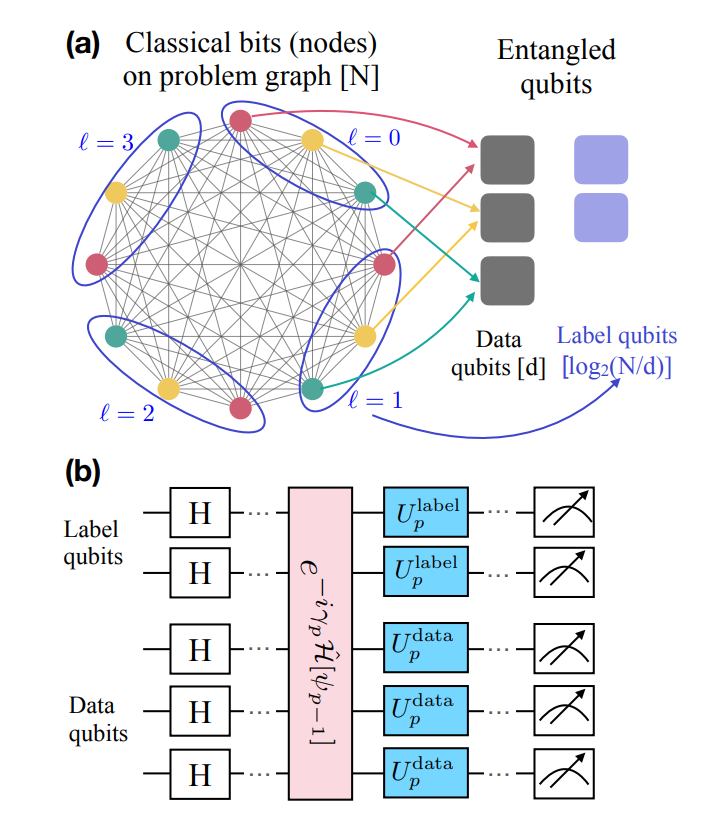
A Rigetti research team published a study in Physical Review Applied, successfully demonstrating an algorithm on a 9-qubit superconducting quantum processor based on the SK model (Sherrington-Kirkpatrick spin-glass model) that solves continuous optimization problems using fewer physical qubits than classical variables [11]. In terms of technical significance, by mapping multiple classical variables onto many-body entangled quantum states, researchers achieved on hardware for the first time a continuous trade-off where variables do not correspond one-to-one with physical qubits, breaking through the rigid constraints on physical qubit counts inherent to conventional superconducting circuits [11]. In terms of landscape impact, benchmarked against the superconducting SOTA baseline (median fidelities of ~99.5% for IBM Heron r2 and Rigetti Cepheus-1), although this algorithm economizes physical qubits, it increases quantum circuit depth; because finite coherence times and two-level system (TLS) defect fluctuations in superconducting devices lead to error accumulation in deep circuits, its near-to-mid-term utility primarily enables existing NISQ (noisy intermediate-scale quantum) devices of tens to hundreds of qubits to solve high-dimensional financial and logistics optimization problems ahead of schedule [11].

(Follow-up report: Following the funding progress reported on September 13, 2026) Rigetti officially finalized a definitive $100 million award agreement under the U.S. Department of Commerce's CHIPS Act, under which the U.S. Department of Commerce will acquire a minority equity stake in Rigetti as a condition of the award; the agreement specifies that funds will be directed entirely toward three key hardware engineering initiatives: developing compact readout electronics, building high-capacity dilution refrigerators, and expanding and upgrading cleanroom manufacturing capabilities at its Fab-1 facility [12]. In terms of technical significance, this incremental development marks the formal execution of a binding final agreement and the transition into R&D and production delivery, focusing squarely on the cryogenic thermal load and readout cabling bottlenecks that arise when scaling superconducting systems to thousands of qubits [12]. In terms of landscape impact, it cements the core position of full-stack superconducting hardware vendors in maintaining independent control over cryogenic processes and wafer fabrication, and is expected to drive delivery of next-generation high-density integrated superconducting chips within 3 years [12].

Kiefer Vermeulen, Head of R&D at Delft Circuits in the Netherlands, stated in an interview preview that the team conducted R&D under an extremely tight budget and aggressive timelines, though specific technical breakthroughs have not yet been disclosed [7]. In terms of technical significance, the interview preview made no mention of specific technical details such as breakthroughs in flexible microwave cabling or reductions in volume and thermal load, and relevant data remains undisclosed [7]. In terms of landscape impact, it offers European and global superconducting hardware startups a low-cost commercial alternative to break their dependency on expensive military-grade cabling [7].

Trapped Ions and Neutral Atoms

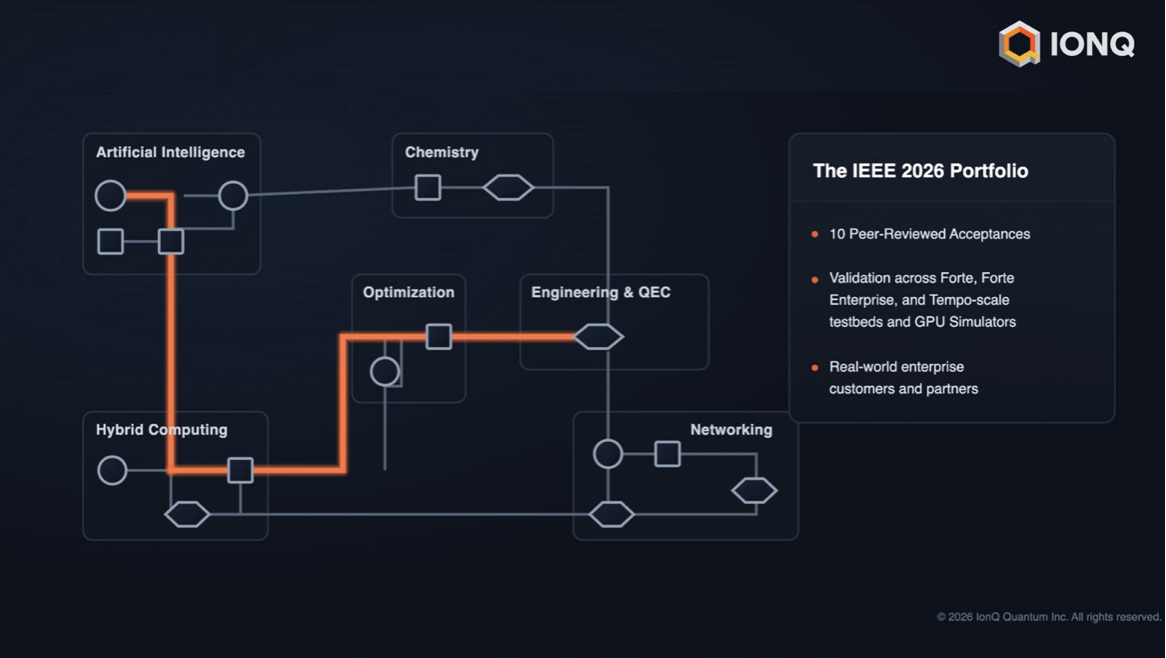
IonQ published 10 peer-reviewed academic papers and garnered 4 awards at the IEEE International Conference on Quantum Computing and Engineering (IEEE QCE26), highlighting benchmark results of hybrid quantum-classical workflows in enterprise computing environments [2]. In terms of technical significance, the papers focused on the empirical deployment efficacy of hybrid quantum-classical workflows in enterprise computing environments, without disclosing specific findings regarding reductions in SWAP gate overhead or compilation efficiency comparisons against superconducting grid topologies [2]. In terms of landscape impact, it accelerates the integration of trapped-ion cloud services into enterprise daily data analytics pipelines, solidifying its commercial deployment edge in financial modeling and chemical simulations [2].

At IEEE Quantum Week 2026, Infleqtion showcased its latest R&D progress in QEC (quantum error correction) utilizing NVIDIA CUDA-Q Logical through an early access program [1]. In terms of technical significance, it establishes a collaborative framework between neutral-atom arrays and a general-purpose GPU logical orchestration layer for the first time, realizing hardware-software co-simulation of physical atom reconfiguration and logical qubit scheduling [1]. In terms of landscape impact, it advances the integration of the neutral-atom modality into mainstream accelerated computing ecosystems and accelerates the standardization of its logical qubit control interfaces [1].

Photonic Quantum and Control Systems

Quantum Machines announced that, leveraging NVIDIA NVQLink high-speed interconnect technology, it successfully executed CUDA-Q programs end-to-end on physical qubits, achieving ultra-low-latency hardware interconnects between PPUs (Pulse Processing Units) and GPU clusters [24]. In terms of technical significance, it breaks through the microsecond-level bus latency bottleneck between classical instructions and pulse generation in conventional quantum control systems, supporting hardware-level ultra-fast feedback control and real-time error-correction decoding pipelines for the first time [24]. In terms of landscape impact, it delivers a standardized hybrid classical-quantum control solution for global superconducting and spin hardware teams, poised to reshape interconnect interface specifications for deploying quantum nodes in supercomputing centers [24].

Anyon Computing released a new open-source quantum control system built on NVIDIA NVQLink, enabling its microwave quantum control clusters and quantum processors to serve as coprocessor nodes integrated alongside GPUs and CPUs within the same supercomputer [13]. In terms of technical significance, the system will be open-sourced in the future to serve as a control plane, supporting collaborative operations between distributed microwave control hardware and high-performance heterogeneous clusters [13]. In terms of landscape impact, it lowers the barrier for third-party research institutions to develop proprietary control infrastructures, driving the evolution of quantum hardware from customized peripherals toward general-purpose data-center expansion boards [13].

French photonic quantum computing company Quandela and NVIDIA jointly released a technical white paper proposing a progressive architectural framework for deeply integrating photonic QPUs (quantum processing units) with GPU computing infrastructure [32]. In terms of technical significance, addressing the high-throughput data streams of measurement-based quantum computing in photonics, the white paper designs a low-latency pipelined matching model between optical pulse transmission and parallel GPU computation [32]. In terms of landscape impact, it provides an engineering implementation roadmap for European supercomputing centers to introduce photonic quantum coprocessors in the future, accelerating the transition of photonic systems from laboratories into supercomputing data halls [32].

03Algorithms

Algorithms and Software

NVIDIA officially launched CUDA-Q Logical, a new extension module for its open-source CUDA-Q platform, providing a programmable and verifiable logical qubit application development orchestration layer for fault-tolerant quantum computing [36]. In terms of technical significance, this module abstracts a standardized logical qubit interface across a multi-platform software stack for the first time, allowing developers to write fault-tolerant algorithms by directly invoking error-correcting code protocols without having to manage disparate underlying physical noise characteristics [36]. In terms of landscape impact, NVIDIA secures a critical strategic vantage point in the progression from physical-layer control to logical-layer applications via CUDA-Q Logical, consolidating the software ecosystems of multiple hardware modalities—including superconducting, trapped-ion, neutral-atom, and silicon-based systems—further into its platform umbrella [36].

Quantum algorithm company Phasecraft announced the deep integration of its hardware-adaptive quantum algorithms with NVIDIA's computing platform, achieving a 15x computational speedup in biomolecular simulation collaborations under the Wellcome Leap Q4Bio program [37]. In terms of technical significance, by deeply compressing quantum circuit depth and working in tandem with classical tensor network acceleration, the algorithm bridges the bottleneck of prohibitively long simulation times for complex biomolecules, approaching chemical accuracy requirements with minimal gate overhead [37]. In terms of landscape impact, it confirms that prior to the arrival of fully fault-tolerant quantum computers, algorithmic optimization paired with heterogeneous acceleration can unlock practical value early in high-value sectors such as biomedicine, which will prompt multinational pharmaceutical companies to increase R&D investment in dedicated quantum simulation algorithms over the next 1 to 2 years [37].

Quantum error mitigation software startup Qedma announced the integration of its QESEM software into the NVIDIA CUDA-Q platform, currently supporting Quantinuum hardware with plans to expand to additional platforms in the future [35]. In terms of technical significance, QESEM automatically characterizes and cancels physical gate noise during compilation, delivering multi-fold output fidelity improvements on hardware before full QEC is achieved [35]. In terms of landscape impact, it directly enhances the data utility of high-precision hardware such as Quantinuum during the commercial exploration phase, extending the viable lifespan of NISQ devices in specific application scenarios [35].

Theoretical researchers achieved a breakthrough in quantum simulation optimization by successfully stabilizing the minimum-step stochastic reconfiguration method, outperforming conventional optimization techniques in both convergence speed and precision across benchmarks such as the 1D transverse-field Ising model [23]. In terms of technical significance, this effectively mitigates the training instability of recurrent neural networks when representing complex many-body quantum states, enabling efficient training of complex quantum states under finite data constraints [23]. In terms of landscape impact, it significantly reduces the computational threshold for leveraging classical neural networks to assist in designing quantum error-correcting codes and analyzing material phase transitions [23].

The 2026 Quantum Programming Languages and Semantics School (QCOMICAL School 2026) announced it will be held from November 16 to 20, 2026, focusing on formal verification of quantum programs and type-system semantics [8]. In terms of technical significance, the school aims to establish an unambiguous formal mathematical semantic foundation for next-generation fault-tolerant quantum compilation systems [8].

04Industry

Industry and Ecosystem

Canadian photonic quantum computing company Photonic Inc. officially announced its "Project VANGUARD" proposal, planning to invest C$500 million (approximately $359.1 million) to establish a multi-tenant semiconductor fabrication and advanced packaging facility in Vancouver [10]. In terms of commercial and technical significance, this project targets the critical capacity bottleneck in cryogenic co-packaged optics for quantum computing and advanced process chips, mitigating overreliance on overseas foundries through shared domestic infrastructure [10]. In terms of landscape impact, this represents Canada's largest quantum-dedicated semiconductor infrastructure investment proposal to date; if approved, it will establish North American sovereign supply capabilities in silicon photonic quantum chip packaging, reshaping the global division of labor in the photonic quantum supply chain [10].

(Follow-up report: Following developments disclosed at the recent Quantum World Congress) The U.S. government is coordinating a comprehensive support initiative totaling over $2 billion aimed at accelerating the establishment of a domestic quantum manufacturing base [18]. In terms of commercial significance, this funding marks a systematic transition from past pure R&D subsidies focused on academic research topics to supporting industrial-scale supply chains for dilution refrigerators, ultra-low-noise amplifiers, and specialty lasers [18]. In terms of landscape impact, the United States is fortifying a quantum manufacturing moat through industrial policy barriers, which is expected to widen the industrial generation gap over the next 3 to 5 years against nations lacking a domestic manufacturing base [18].

The U.S. National Science Foundation (NSF) announced a two-year, $20 million pilot fund dedicated to helping small businesses bridge the commercialization gap for deep-tech innovations [33]. In terms of commercial significance, this program bridges the "valley of death" between basic research in federal laboratories and commercial venture capital, supporting enterprises through critical engineering validation from prototypes to industrial-grade products [33]. In terms of landscape impact, it provides vital non-dilutive seed capital for domestic U.S. quantum hardware and software startups, accelerating the pace of commercial monetization for cutting-edge breakthroughs [33].

Quantum development platform BlueQubit announced the launch of its "Quantum Flywheel" research grant program, backed by $150,000 in dedicated funding and supported by IBM, Amazon Web Services (AWS), and NVIDIA's accelerated computing platform [34]. In terms of commercial significance, recipient research teams will receive three months of cross-platform cloud compute credits across QPUs, CPUs, and GPUs, alongside cutting-edge model resources [34]. In terms of landscape impact, cloud hyperscalers are competing via third-party aggregator platforms for the next-generation quantum algorithm developer ecosystem, deepening user stickiness for multi-cloud hybrid access [34].

The GSM Association (GSMA) and QCentroid jointly launched a quantum application framework for the telecommunications industry, prioritizing and advancing two key deployment use cases: network topology optimization and telecom fraud prevention [25]. In terms of commercial significance, an authoritative industry body has established a standardized evaluation methodology for telecom operators entering quantum computing, enabling carriers to quantitatively assess the return on investment (ROI) of hybrid computing in network scheduling [25]. In terms of landscape impact, it sets a clear roadmap for telecommunications network infrastructure to transition toward quantum-safe and quantum-enhanced computing, driving the placement of the first commercial B2B telecom contracts over the next 1 to 2 years [25].

Palo Alto Networks' Quantum Security Solution (QSS) officially received FedRAMP (Federal Risk and Authorization Management Program) "Moderate" impact level compliance authorization [15]. In terms of commercial significance, this enables federal agencies to compliantly procure its automated cryptographic asset discovery and inventory tools directly, fulfilling statutory mandates from the U.S. government regarding post-quantum cryptography migration [15]. In terms of landscape impact, it signals that post-quantum cybersecurity tools are definitively transitioning from technical validation to federal procurement monetization, with legacy cybersecurity giants establishing early regulatory barriers to entry [15].

German security technology company GECCO established a strategic partnership with enclaive to roll out post-quantum confidential computing solutions tailored for edge computing nodes such as smart hospitals and electrical substations [16]. In terms of commercial significance, this solution tightly couples post-quantum cryptographic algorithms with hardware-level confidential container technology, closing a critical security gap for edge endpoints operating in physically vulnerable environments [16]. In terms of landscape impact, it extends the critical infrastructure defense perimeter from centralized data centers out to edge nodes [16].

Quantum Computing Inc. (QCi) signed a three-year framework collaboration agreement with Hamad Bin Khalifa University (HBKU) in Qatar to conduct joint R&D and talent development across quantum computing, quantum sensing, and quantum communications [22]. In terms of commercial significance, QCi leverages overseas academic partnerships to expand into Middle Eastern emerging technology markets and cultivate localized application ecosystems [22].

Zapata Quantum CEO Sumit Kapur disclosed in an interview that after navigating SPAC (special purpose acquisition company) volatility and a capital winter, the company completed a business restructuring to focus squarely on high-value vertical applications, noting its cancer research breakthrough previously graced the cover of Nature Biotechnology [9]. In terms of commercial significance, this confirms that for pure-play quantum software companies in the pre-fault-tolerant era, deep integration with real-world industries possessing acute pain points—such as biomedicine—is essential to sustaining healthy cash flows [9].

Cloq, a quantum spinout from the University of Oxford, took top honors at the 4th Reuben Entrepreneurship Forum, showcasing its commercialization vision in ultra-high-precision laser physics and quantum timing [31].

The U.S. National Science Foundation awarded a $2 million grant to Middle Tennessee State University's (MTSU) QRISE Center, supporting graduate students in conducting frontier quantum and AI research at Oak Ridge National Laboratory [20]. This move strengthens the engineering talent pipeline between U.S. national supercomputing laboratories and regional universities [20].

05Other

Academic Frontiers

A research team achieved an important breakthrough in quantum communication and cloning theory, demonstrating that using only local BSMs (Bell state measurements, a type of two-qubit entangled projective measurement), symmetric N-to-M telecloning can be realized across spatially separated nodes with fidelities strictly achieving the theoretical limits dictated by the no-cloning theorem [14]. In terms of technical significance, previous quantum cloning operations reaching this theoretical limit were strictly confined to single network nodes, as distributed cross-node cloning often demanded complex multi-qubit global joint measurements; the new technique completely circumvents this complex hardware obstacle using pairwise entanglement measurements alone [14]. In terms of landscape impact, it offers a highly engineering-viable, simplified architecture for long-haul distributed quantum communication networks, entanglement repeaters, and quantum state backup and distribution [14].

Theoretical physicists successfully established theoretical upper bounds on the sample complexity of quantum Rényi entropy and Tsallis entropy for arbitrary order α, rigorously proving that the sample size required for measurement satisfies O(d^(1+1/α) / ε^(1/α)), where d is the quantum system dimension and ε is the error tolerance [19]. In terms of technical significance, this result substantially improves upon previous measurement protocols proposed by Acharya et al. and Chen et al., while strictly matching the theoretical lower bound previously proven by Wang et al., achieving an asymptotically optimal bound for entropy estimation of quantum many-body mixed states [19]. In terms of landscape impact, it drastically reduces the volume of experimental data needed to characterize entanglement purity and thermodynamic entropy of high-dimensional many-body quantum states in the laboratory, rendering tomographic verification of complex quantum states significantly more practical [19].

An international collaboration including University of Oxford physicists confirmed the presence of quantum entanglement between pairs of extremely heavy, ultra-short-lived top quarks in ultra-high-energy collisions at CERN's Large Hadron Collider (LHC), with findings published in Physical Review Letters [4]. In terms of technical significance, the study confirms the existence of quantum entanglement under extreme physical conditions of fundamental particles at tera-electronvolt (TeV) energy scales for the first time, breaking through the traditional perception that quantum information measurements are confined to low-energy solid-state or optical systems [4]. In terms of landscape impact, it inaugurates a new frontier at the intersection of high-energy physics and quantum information, establishing an experimental foundation for probing quantum physics with ultra-high-energy states in the future [4].

Experimental physicists utilized a one-dimensional ultracold cesium optical lattice system to successfully observe "Bethe strings," multi-particle quantum bound states predicted by physicist Hans Bethe in 1931 [5]. In terms of technical significance, it proves that in strictly one-dimensional systems, particles can condense into stable bound states solely through pure quantum many-body interactions without chemical bonds, putting an end to nearly a century of purely theoretical conjecture surrounding this foundational quantum hypothesis [5]. In terms of landscape impact, it establishes the gold-standard status of ultracold atom simulators in validating integrable many-body systems and strongly correlated physical models [5].

Researchers developed a precise temporal and spectral wave-packet shaping technique for single photons, achieving high-efficiency emission and absorption matching for flying photons across disparate physical nodes [3]. In terms of technical significance, it eliminates absorption cross-section losses caused by wave-packet asymmetry in heterogeneous physical qubit emission, surmounting the technical barrier of steep fidelity drops in optical interconnects between solid-state memories and atomic qubits [3]. In terms of landscape impact, it provides a core physical-layer interface solution for constructing heterogeneous quantum internets interconnecting superconducting, trapped-ion, and photonic systems [3].

Theoretical physicists published a feature discussion in Physics World, proposing a new model that utilizes entropic gravity theory and quantum information metrics to explain the evolution of low-entropy regions in the early universe [6]. In terms of technical significance, it introduces holographic entanglement entropy and the law of quantum information conservation into cosmological macroscopic gravitational field equations, providing a microscopic quantum-information perspective for inflation theory [6].

06Impact

Today's Impact

  1. Quantum Hardware Manufacturing and Packaging Supply Chain (Impacted: North American semiconductor manufacturers and full-stack quantum system teams) [10][12][18]

What Changed: The U.S. government's coordination of a >$2 billion manufacturing initiative, Rigetti's finalized $100 million CHIPS Act award, and Photonic Inc.'s proposed C$500 million dedicated packaging center in Canada collectively signal that quantum hardware is moving definitively past the workshop phase of opportunistic pilot runs in generic commercial fabs, transitioning into dedicated industrial manufacturing ecosystems capable of cryogenic optoelectronic integration.

What to Watch Next: Track the approval progress of matching government subsidies for Canada's Project VANGUARD, as well as empirical benchmarks for chip readout crosstalk and fabrication yields following Rigetti's Fab-1 cleanroom expansion.

  1. Supercomputing Centers and Hybrid Compute Orchestration Architectures (Impacted: Heterogeneous computing center administrators and systems software engineers) [13][24][36]

What Changed: NVIDIA's release of the CUDA-Q Logical orchestration layer, alongside Quantum Machines and Anyon Computing achieving ultra-low-latency interconnects between pulse control planes and GPU compute clusters via NVQLink, transforms quantum processors from remote peripherals reliant on sluggish network API calls into direct coprocessors sitting on unified supercomputing buses alongside GPUs.

What to Watch Next: Track compilation overhead for CUDA-Q Logical across underlying hardware backends (particularly neutral atoms and silicon spin), as well as end-to-end throughput of microsecond-level real-time error-correction decoding pipelines on physical hardware.

  1. Computational Biology and Drug Discovery Institutions (Impacted: Multinational pharmaceutical R&D divisions and computational chemists) [9][37]

What Changed: Phasecraft's 15x computational acceleration in health simulation projects, combined with Zapata's commercial achievements in oncology research, dismantles the conventional pessimistic assumption that practical molecular problems must await million-qubit fault-tolerant systems, demonstrating that early error mitigation/correction combined with hardware-adaptive algorithms can already deliver throughput beyond classical computing in specialized biomedical regimes.

What to Watch Next: Observe whether leading global pharmaceutical players disclose procurement budgets for hybrid quantum computing targeting specific oncological or rare-disease targets in upcoming quarterly earnings reports.

  1. Enterprise and Government Cybersecurity & Compliance Officers (Impacted: Federal agency CISOs and cloud security architects) [15][16]

What Changed: Palo Alto Networks' QSS achieving FedRAMP Moderate compliance certification indicates that post-quantum cryptographic defense has transitioned from exploratory drills and technical R&D into mandatory compliance enforcement within U.S. federal procurement, while post-quantum confidential computing at edge endpoints is making inroads into power grid and healthcare infrastructure.

What to Watch Next: Follow forthcoming solicitations and RFPs published by U.S. federal agencies for cryptographic asset discovery and remediation, alongside actual order conversion rates for cybersecurity incumbents' post-quantum subscription services.

07Other

Editorial Commentary

Quantum computing is undergoing a profound paradigm shift: transitioning from a "race over isolated physical benchmarks" to "system-level engineering architecture construction." For years, industry discourse has fixated disproportionately on physical qubit counts on a chip or gate fidelities between specific qubit pairs, overlooking the systemic chasm that must be crossed to advance from laboratory prototypes to industrial-grade computers. Today's technical developments—whether direct bus-level integration between control hardware and classical compute clusters, or the abstraction of standardized logical qubit orchestration frameworks at the top of the stack—clearly demonstrate that quantum computing is becoming fully integrated into the modern heterogeneous supercomputing landscape. The competitive core is shifting away from isolated physical device exploration toward full-stack engineering co-design, spanning dedicated cryogenic manufacturing, microsecond-level real-time error correction, and high-level software ecosystems.

Concurrently, the logic governing capital allocation and industrial policy is undergoing a qualitative transformation. Proposals for dedicated manufacturing hubs reaching hundreds of millions of dollars and finalized federal appropriations underscore the strategic clarity of major technological powers regarding core hardware supply chains: without sovereign, controlled advanced processes, cryogenic optoelectronic packaging, and high-precision control components, any grand vision of fault-tolerant universal quantum computing will remain castles in the air. For all industry participants, a consolidation phase has quietly begun. Teams that remain confined to proof-of-concept demonstrations without stable engineering manufacturing foundations and clear hardware-software co-design roadmaps will face increasingly severe survival challenges, while modalities that take root early in industrial closed loops will accelerate the realization of their long-term value.