Light's "curveball" measured for the first time: the strongest interaction point of a tightly focused laser is not at the beam center
Researchers have for the first time experimentally demonstrated the optical Magnus effect (the Magnus effect being the phenomenon in which a spinning object deviates from a straight line in a fluid), finding that the position where a tightly focused laser interacts most strongly with atoms is slightly offset from the beam's geometric center, by a mechanism analogous to a spinning ping-pong ball curving in flight [18]. The reporting notes that because lasers are precisely the means of manipulating qubits, the effect may introduce gate operation errors, but the same sentence also states that it may offer a new route to coupling qubits together [18].
Technical implication: this is both a "new error source" type of result — its value lying in identifying a physical mechanism for one of the error terms previously filed under unknown origin — and possibly a lead on a new coupling mechanism; the source presents both possibilities side by side. Both the trapped-ion and neutral-atom routes use focused lasers to address individual qubits, and an offset between the beam spot center and the atom's actual point of strongest interaction manifests directly as addressing crosstalk and gate phase error.
What's still missing: the reporting gives no magnitude for the offset or a corresponding estimate of fidelity loss. This number is critical — if the error introduced by the offset is below the 10⁻⁵ level, it has no practical impact on current two-qubit gate performance of 99.5%–99.99%; if above 10⁻⁴, it eats into the error budget for the trapped-ion route's push toward 99.99% (Oxford Ionics' reported gate error is 8.4×10⁻⁵, this brief's archived data, not from this issue's sources, pending verification).
Landscape impact: what's affected is every hardware team using laser addressing and their calibration procedures — the good news is that once the mechanism behind such a systematic offset is clear, it can usually be compensated via calibration rather than requiring a hardware redesign. Timeline: months to work into calibration procedures.
Stevens team proposes a new laser method improving quantum state control under strong fields
A "Stevens team" has developed a new laser method for precise control of quantum systems, targeting the problem of disturbances caused by strong fields [13]; the source does not spell out the full institutional name, so the attribution remains to be confirmed.
Technical implication: this points to the same class of problem as the preceding item on the optical Magnus effect — the non-idealities introduced by the laser itself as a control mechanism. Control precision in the strong-field regime is an unavoidable trade-off when raising gate speed: increasing laser power shortens gate time (superconducting t₂Q is 20–100 ns, trapped ion 10–500 µs, and trapped ions' slow gate times are precisely one of their scaling bottlenecks), but the disturbances introduced by strong fields eat into fidelity.
Landscape impact: if the method transfers, the most direct beneficiaries are gate-speed optimization paths for trapped ions and neutral atoms; the reporting gives no quantitative improvement figure, so for now it counts as methodological progress.
Kyushu University proposes a "relativity of spacetime superpositions" framework, noting that quantum gravity experimental signatures may be hard to distinguish from ordinary gravity
Researchers at Kyushu University have proposed a framework called "Relativity of Spacetime Superpositions" for identifying experimental signatures of quantum gravity [4].
Technical implication: the thrust of this result is to dampen experimental enthusiasm rather than fuel it — if the experimental signals of quantum gravity can be mimicked by ordinary gravitational effects, then the criteria used by a whole set of existing "tabletop quantum gravity experiments" will need to be redesigned.
Landscape impact: the scope is limited to fundamental physics experiment design, with no direct bearing on quantum computing engineering; it constitutes a new constraint on proposal review for the relevant experimental groups.
IFAE uses levitated milligram-scale magnets as force sensors to search for ultraheavy dark matter
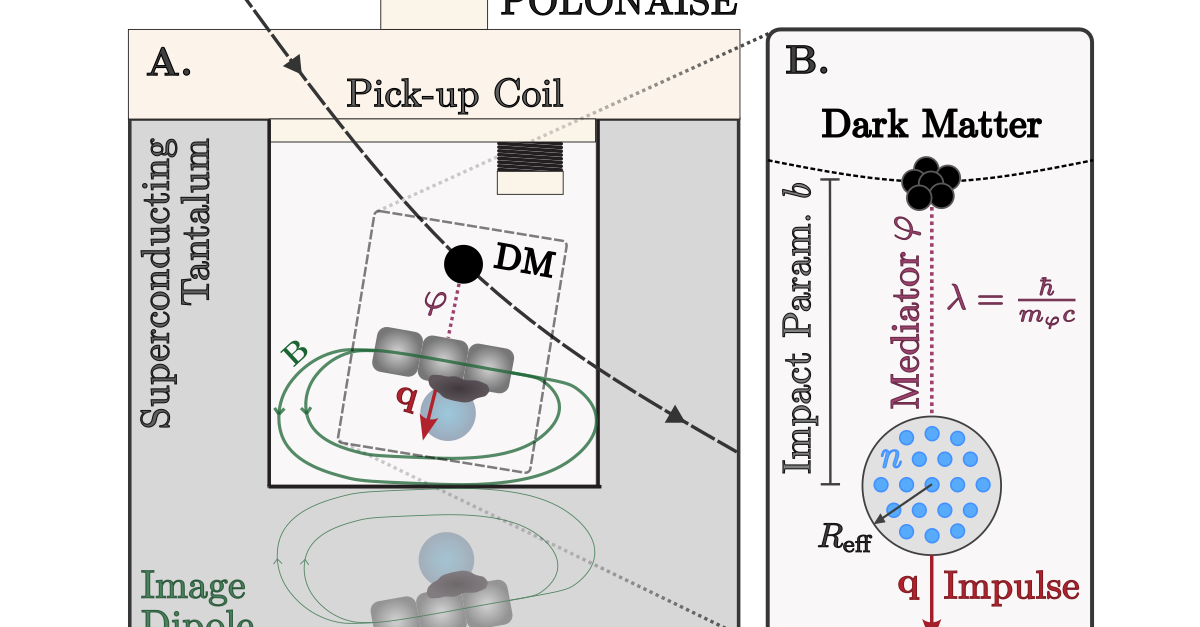
Research co-authored by Dorian Amaral of IFAE (Institut de Física d'Altes Energies) explores using levitated milligram-scale magnets as force sensors to detect ultraheavy dark matter.[11]
Technical implication: this is a classic path by which quantum sensing technology feeds back into fundamental physics — the displacement sensitivity of levitated magnets rests on cryogenics and superconducting quantum interference measurement, sharing the same cryogenic engineering infrastructure as quantum computing [7].
Landscape impact: what's affected is the spectrum of experimental approaches to direct dark matter detection, offering a miniaturized route alongside conventional large-volume detectors.
Monash University predicts that Bose-Fermi mixtures can form stable "quantum droplets"
Researchers at Monash University's School of Physics and Astronomy predict that boson-fermion mixtures can form stable "quantum droplets," a conclusion that challenges existing theory of ultracold particles [5].
Technical implication: quantum droplets are a state of matter whose shape is sustained by quantum fluctuations rather than conventional interactions; predicting their stable existence in Bose-Fermi mixtures extends a picture previously established mainly in Bose mixtures.
Landscape impact: this belongs to fundamental ultracold atom theory and shares an experimental platform with neutral-atom quantum computing (the same optical lattice and magneto-optical trap equipment); theoretical progress may in turn inform state preparation schemes for atom arrays.
Metasurface-nanoparticle hybrid structure improves infrared upconversion imaging
Researchers have enhanced infrared-to-visible upconversion imaging using a hybrid metasurface and nanoparticle structure, opening possibilities for quantum infrared sensing by strengthening light-matter interaction [6].
Technical implication: the point of infrared upconversion imaging is to bypass expensive infrared detectors — move the infrared signal into the visible band and a cheap silicon-based camera can capture it.
Landscape impact: if the efficiency can be raised, what's affected is the cost structure of infrared imaging, with applications spanning night vision, gas detection, and medical imaging; quantum infrared sensing is a further-out application layer.
Electron microscopes connected to quantum computers, aiming to squeeze more information out of every electron
Researchers are combining electron microscopes with quantum computers, aiming to extract far more information from each electron than is currently possible, so that faint details can be resolved with fewer electrons, protecting fragile samples that conventional microscopy would damage [17].
Technical implication: the physical basis for this direction is quantum-enhanced measurement — the limit on measurement precision is set not by the detector but by the quantum state of the probing particles. For biological samples, electron dose is damage dose, and reducing the electron count means extending sample lifetime.
What's still missing: the reporting does not explain the specific role the quantum computer plays or the information-gain factor already achieved. Until these figures appear, this should count as a concept demonstration.
Landscape impact: what's affected are the sample limitations of structural biology methods such as cryo-electron microscopy (cryo-EM); if it holds up, the timeline is several years.
The brain is not a quantum computer: decoherence times are off by ten orders of magnitude
A quantitative accounting of "is the brain a quantum computer" returns a negative verdict: Tegmark's calculation from 2000 gives a superposition lifetime inside microtubules of about 10⁻¹³ seconds, and about 10⁻²⁰ seconds for superpositions spanning the scale of a single neuron, while neurons operate on timescales from a ten-thousandth of a second to 1 second [12]. The gap is ten orders of magnitude — not a close score [12].
Technical implication: this is not a new calculation but a way of pulling a recurring public debate back to the numbers. For comparison, engineered quantum systems require extreme measures to push coherence times into a useful range — superconducting T₁ is about 100 µs (Willow, roughly a 5× improvement over Sycamore; this brief's archived data, not from this issue's sources, pending verification), requiring millikelvin cryogenics; trapped-ion clock states can reach seconds to minutes, requiring ultrahigh vacuum and laser cooling. The human brain is a warm, wet 37°C environment where none of these conditions hold.
Landscape impact: what's affected is the "quantum consciousness" narrative and its associated fundraising rhetoric; it does not negate serious quantum biology (such as avian magnetoreception or photosynthetic energy transfer), where coherence time requirements are far lower.