Trapped Ions
Quantinuum fills in the compute piece of error correction
Quantinuum released measured results for the Helix architecture on Helios: logical storage, Clifford computation (a class of basic gate sets that can be efficiently simulated classically), and inter-code interfaces all realized on the same compact error-correcting code, with no reliance on post-selection at any point[2].
Technical significance: post-selection means discarding failed runs after the fact and tallying only the successful data, and it has long been the most-questioned methodological issue in logical-qubit demonstrations; remove that step, and the reported logical error rate becomes a full-match score rather than a highlight reel. Against current baselines, the report states only that this is a compact error-correcting code; Helios's qubit count, two-qubit gate fidelity, and physical-to-logical encoding ratio are not disclosed within it (the relevant figures mostly appear in the company's own announcements and await independent verification) — this is not a new fidelity record but the filling-in of one more capability dimension on the same hardware. What's still missing: non-Clifford gates (the magic-state-injection class, which determines whether universal computation is possible) and sustained long-duration operation; the report frames that gap as the next step.
Competitive impact: the trapped-ion camp continues to counter the neutral-atom route's scale advantage in qubit count with logical-qubit quality; for buyers, whether post-selection was used is becoming a mandatory field on the due-diligence sheet, on a timescale of quarters.
Clarendon Laboratory proposes a scheme for 200,000 atom-atom entangled pairs per second
A temporal- and wavelength-multiplexed protocol based on cavity-assisted photon scattering predicts generation of 2×10⁵ atom-atom Bell pairs (the most basic two-body entangled state) per second, with a predicted heralded fidelity of 0.999 and no need for intracavity qubit reset[22].
Technical significance: this is a proposal with numerical predictions, not yet validated on hardware; the source also gives no comparable baseline rate from existing experiments, so whether it pans out awaits an experimental group picking it up. Competitive impact: remote entanglement rate is the hard bottleneck in stitching many small machines into one large one, and also the rate-limiting link in quantum network repeaters; if an experimental group takes up and reproduces this protocol, the modular-architecture route would be affected fastest, on a timescale of years.
Photonics and Quantum Communication
The attenuator inside a QKD chip is emitting light on its own
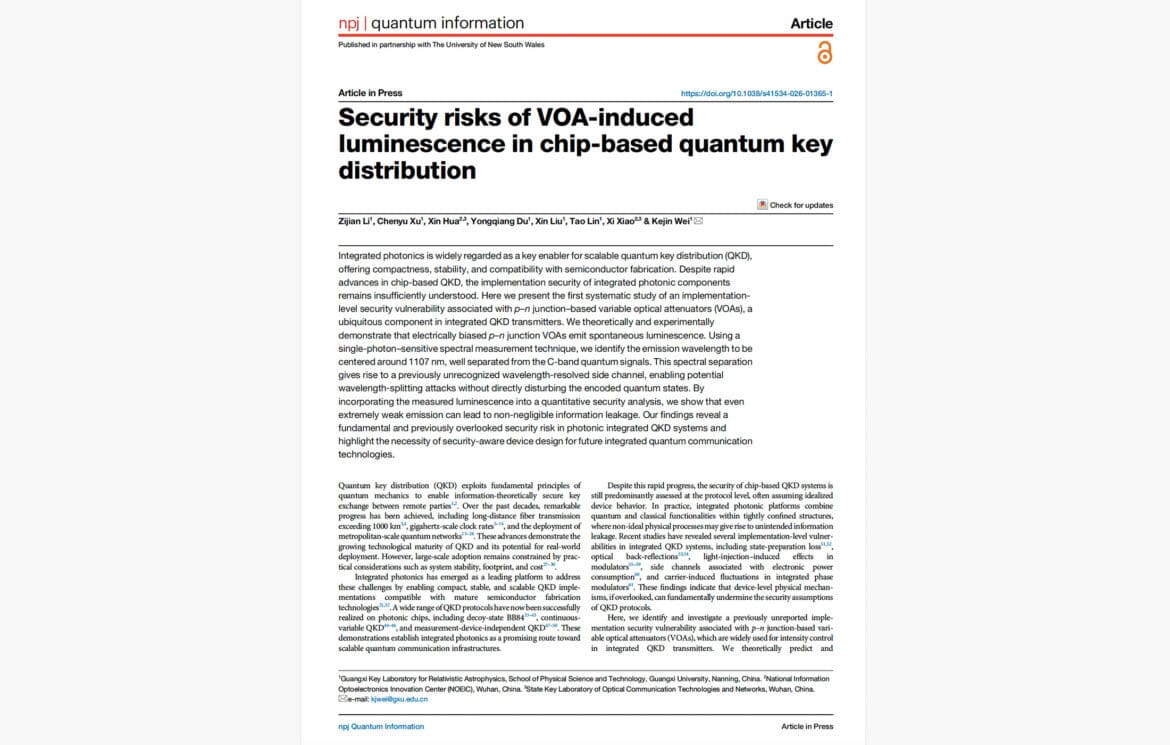
A peer-reviewed study found that the variable optical attenuator in integrated QKD (quantum key distribution, an encryption method that distributes keys using photons) chips emits unintended light near 1107 nanometers, and that this light forms a wavelength-distinguishable side channel that standard BB84 security analysis does not account for[3].
Technical significance: QKD's selling point is that security is guaranteed by the laws of physics, but that guarantee covers only the degrees of freedom written into the security proof; the attenuator's emission is unintended device-level radiation, an item the proof simply does not contain — a textbook implementation loophole rather than a protocol loophole. This is not a theoretical derivation but an emission spectrum measured on an actual chip.
Competitive impact: every QKD vendor pursuing on-chip integration, plus telecom and government customers currently running QKD procurement certification, is directly affected — security proofs need supplementary device modeling, and certification processes need a wavelength-scan item added; for deployed systems this is a patch cycle rather than a teardown, on a timescale of months.
Superconducting
A quantum memory scheme stores signals for 620 microseconds
Researchers used a new quantum memory technique to improve the coherence performance of superconducting qubits, storing signals for up to 620 microseconds[24].
Against baselines: the source gives only the single figure of 620 microseconds, with no coherence-time comparison for equivalent superconducting devices; moreover, a memory device's retention duration and a qubit's own T1 (energy relaxation time, how fast a qubit forgets its own state) are not the same metric and cannot be placed side by side as a record. What's still missing: superconducting's perennial problem is defect-induced timing drift, and beyond a single best value one must look at the long-term stability distribution.
Competitive impact: synchronization and buffering capability determine the efficiency of multi-qubit scheduling, and the major superconducting players' compiler layers can absorb components like this directly — an incremental improvement, not a change of route.
Neutral Atoms
Controlling where atoms are lost improves logical error rates 5.3× under realistic conditions
A new optimization method folds atom loss (an error mode specific to neutral-atom arrays: atoms escaping from the optical tweezers) into the design variables of the error-correcting code, improving logical error rates in up to 73% of tested scenarios, with a 5.3× gain under realistic conditions[23].
Technical significance: previously this route mainly cared about how many atoms were lost; this work turns where in the code they are lost into an actively manageable quantity. Against baselines: neutral atoms' strength has always been array scale, with weaknesses in cycle repetition rate (typically 1–10 Hz) and mid-circuit measurement; atom loss is a derivative problem of the latter, and what improves here is the error-correction-layer strategy, leaving the hard constraint on repetition rate untouched.
Competitive impact: the error-correction stacks at QuEra, Pasqal, and Atom Computing can absorb compile-time optimizations like this without changing hardware, with effects on a timescale of quarters.
Materials and Devices
University of Vienna etches atomic-scale holes in white graphene
A team led by Jani Kotakoski used electron irradiation combined with oxygen to precisely shape atomic-scale holes in hexagonal boron nitride (the two-dimensional insulating material commonly known as white graphene)[19]. Technical significance: controllable hole position and size is a prerequisite for turning single-photon emitters into reproducible devices; previously such defects were largely generated by chance. Competitive impact: affects the materials supply side for single-photon sources and quantum sensing, still years away from a device product.
The hydrogen defects dragging down diamond sensors are fully traced
DEER spectroscopy revealed an X ensemble defect whose vacancy and interstitial components disappear before 650°C, while vacancy clusters persist up to 1000°C[13]. Technical significance: assessing irradiation's effect on diamond quantum sensing has previously required analyzing the processing stage and the growth stage separately; this work connects the defect's evolution from creation through annealing into a single complete picture. Competitive impact: diamond quantum sensor manufacturers now have an evidence-based temperature boundary for their annealing process window — a process-parameter-level improvement.