Trapped Ion
Quantinuum achieves a per-round qubit error rate of 4.6×10⁻⁵ on Helios
On September 9, 2026, Quantinuum released results for Helix running on the Helios system: a per-qubit per-round error rate of 4.6×10⁻⁵, with syndrome (error signature — the error fingerprint read out repeatedly during error correction) measurements across 20 rounds yielding a 99.925% fidelity lower bound for a logical GHZ state[50].
Beyond these two figures, the source discloses nothing about two-qubit gate fidelity across all qubit pairs on the commercial Helios system, the number of fully error-corrected logical qubits, or the physical-to-logical encoding ratio. The significance here is that the verifiable lower bound on logical state fidelity has been pushed to the same order of magnitude as physical gate fidelity — and it still holds after 20 rounds of repeated measurement, rather than being a single-shot snapshot.
What's still missing: ion transport overhead and circuit repetition rate remain the scaling bottlenecks for this route, and the structural limit keeping qubit counts in the tens-to-hundreds range is unchanged by this result.
Integrated laser chip drives single-qubit gates to 99.61%
Researchers used an integrated laser chip rather than a tabletop bulk-optics system to drive trapped ions, achieving 99.61% single-qubit gate fidelity and generating two-qubit entanglement at 92.35% fidelity[33].
Technical significance: the novelty lies not in the fidelity figures — the best published trapped-ion single-qubit gate performance is Helios's 99.9975%, and single-pair two-qubit gates have reached 99.99%, so 92.35% two-qubit entanglement lags by nearly three orders of magnitude in error — but in relocating coherent control that previously required bulky optical benches onto a compact photonic chip.
Landscape impact: who is affected is clear — every vendor hoping to push trapped ions from rack scale to volume-production scale, for whom optical path volume and alignment stability are the wall that gets hit before fidelity does; but until integrated optics pull two-qubit fidelity back above 99.9%, this route remains engineering pre-research.
Superconducting
IQM's logical-qubit machine named LUMI-IQ, funded jointly by four countries
Following the 09/09 report on the 300-qubit Radiance roadmap from IQM and VTT, IQM has disclosed another upgrade path: LUMI-IQ, a superconducting system aimed at logical qubits, will be deployed at Finland's LUMI supercomputing site, jointly funded by Finland, the Czech Republic, Norway and Poland and delivered in stages, starting in 2027 with an IQM Halocene H4 — 150 physical qubits with early quantum error correction capability[31].
This report adds three increments over the previous one: funding expands from Finland alone to four countries, the system is separately named and bound to the LUMI supercomputer, and delivery is broken into an explicit staged upgrade toward logical qubits.
Against published benchmarks: the gold standard for error correction on the superconducting route remains Google Willow's surface-code error suppression factor Λ≈2.1 at code distance d=7, the first demonstration of a real-time error correction loop, using 105 physical qubits. How many logical qubits 150 physical qubits can support, and at what code distance, has not been disclosed by IQM — and that is the single critical number for judging this machine's quality.
Readout power consumption pressed down to the 0.3 mW range
Chalmersnext Labs has measured that the low-noise amplifier power required for readout fidelity above 80% is roughly 0.3 mW, an order of magnitude lower than previously needed; moreover, optimal low-noise amplification is determined neither by lowest noise nor highest gain, but by the indium content in the HEMT device[34].
Technical significance: this is not a fidelity record — published superconducting readout fidelity runs 98% to 99.5% — but a new point on the power-fidelity tradeoff curve, while also pointing out that the amplifier benchmark metric the industry commonly uses tracks the wrong variable.
Landscape impact: the thermal budget of dilution refrigerators is a hard constraint on scaling to ten thousand qubits, and every milliwatt saved per readout line gets multiplied by the qubit count. Affected are all suppliers of cryogenic control electronics, on a timescale set by the design cycle of the next generation of readout chains — measured in quarters.
Operation speed reported as 1000x faster than before
One study reports quantum operation speeds improved to 1000x the previous level, on the rationale that the longer an operation takes, the more external disturbance and computational error accumulate[7]. The abstract does not disclose the technology route, the absolute gate duration, or the fidelity cost; until those three figures are published, the multiplier cannot be compared against any route's published gate-time baseline (superconducting two-qubit gates 20 to 100 ns, trapped ion 10 to 500 µs, neutral atom 0.1 to 1 µs).
SuperQ building the Super Nova processor at the University of Waterloo
SuperQ Quantum Computing's modular hybrid computer Super Nova is completing hardware fabrication in Professor Matteo Mariantoni's lab at the University of Waterloo[24] — modularity is the mainstream answer for the superconducting route to circumvent the single-chip yield ceiling, but this item gives no qubit count or fidelity and does not yet constitute a capability claim.
Neutral Atom
First hardware for planqc's 1000-qubit machine arrives at LRZ
Hardware for the MAQCS project has arrived at the Leibniz Supercomputing Centre (LRZ) in Germany, to advance planqc's 1000-qubit neutral atom quantum computer[36].
Against published benchmarks: the neutral atom scale record is Atom Computing's 1180 physical qubits (1225 sites), and the logical qubit record is QuEra's 96 logical qubits realized with 448 physical qubits. planqc's 1000-qubit target amounts to catching up with the leading scale rather than resetting it.
What's still missing: the acknowledged weakness of this route is mid-circuit measurement and a 1 to 10 Hz circuit repetition rate — however many qubits you add, running only a few circuits per second means practical throughput still doesn't hold up.
Fujitsu ports the STAR architecture onto a neutral atom processor for validation
Fujitsu is working with Yaqumo to experimentally validate Fujitsu's STAR architecture on Yaqumo's neutral atom processor, aiming to reduce physical qubit overhead, improve error correction, and connect into Fujitsu's Open Quantum Toolchain to give external users access to multiple hardware types[17].
Technical significance: the physical-to-logical encoding ratio is the core metric for error correction economics; the current published best is Quantinuum's 2:1, the neutral atom route runs about 4.7:1, and the superconducting surface code is 105:1. The STAR architecture had previously been discussed mainly in a superconducting context; this is the first time it has been taken onto neutral atom hardware for validation.
Landscape impact: after the 09/07 report of NEC exiting superconducting hardware, Fujitsu became Japan's principal enterprise-level superconducting hardware developer, and this move shows it is simultaneously betting on neutral atoms rather than locking its architecture to a single route.
Photonics and Solid-State Spins
Silicon carbide network node reaches 82% two-photon interference visibility, needing recalibration only every 8.4 hours
A silicon carbide color center node sustained two-photon interference visibility at 82%, with the p-i-n diode bias needing readjustment only once every 8.4 hours on average[25].
Technical significance: comparable prior experiments required frequent recalibration for spectral stability; an 8.4-hour unattended window brings experimental overhead down to a level compatible with continuous operation — this is progress on a runtime metric, not a fidelity metric.
Landscape impact: for quantum repeater nodes to reach field deployment, recalibration interval matters more than peak performance; those affected are quantum network hardware suppliers and operators, on a scale measured in years.
Twin photons cross 7 kilometers of Brazil's Guanabara Bay
Researchers completed a 7 km distribution of entangled photon pairs across Guanabara Bay in Brazil[44] — a field link validation in an urban waterway environment, taking Southern Hemisphere quantum network infrastructure from the lab into municipal geography.
Singular Photonics launches the Litavis SPAD image sensor
Singular Photonics has released the Litavis single-photon avalanche diode (SPAD, a detector capable of counting individual photons) image sensor[47] — single-photon detection devices are moving from research-custom builds to commercial catalogs, with quantum imaging and lidar as two outlets of the same supply chain.
TriPleX photonic chip to fly for the first time
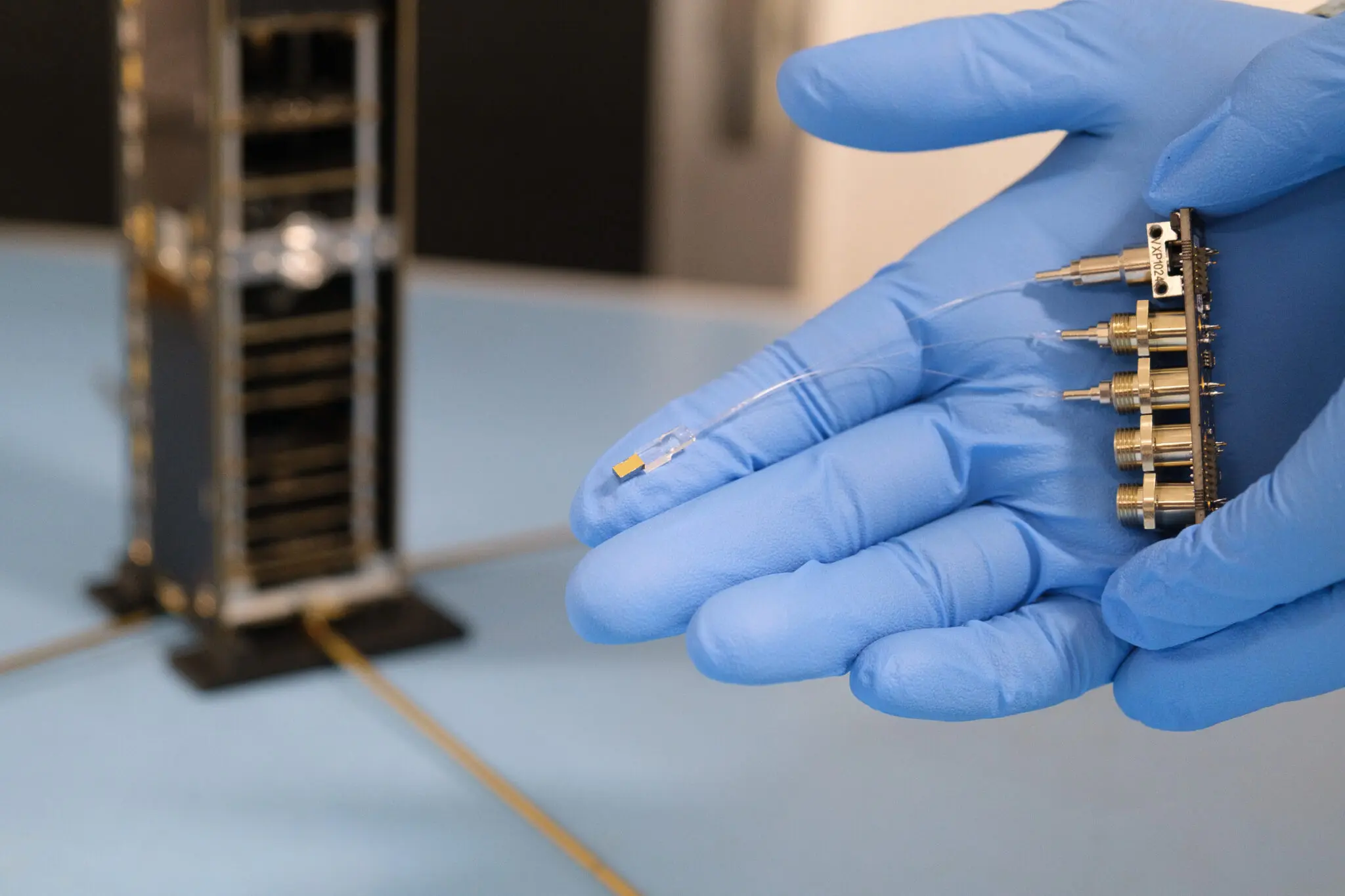
A satellite built by Delft University of Technology (TU Delft) will send the first TriPleX photonic chip into space to demonstrate a novel sensing system aimed at future planetary exploration[29] — on-orbit data under space radiation and thermal cycling is the admission threshold for whether integrated photonics can enter the aerospace supply chain.