Sep 9, 2026 – Sep 10 · Daily Brief

Switzerland to Install Its First IBM Quantum Machine at the National Supercomputing Centre

58 items · 11 sourcesPDFThis issue's roundup is free
02Hardware

Hardware Frontier

Trapped Ion

Quantinuum achieves a per-round qubit error rate of 4.6×10⁻⁵ on Helios

On September 9, 2026, Quantinuum released results for Helix running on the Helios system: a per-qubit per-round error rate of 4.6×10⁻⁵, with syndrome (error signature — the error fingerprint read out repeatedly during error correction) measurements across 20 rounds yielding a 99.925% fidelity lower bound for a logical GHZ state[50].

Beyond these two figures, the source discloses nothing about two-qubit gate fidelity across all qubit pairs on the commercial Helios system, the number of fully error-corrected logical qubits, or the physical-to-logical encoding ratio. The significance here is that the verifiable lower bound on logical state fidelity has been pushed to the same order of magnitude as physical gate fidelity — and it still holds after 20 rounds of repeated measurement, rather than being a single-shot snapshot.

What's still missing: ion transport overhead and circuit repetition rate remain the scaling bottlenecks for this route, and the structural limit keeping qubit counts in the tens-to-hundreds range is unchanged by this result.

Integrated laser chip drives single-qubit gates to 99.61%

Researchers used an integrated laser chip rather than a tabletop bulk-optics system to drive trapped ions, achieving 99.61% single-qubit gate fidelity and generating two-qubit entanglement at 92.35% fidelity[33].

Technical significance: the novelty lies not in the fidelity figures — the best published trapped-ion single-qubit gate performance is Helios's 99.9975%, and single-pair two-qubit gates have reached 99.99%, so 92.35% two-qubit entanglement lags by nearly three orders of magnitude in error — but in relocating coherent control that previously required bulky optical benches onto a compact photonic chip.

Landscape impact: who is affected is clear — every vendor hoping to push trapped ions from rack scale to volume-production scale, for whom optical path volume and alignment stability are the wall that gets hit before fidelity does; but until integrated optics pull two-qubit fidelity back above 99.9%, this route remains engineering pre-research.

Superconducting

IQM's logical-qubit machine named LUMI-IQ, funded jointly by four countries

Following the 09/09 report on the 300-qubit Radiance roadmap from IQM and VTT, IQM has disclosed another upgrade path: LUMI-IQ, a superconducting system aimed at logical qubits, will be deployed at Finland's LUMI supercomputing site, jointly funded by Finland, the Czech Republic, Norway and Poland and delivered in stages, starting in 2027 with an IQM Halocene H4 — 150 physical qubits with early quantum error correction capability[31].

This report adds three increments over the previous one: funding expands from Finland alone to four countries, the system is separately named and bound to the LUMI supercomputer, and delivery is broken into an explicit staged upgrade toward logical qubits.

Against published benchmarks: the gold standard for error correction on the superconducting route remains Google Willow's surface-code error suppression factor Λ≈2.1 at code distance d=7, the first demonstration of a real-time error correction loop, using 105 physical qubits. How many logical qubits 150 physical qubits can support, and at what code distance, has not been disclosed by IQM — and that is the single critical number for judging this machine's quality.

Readout power consumption pressed down to the 0.3 mW range

Chalmersnext Labs has measured that the low-noise amplifier power required for readout fidelity above 80% is roughly 0.3 mW, an order of magnitude lower than previously needed; moreover, optimal low-noise amplification is determined neither by lowest noise nor highest gain, but by the indium content in the HEMT device[34].

Technical significance: this is not a fidelity record — published superconducting readout fidelity runs 98% to 99.5% — but a new point on the power-fidelity tradeoff curve, while also pointing out that the amplifier benchmark metric the industry commonly uses tracks the wrong variable.

Landscape impact: the thermal budget of dilution refrigerators is a hard constraint on scaling to ten thousand qubits, and every milliwatt saved per readout line gets multiplied by the qubit count. Affected are all suppliers of cryogenic control electronics, on a timescale set by the design cycle of the next generation of readout chains — measured in quarters.

Operation speed reported as 1000x faster than before

One study reports quantum operation speeds improved to 1000x the previous level, on the rationale that the longer an operation takes, the more external disturbance and computational error accumulate[7]. The abstract does not disclose the technology route, the absolute gate duration, or the fidelity cost; until those three figures are published, the multiplier cannot be compared against any route's published gate-time baseline (superconducting two-qubit gates 20 to 100 ns, trapped ion 10 to 500 µs, neutral atom 0.1 to 1 µs).

SuperQ building the Super Nova processor at the University of Waterloo

SuperQ Quantum Computing's modular hybrid computer Super Nova is completing hardware fabrication in Professor Matteo Mariantoni's lab at the University of Waterloo[24] — modularity is the mainstream answer for the superconducting route to circumvent the single-chip yield ceiling, but this item gives no qubit count or fidelity and does not yet constitute a capability claim.

Neutral Atom

First hardware for planqc's 1000-qubit machine arrives at LRZ

Hardware for the MAQCS project has arrived at the Leibniz Supercomputing Centre (LRZ) in Germany, to advance planqc's 1000-qubit neutral atom quantum computer[36].

Against published benchmarks: the neutral atom scale record is Atom Computing's 1180 physical qubits (1225 sites), and the logical qubit record is QuEra's 96 logical qubits realized with 448 physical qubits. planqc's 1000-qubit target amounts to catching up with the leading scale rather than resetting it.

What's still missing: the acknowledged weakness of this route is mid-circuit measurement and a 1 to 10 Hz circuit repetition rate — however many qubits you add, running only a few circuits per second means practical throughput still doesn't hold up.

Fujitsu ports the STAR architecture onto a neutral atom processor for validation

Fujitsu is working with Yaqumo to experimentally validate Fujitsu's STAR architecture on Yaqumo's neutral atom processor, aiming to reduce physical qubit overhead, improve error correction, and connect into Fujitsu's Open Quantum Toolchain to give external users access to multiple hardware types[17].

Technical significance: the physical-to-logical encoding ratio is the core metric for error correction economics; the current published best is Quantinuum's 2:1, the neutral atom route runs about 4.7:1, and the superconducting surface code is 105:1. The STAR architecture had previously been discussed mainly in a superconducting context; this is the first time it has been taken onto neutral atom hardware for validation.

Landscape impact: after the 09/07 report of NEC exiting superconducting hardware, Fujitsu became Japan's principal enterprise-level superconducting hardware developer, and this move shows it is simultaneously betting on neutral atoms rather than locking its architecture to a single route.

Photonics and Solid-State Spins

Silicon carbide network node reaches 82% two-photon interference visibility, needing recalibration only every 8.4 hours

A silicon carbide color center node sustained two-photon interference visibility at 82%, with the p-i-n diode bias needing readjustment only once every 8.4 hours on average[25].

Technical significance: comparable prior experiments required frequent recalibration for spectral stability; an 8.4-hour unattended window brings experimental overhead down to a level compatible with continuous operation — this is progress on a runtime metric, not a fidelity metric.

Landscape impact: for quantum repeater nodes to reach field deployment, recalibration interval matters more than peak performance; those affected are quantum network hardware suppliers and operators, on a scale measured in years.

Twin photons cross 7 kilometers of Brazil's Guanabara Bay

Researchers completed a 7 km distribution of entangled photon pairs across Guanabara Bay in Brazil[44] — a field link validation in an urban waterway environment, taking Southern Hemisphere quantum network infrastructure from the lab into municipal geography.

Singular Photonics launches the Litavis SPAD image sensor

Singular Photonics has released the Litavis single-photon avalanche diode (SPAD, a detector capable of counting individual photons) image sensor[47] — single-photon detection devices are moving from research-custom builds to commercial catalogs, with quantum imaging and lidar as two outlets of the same supply chain.

TriPleX photonic chip to fly for the first time

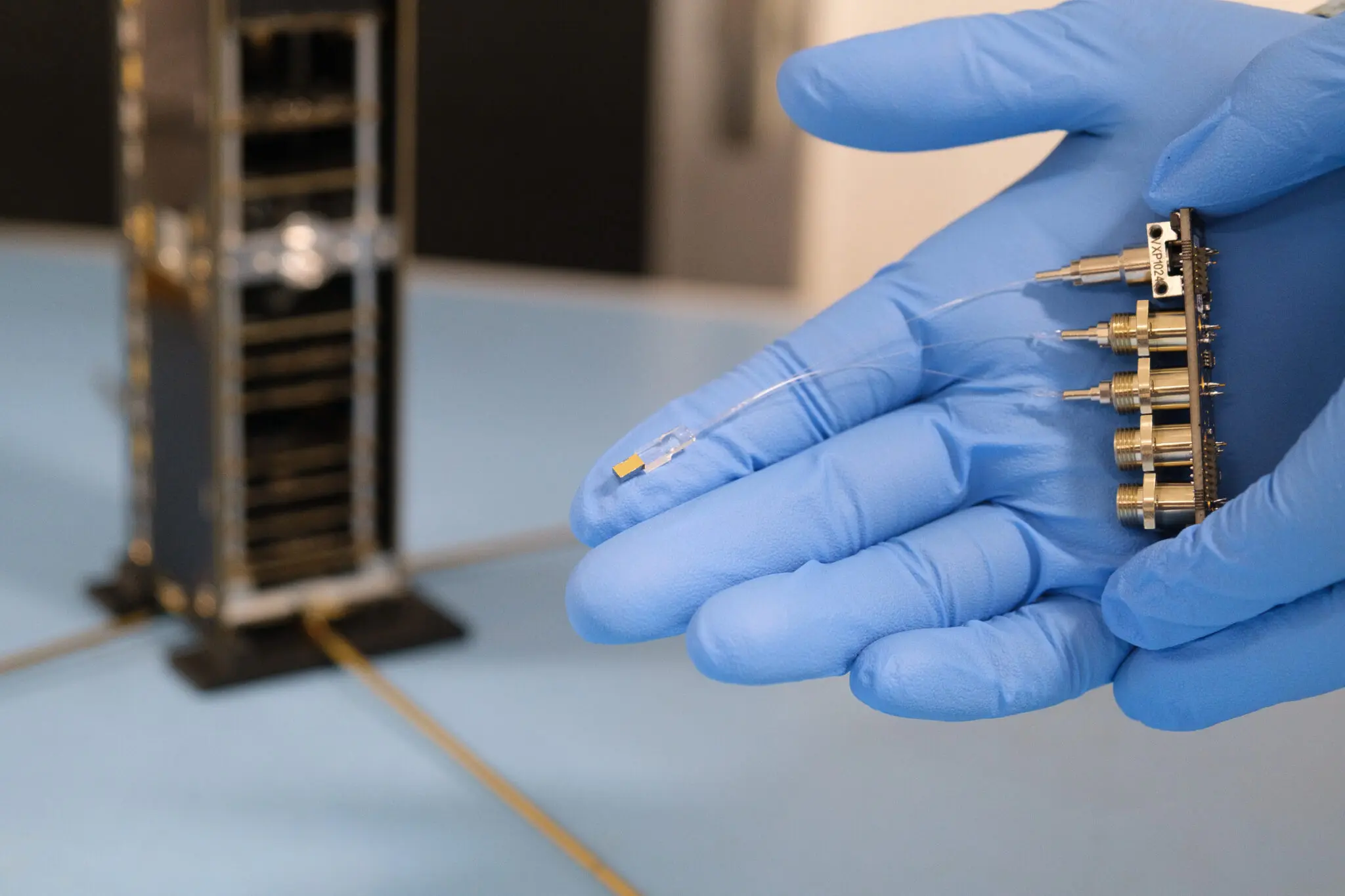
A satellite built by Delft University of Technology (TU Delft) will send the first TriPleX photonic chip into space to demonstrate a novel sensing system aimed at future planetary exploration[29] — on-orbit data under space radiation and thermal cycling is the admission threshold for whether integrated photonics can enter the aerospace supply chain.


03Algorithms

Algorithms and Software

The spacetime bill for elliptic curve circuits gets recomputed

A new elliptic curve point addition circuit brings final spacetime complexity to 1.259 billion, a reduction of over 80% relative to prior implementations[27].

Technical significance: spacetime complexity (measured as qubit count × number of runtime rounds) is the common currency for gauging attack cost in the error-correction era, and hews closer to real resources than raw gate counts; point addition is the subcircuit called most often when Shor's algorithm breaks a 256-bit elliptic curve signature, so its reduction propagates proportionally into whole-machine requirements.

Landscape impact: following IonQ's end-to-end resource estimate released on 09/08, the answer to the same problem has been rewritten within two days: circuit size reduced by over 80% relative to prior implementations — though whether the two baselines are directly comparable is not addressed by the source. The spreadsheet banks, payment institutions and certificate authorities use to schedule post-quantum migration needs a new version number; but this result so far appears only in abstract form, and the reduction's measurement convention and choice of baseline remain to be verified.

QLDPC decoding complexity cut to one-fifth, 15x faster

A new framework decoding quantum low-density parity-check codes (QLDPC, a class of high-rate error-correcting codes) at realistic error rates achieves 15x the prior decoding speed at one-fifth the computational complexity, by first applying belief propagation for preliminary processing and then invoking the Tesseract algorithm in targeted fashion[32].

Technical significance: decoding must run faster than syndromes are generated, or errors pile up and the error correction loop fails to close; Google Willow's first demonstration of a real-time error correction loop and Quantinuum's use of NVIDIA GB200 for real-time decoding are both solving the same problem. This one cuts cost from the algorithm side rather than the compute side.

Landscape impact: the beneficiaries are all vendors betting on the high-rate QLDPC route to escape the surface code's 105:1 encoding ratio; whether decoders can run on cheap hardware directly determines the whole-machine cost of error correction.

Streaming belief propagation solves syndrome backlog

A paper proposes streaming belief propagation decoding on mixed-alphabet Tanner graphs for practical quantum memories: processing syndrome information continuously under circuit-level noise, at a processing rate comparable to its generation rate[21].

Technical significance: repeated syndrome measurement produces data continuously, and "process continuously, no backlog" is the threshold condition for turning offline decoding into online decoding; this work writes it up as a deployable decoder structure.

Toffoli cost of sparse state preparation driven down

A paper improves the Toffoli gate overhead of sparse quantum state preparation[20] — Toffoli gates must be realized through magic state distillation in a fault-tolerant architecture, making them the most expensive class of operation; state preparation is in turn the entry primitive for quantum simulation and linear system solving algorithms, so a cheaper entry point shifts the resource estimate for the whole algorithm downward.

Xanadu and AMD jointly open-source Backline

Xanadu and AMD have released Backline, an open-source framework integrated into Xanadu's PennyLane platform that provides ultra-low-latency links among CPU, GPU, FPGA and SmartNIC, enabling Python-native, microsecond-scale communication — aimed precisely at the classical-quantum data bottleneck in applications such as quantum error correction[13].

Technical significance: the time budget for an error correction loop is measured in microseconds, while conventional communication stacks in the Python ecosystem operate in milliseconds — a gap of orders of magnitude that previously could only be bridged with proprietary firmware.

Landscape impact: AMD thereby plugs its FPGA and network card product lines into the quantum control stack; those affected are vendors developing control electronics in-house, whose room for differentiation is squeezed by an open-source alternative.

Riverlane packs an error correction decoder into Altera FPGAs

Altera and Riverlane are collaborating to provide quantum error correction support for the Agilex family of FPGAs[45] — two FPGA-side error correction partnerships landing on the same day shows that real-time decoding is turning from a paper metric into a procurable device option; for system vendors, this means the control layer can be bought rather than built.

QiliSDK v0.3.0 adds GPU-accelerated analog simulation

Qilimanjaro Quantum Tech has released QiliSDK v0.3.0, adding GPU-accelerated analog simulation, Python 3.14 support, a stabilizer state simulator and an improved tensor network engine[15] — how fast an open-source toolchain tracks the latest Python release is a cheap indicator of whether a software stack has real users.

04Industry

Industry and Ecosystem

Switzerland's first on-premises IBM Quantum System Two lands at a supercomputing center

Under an agreement with armasuisse, the Swiss federal defense procurement agency, IBM and Lockheed Martin are establishing a national quantum innovation hub at ETH Zurich, installing Switzerland's first on-premises IBM Quantum System Two — carrying a Nighthawk r2 processor — at the Swiss National Supercomputing Centre in Lugano before the end of 2026, building a quantum-centric supercomputing environment[16].

Business significance: IBM's overseas installations are upgrading from "selling machines" to "co-building a national hub with a defense procurement agency," with sovereign parties and defense contractors written into the contract structure.

Landscape impact: the source does not disclose Nighthawk r2's specific architectural parameters; this product line pursues high circuit complexity rather than qubit-count stacking, and siting it at a supercomputing center means it will be co-scheduled with classical compute in the role of an accelerator. Those affected include other European national computing centers currently in the selection process, on a timescale of months.

IBM Ventures leads $8 million round in BQP

IBM Ventures led an $8 million investment in BQP to advance commercial deployment of its BQPhy quantum-accelerated physics simulation platform, which optimizes GPU utilization in engineering environments — the company claims up to 10x performance — and lets classical workloads transition smoothly to hybrid quantum-classical[14].

Business significance: this is the classic "sell classical acceleration first, swap in a quantum backend later" business model, where revenue need not wait for hardware maturity; for investors, valuations of such targets do not hinge on the fault-tolerance timeline.

Nearly 80% of the world's 50 largest banks are deploying quantum

According to the latest data from benchmarking platforms including the Evident Banking Brief, nearly 80% of the world's 50 largest banks are actively deploying quantum computing, with the financial industry having moved from theoretical experiments to aggressive strategic investment[3].

Business significance: this is quantitative demand-side evidence, not vendor-reported pipeline figures; for quantum software and consulting providers, finance is currently the only large-scale industry customer with verified willingness to pay.

Landscape impact: those affected are each bank's technology strategy department and its supplier list, on a timescale set by the current fiscal year's budget cycle.

Universal Quantum establishes its first R&D center outside Europe, in Singapore

With an investment exceeding S$30 million, Universal Quantum is establishing its first R&D capability center outside Europe in Singapore, serving as its Asia-Pacific headquarters and handling manufacturing, packaging and algorithm co-design for advanced ion trap microchips, with partners including Singapore government agencies and research institutions[19].

Landscape impact: the scaling bottleneck for the trapped ion route lies in chip fabrication and packaging rather than physical principle, so placing capacity in a region with mature semiconductor back-end capability is an engineering choice; for the Asia-Pacific quantum supply chain, this marks the first time Universal Quantum has landed ion trap microchip manufacturing and packaging capability outside Europe.

Infleqtion partners with Cisco on networked quantum

On September 10, 2026, Infleqtion announced joint R&D with Cisco, combining Infleqtion's neutral atom quantum computers and quantum sensors with Cisco's networking technology stack to advance scalable distributed quantum computing[1].

Technical significance: distributed quantum computing circumvents the single-machine qubit ceiling only if the rate and fidelity of inter-node entanglement distribution hold up; what a network equipment vendor brings is the classical control plane and synchronization piece.

Landscape impact: networking giants are beginning to treat quantum as an application scenario for next-generation network equipment; those affected are startups specializing in quantum network middleware.

QuantrolOx moves into UC Berkeley

UC Berkeley's Roger Herst Quantum Nexus has brought in UK qubit-automation startup QuantrolOx, which thereby establishes its first North American base; the two signed a five-year memorandum of understanding to interface QuantrolOx's Quantum EDGE software with Berkeley's quantum processors, automating qubit tuning and calibration with the goal of standardizing hardware processes[18].

Business significance: qubit tuning and calibration currently consume repeated PhD-level labor on every single machine, and turning that into reusable software is one of the few businesses in the quantum field with genuine economies of scale.

Italy extends an olive branch to IonQ

Rome is courting IonQ, seeking to deepen the Italy-US quantum partnership[48]; over the same period, Steve Hoffman publicly offered views on the adoption path for quantum technology within the US defense establishment[49].

Landscape impact: quantum procurement is spreading along existing defense alliance lines, and a supplier's country of origin is becoming a selection variable, on a timescale measured in years.

Cal State East Bay opens an undergraduate quantum technology pathway

California State University, East Bay (Cal State East Bay) has opened a quantum technology career development pathway for undergraduates[46] — the quantum talent gap is moving down from the PhD level to the undergraduate and technician levels, which determines whether operations engineers can be hired when capacity expands over the next five years.

Adjacent deals: QNu Labs raises ₹2 billion, Xanadu signs lithography agreement with ASML

Other deals disclosed over the same period include: India's QNu Labs closing a ₹2 billion (roughly $24 million) Series A1 round, Xanadu reaching a lithography partnership with ASML, and Altera implementing post-quantum cryptographic secure boot on Agilex 3 and Agilex 5[50] — the most notable is the Xanadu-ASML combination: the photonic route's success or failure depends on fab process rather than lab technique, PsiQuantum has already run BTO electro-optic switches on a 300 mm line, and Xanadu turning to a lithography equipment maker is another expression of the same logic.

University of Groningen uses quantum sensing to examine colon cancer

The ONCO-Q project at the University of Groningen and UMCG uses nanodiamonds for quantum sensing to measure the activity of colon cancer cells[23] — quantum sensing's landing point in life sciences is metabolic readout at single-cell scale, a regime conventional fluorescent labeling struggles to cover; those affected are research pipelines for early cancer screening and drug efficacy assessment, on a scale measured in years.

05Other

Academic Frontier

The nonlinear Vlasov equation goes onto a quantum computer

A study examines the practical applicability of quantum algorithms based on Carleman linearization (expanding a nonlinear equation into an infinite-dimensional linear one, then truncating) to the nonlinear electrostatic Vlasov equation with a Krook-type collision term[22].

Technical significance: nonlinearity is the hardest nut for quantum algorithms — quantum mechanical evolution is itself linear, so handling nonlinearity necessarily costs extra; focusing on "practical applicability" rather than asymptotic speedup is a shared turn in such work in recent years.

Landscape impact: plasma and fusion simulation is one of the few repeatedly named high-value scenarios for quantum simulation; those affected are the computational roadmaps of fusion research institutions, on a scale measured in years.

Memory requirements for polymer simulation drop from linear to logarithmic

A new circuit achieves an exponential reduction in memory requirements when representing complex chemical reactions — growing logarithmically rather than linearly with system size; at a scale of 1000 system qubits, the simulation requires only about 10,000 to 100,000 gate operations[26].

Technical significance: the 10,000-to-100,000-gate magnitude is the key point — it falls within the circuit depth range that near-term error-corrected machines might reach, rather than the billion-gate estimates typical of conventional chemistry simulation.

Landscape impact: quantum simulation for materials and polymers moves up a notch from the "wait for a fault-tolerant machine" list; those affected are quantum assessment teams at chemical and materials companies.

X-ray photon simulation: 23 minutes versus 57 milliseconds

A new quantum algorithm simulating complex X-ray photon behavior gives a runtime comparison of 23 minutes versus 57 milliseconds, by encoding every possible optical path into a single quantum state, and accurately reproduced the reference results; the source also states outright that such a speedup awaits the arrival of a sufficiently powerful quantum computer and is not a realized, measured acceleration[35].

Technical significance: this "encode all paths simultaneously" construction is the most classic use of quantum parallelism, and whether it pays off depends on how useful information is extracted at readout — the abstract does not specify measurement overhead or whether this was an estimate under classical simulation, so the time difference should be read with that caveat.

Landscape impact: if it holds up, those affected are the simulation stages of medical imaging and industrial non-destructive testing, where current compute wait times are measured in hours.

Princeton measures magnetic fluctuation wavelengths below the diffraction limit

A Princeton team used diamond sensors to resolve the dynamic patterns of magnetic fluctuations inside materials, improving spatial scale by three orders of magnitude over prior work with tunable frequency, enabling them to map previously unobservable magnetic noise distributions[28].

Technical significance: a three-order-of-magnitude improvement in spatial resolution pushes the observation window from the optical diffraction limit down to the nanometer scale — and magnetic noise happens to be one of the killers of superconducting qubit coherence time.

Landscape impact: those affected span both condensed matter research and failure analysis of quantum devices — you can only talk about suppressing a noise source once you can measure it.

Xiamen University raises quantum battery storage to 16x

Work from Xiamen University claims quantum battery energy storage can reach 16x that of conventional designs, whereas prior models held that improvement was capped at 4x before inconsistencies appeared; the new approach circumvents those flaws through a rigorously defined system while also demonstrating higher charging efficiency[30].

Technical significance: the 4x ceiling was the field's previously accepted conclusion, and raising it to 16x amounts to overturning a boundary; but quantum batteries remain a principle-level construction, separated from a portable energy storage device by an entire engineering chain.

Landscape impact: no impact on any battery supply chain in the near term; what's worth watching is whether the conclusion can be independently reproduced.

Spinons may let electrons pair along stripes

One study proposes that in certain superconductors, spinons (spinon, the quasiparticle of the spin degree of freedom) may help electrons pair along stripe structures[8] — the pairing mechanism of high-temperature superconductivity remains unsettled, and any clue about mechanism bears directly on whether materials with higher transition temperatures can be designed.

Pulse sequence method improves quantum control precision

A new pulse-train method aims to improve the precision of quantum control, targeting the common step of manipulating atomic and molecular energy states with laser pulses[6] — control precision is an upstream variable of fidelity, and improving control waveforms is one of the few means of raising gate fidelity without changing hardware.

Ultracold quantum sensors reduce X-ray uncertainty, applied to nuclear material verification

Ultracold quantum sensors have reduced the uncertainty of X-ray measurements, thereby improving nuclear material assessment: nuclear material accounting at power plants and weapons facilities relies on the characteristic gamma-ray patterns of specific radioactive elements, but some elements also emit X-rays in the same energy band, masking the signal[4].

Landscape impact: those affected are nuclear material accountancy and international verification regimes; being able to resolve a masked signal means higher confidence in verification conclusions, making this one of the quantum sensing applications with a paying customer soonest.

Optical fiber guides atoms, paving the way for navigation when GPS fails

Researcher Jongmin Lee guided atoms in the halo of light surrounding an ultrathin optical fiber; when the fiber is shaken, the atoms move sideways with it without falling away — useful for precise motion measurement in turbulent environments[5].

Technical significance: tight-binding guidance solves the most fragile link in inertial quantum sensors — atoms being lost under vibration; low power consumption is the key metric distinguishing this route from laboratory atom interferometers.

Landscape impact: following the 09/09 report that SandboxAQ's magnetic navigation completed drone flight testing, this is the second engineering advance in the same week for positioning schemes independent of satellite signals; those affected are defense and aviation navigation supply chains, on a scale measured in years.

06Impact

Today's Impact

1. The cost baseline for cryptographic migration needs recomputing; the owners are security architecture teams at banks and certificate authorities

Elliptic curve point addition circuit spacetime complexity dropping to 1.259 billion, a reduction of over 80% from prior work[27], together with IonQ's 09/08 end-to-end resource estimate, constitutes two consecutive blows in the same direction. What changed: the resource table once used to argue "we still have a decade or more" has had its baseline circuit size cut by over 80% within two days — though whether the two estimates' baselines are directly comparable is not addressed by the sources. Worth watching next: whether this result's reduction convention and chosen baseline survive peer review, and whether NIST and national regulators adjust migration deadlines accordingly.

2. Real-time error correction decoding turns from a research topic into a procurable device, affecting system vendors' in-house development budgets

QLDPC decoding at 15x the prior speed and one-fifth the complexity[32], streaming belief propagation solving syndrome backlog[21], Xanadu and AMD open-sourcing microsecond-scale classical-quantum interconnect[13], Riverlane bringing error correction support into Altera Agilex FPGAs[45] — four same-day developments point at one thing: the control layer of the error correction loop is standardizing. What changed is that hardware companies no longer need to build an entire decoding stack in-house. Worth watching next: end-to-end latency figures for these solutions on real machines, not simulation benchmarks.

3. National-level quantum installations are beginning to be bundled with supercomputing and defense procurement

Switzerland's first on-premises IBM Quantum System Two is being co-built by IBM, Lockheed Martin and armasuisse and sited at the Swiss National Supercomputing Centre[16]; LUMI-IQ is jointly funded by four countries and deployed at Finland's LUMI supercomputing site[31]; Italy is courting IonQ[48]. What changed is that the procuring party shifts from research institutions to national computing and defense departments, with contract scale and duration changing accordingly. Worth watching next: the error correction capability figures these systems publish — how many logical qubits 150 physical qubits can sustain is the only hard indicator of quality.

4. The revenue model for quantum software is validated: sell classical acceleration first, swap the backend later

IBM Ventures led an $8 million round in BQP, a target that accelerates with GPUs today and switches to hybrid quantum later[14]; meanwhile nearly 80% of the world's 50 largest banks are already deploying quantum[3]. What changed: quantum software companies can generate revenue without waiting for hardware to mature, and investors' exit paths are no longer tied to the fault-tolerance timeline. Worth watching next: whether these platforms' classical acceleration holds up in head-to-head comparison against purely classical competitors.

5. Quantum sensing produces paying scenarios along three lines at once: verification, medicine, navigation

Ultracold sensors reducing X-ray uncertainty to improve nuclear material assessment[4], nanodiamonds measuring colon cancer cell activity[23], fiber-guided atoms pointing toward low-power satellite-free navigation[5]. What changed is that each of these three lines has an identified payer — verification agencies, medical research, defense. Worth watching next: which one first produces third-party replication data rather than a single team's demonstration.

07Other

Editor's Note

The most noteworthy thing today is not any single hardware figure, but the division of labor taking shape around error correction. Over the past year, error correction discussion has centered on the physical layer: whose code distance is larger, whose error suppression factor is higher, whose encoding ratio is more economical. Today, in a single day, four advances appeared at the control and algorithm layers — decoder speedup, streaming processing eliminating backlog, an open-source framework opening up microsecond-scale classical interconnect, decoding capability built into general-purpose FPGAs. None of this work produces a new fidelity record, but together they answer a different question: when the physical layer finally runs below threshold, can the accompanying classical side keep up. The answer is sliding from "everyone builds their own" to "buy it off the shelf." For system vendors, this means the room for differentiation is narrowing, and competition will be pushed back more completely onto the quality of physical qubits themselves; for investors, this control stack and decoder layer has for the first time acquired an independent valuation logic.

The other undercurrent is the turnover in who does the procuring. Contracts for national-level installations now feature supercomputing centers, defense procurement agencies and aerospace-defense contractors simultaneously; funders expand from a single country to multinational consortia; installation sites move from university labs into national computing infrastructure. This changes two things: first, the evaluation criteria — supercomputing centers care about scheduling, availability and performance per watt, not paper metrics; second, time expectations — sovereign procurement contracts run in years and specify delivery milestones, so vendors can no longer raise money on a roadmap. Meanwhile, the demand side has finally produced non-vendor-sourced data: the deployment rate among large banks is approaching 80%. The narrative of the quantum industry over the past decade has been driven by the supply side — who can build a better machine; from now on, asking who is buying, what they are buying it for, and whether they renew will distinguish real from fake better than asking about qubit counts.