Government Awards: Five Finalized
GlobalFoundries received a $375 million R&D award from the U.S. Department of Commerce for its quantum technology solutions business, strengthening domestic U.S. quantum chip manufacturing[29]. PsiQuantum finalized $100 million in CHIPS Act funding to accelerate domestic semiconductor process development and onshore supply-chain security for fault-tolerant quantum computing infrastructure, with the money supporting a 300mm wafer line for barium titanate (BTO, an electro-optic switching material) and single-photon detector optimization[13]. D-Wave likewise finalized a $100 million agreement while pursuing two superconducting architectures in parallel — quantum annealing and gate model — targeting a 100,000-qubit system and a 10,000-physical-qubit QPU respectively; as consideration, the Department of Commerce took a minority equity stake[19]. Rigetti received a $100 million award from the U.S. government to advance superconducting quantum computing R&D[30]; Quantinuum received a $100 million CHIPS R&D award[32].
Commercial significance: the key difference in this round is not the amount but the form — the Department of Commerce is taking equity rather than only issuing subsidies[19], tying the return on taxpayer money to the valuation of the assets; at the same time, PsiQuantum's award points explicitly at 300mm lines, materials and packaging[13], while D-Wave's is explicitly targeted at a 100,000-qubit system and a 10,000-physical-qubit QPU[19]. Against SOTA: PsiQuantum's funding goes to a barium titanate 300mm wafer line plus single-photon detectors and packaging-line optimization[13], and its Omega chip has already reached 99.98% dual-rail-encoded SPAM and 99.72% chip-to-chip interconnect fidelity (over 42 meters of fiber), so the funding direction is consistent with its existing strengths; the public material on Rigetti's award says only that the money comes from the U.S. government and will advance superconducting quantum computing R&D[30], with no qubit count or two-qubit gate fidelity given for its production systems — whether $100 million converts into fidelity is the thing to watch. Landscape impact: the U.S. has formally added quantum hardware to its industrial-policy toolbox, and matching moves from Europe and Japan are likely within 6–12 months.
Foundry: SkyWater Turns Quantum Into a Foundry Business
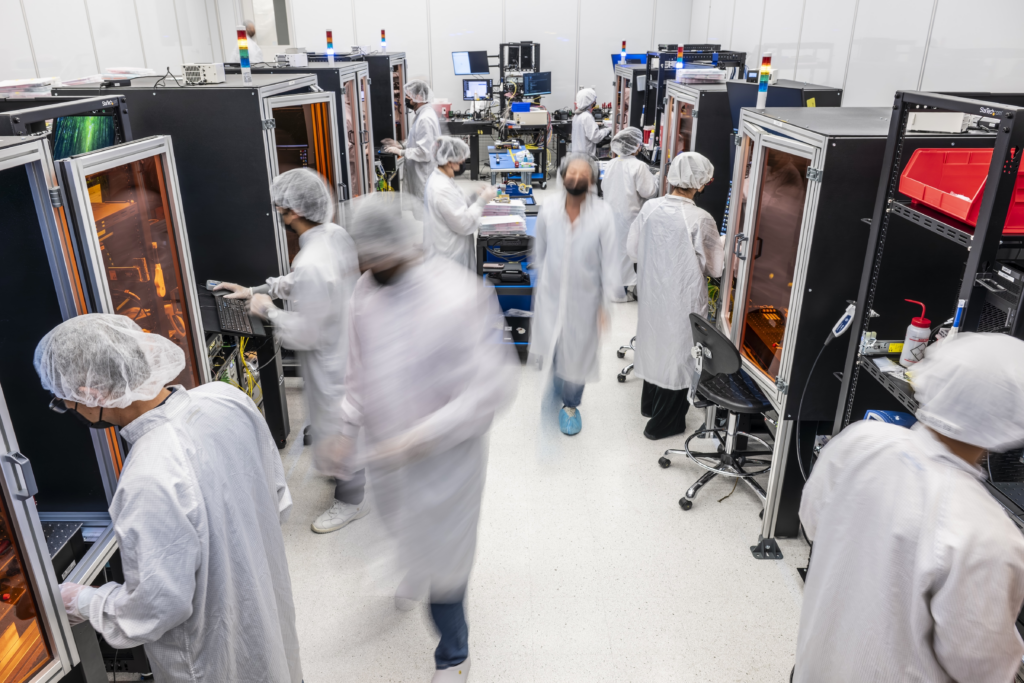
SkyWater established a dedicated commercial foundry unit for quantum solutions, offering two standardized process platforms — SC250 for superconducting circuits and SP90 for quantum photonic routing — and has already won joint development contracts[18]. In parallel, SkyWater signed a multi-year agreement with Qolab, making Qolab the launch customer for the SC250 platform and moving its quantum system-in-package (QSiP) architecture from research into commercial manufacturing[17].
Commercial significance: this is the first appearance in quantum hardware of a semiconductor-style "standard process kit plus multiple customers" model; previously every hardware company built its own process. Standardization means fixed costs for new entrants fall sharply. Landscape impact: the hardest hit are hardware startups that treat "proprietary process" as their moat, whose technical premium will be diluted by foundry platforms — a window of roughly 2 years.
Financials: IonQ Raises Full-Year Guidance
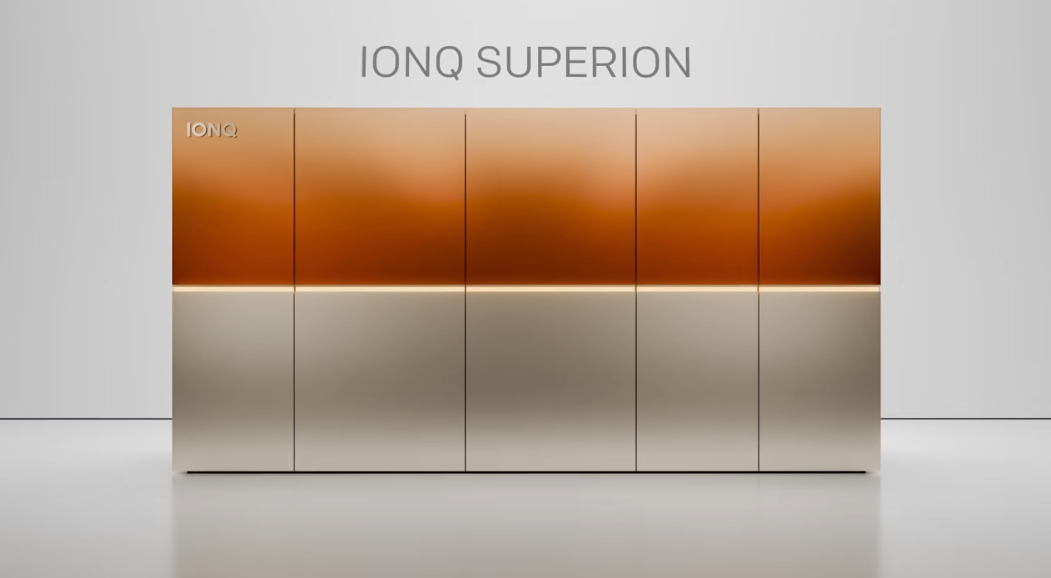
IonQ raised its full-year 2026 revenue guidance to $450–460 million, incorporating the contribution from SkyWater, whose acquisition closed on July 31[15]; the company says manufacturing speed for 256-qubit processor wafers has tripled, with 12 times as many wafer lots delivered every six months[15].
Commercial significance: the incremental revenue comes mainly from the consolidated foundry business rather than quantum machine sales, and investors need to separate "quantum revenue" from "semiconductor foundry revenue"; the 3x and 12x figures describe capacity, not performance. Landscape impact: the valuation anchor for publicly listed quantum companies is sliding from technical metrics toward recognizable revenue, raising the odds that peers follow with acquisitions.
Other Developments
QUDORA Technologies received EU support through the EuroHPC Joint Undertaking to scale its near-field quantum control technology (aimed at microwave qubit control)[28]. Technical significance: control electronics is a major cost driver shared by trapped ions and superconducting alike, and the EU's choice to invest in the control layer rather than the qubits themselves is a play for infrastructure positioning.
NLM Photonics brought in a new investor to scale up industrialization of its organic photonics technology[47]. The 16 finalists at Constructor Start Demo Day include quantum startups[45]. Daniel Freedman joined Quantum X Labs as Distinguished Quantum Scientist[46]. Infleqtion (NYSE: INFQ) announced its participation in the 2026 Quantum World Congress, where CEO Matt Kinsella will deliver a keynote on scaling quantum computing, and company executives will also discuss applications of neutral-atom technology in defense, aerospace and manufacturing[1].
At the ecosystem level, Finland's Kvanttinova ecosystem bundles semiconductors, microelectronics and photonics together with quantum technology[3]; research at Italy's FBK Center for Sensors and Devices spans advanced materials and single-photon technology[2]. Opinion pieces also discuss how tokenized finance can prepare for post-quantum security[48], and the question of legal liability in the use of quantum technology[4].