Sep 5, 2026 – Sep 6 · Daily Brief

Bitcoin Completes Its First Quantum-Resistant Transfer, Giving Wallets an Escape Route

134 items · 27 sourcesPDFThis issue's roundup is free
02Hardware

Hardware Frontier

Superconducting

MIT has proposed a dual-purpose qubit architecture in which qubits can interact quickly while remaining stable, officially framed as paving the way for "running long and complex algorithms" [16][29][105]. Technical significance: rising noise as gates get faster is a long-standing problem; the source says only that this is a "dual-purpose" design, without disclosing what the dual purposes are or explicitly identifying the technology track, but it points toward the hardest path of all — making qubits interact faster without sacrificing stability. Landscape impact: if reproducible, the beneficiaries are every vendor running transmon production systems (the IBM Heron/Nighthawk, IQM, Rigetti tier), but the public information gives no concrete numbers for two-qubit gate fidelity or gate duration, so there is no way to judge how much it advances on the published figures for current production systems. What's still missing: the weak point of the superconducting track remains T₁ fluctuation caused by TLS (two-level-system defects in materials), and turning an academic-grade architectural improvement into a whole-chip median metric typically takes another two to three years.

Neutral Atoms

A Japanese research group has built a 10-channel multiplexed quantum photonic interface based on an integrated waveguide array, described by the source as a world-record 10-channel multiplexed quantum photonic interface, used to optically interconnect multiple quantum computers; the work was published in Optica [20]. Technical significance: 10-way multiplexing is a key technology for optically interconnecting multiple quantum computers, and parallel channels mean inter-module entanglement distribution no longer has to squeeze through a single link. Landscape impact: this is the "networking multiple machines" path rather than "making one machine bigger," so it affects players pursuing modular scaling such as QuEra, Pasqal, and Atom Computing. This result does not touch the logical-qubit level; it is an incremental gain at the interconnect layer. What's still missing: the hard constraints on this track remain cycle repetition rate (typically 1–10 Hz) and mid-circuit measurement, and optical interconnects by themselves solve neither.

Photonics

A new quantum key distribution (QKD — using quantum signals to distribute encryption keys) protocol switches to encoding data in the spatial modes of photons (think of it as the shape of the light spot), achieving a key rate of 0.9 Kb/s [77]. Technical significance: changing the encoding dimension is a way to sidestep the tendency of polarization to degrade in fiber and in the atmosphere, at the cost of greater optical complexity at the receiver. Landscape impact: 0.9 Kb/s is enough to distribute keys but not to carry data, so the deployment setting is dedicated government and enterprise links rather than consumer networks, with a commercialization timeline measured in years.

A hollow-core fiber platform has been proposed to bridge quantum devices operating at different wavelengths — quantum memories and trapped ions mostly work in the ultraviolet or visible bands, while long-distance fiber communication sits in the near-infrared [17]. Technical significance: wavelength mismatch is a physical-layer break in quantum networks, previously addressed mainly with frequency-conversion devices, where the conversion process itself introduces loss and noise. Landscape impact: this affects every team working on quantum network repeaters, and amounts to a component-level improvement.

Trapped Ions

eleQtron, a spin-off of Forschungszentrum Jülich and the University of Siegen, has brought its JION trapped-ion quantum computer formally into operation, connected to the JUNIQ platform and directly linked to JSC's high-performance computing systems [49][106]. Technical significance: this is a step toward European-built ion machines entering national supercomputing centers, and the value lies in hybrid scheduling rather than single-machine metrics. Landscape impact: national supercomputing centers across Europe are becoming the first stable customers for quantum hardware, and their procurement logic is not "the fastest machine" but "the machine that plugs into our existing job queue."

Other Materials and Devices

QRAM (quantum random access memory) routing tests on the third-generation 72-qubit chip of Origin Wukong give a peak transmission rate of 98% for a single router; Physical Review X reports a two-layer network transmission rate of 93% and random-access fidelity of 82.4% [122]. Technical significance: the three figures are three different measures, and the gap between 98% for a single router and 82.4% end-to-end is precisely the real cost of scaling QRAM. Landscape impact: QRAM is a prerequisite component behind many "quantum-accelerated data retrieval" claims, and random-access fidelity of 82.4% shows such applications are still some distance from usable; the reporting also carries cautious statements from the researchers themselves.

A new type of nanoscale diamond structure can better collect and control light, producing "nanojets" of light [133]; a Science Tokyo team achieved reliable magnetization switching in 190-nanometer-scale structures of the multiferroic material BiFe₀.₉Co₀.₁O₃, pointing toward low-power data storage [70]. Technical significance: the former improves light-collection efficiency for color-center quantum devices, the latter is a power-consumption path for memory devices; both are material-level groundwork.

03Algorithms

Algorithms and Software

Researchers have achieved exponentially accurate modeling of open quantum systems using only 4 additional qubits [71]. Technical significance: the cost of simulating open systems (where qubits exchange with an environment) typically balloons with accuracy requirements, and squeezing ancilla qubits down to single digits means such simulations can be trialed on today's mid-scale machines rather than waiting for larger ones. Landscape impact: the direct beneficiaries are algorithm teams in quantum chemistry and materials simulation; this is a tool-level result that can be reused immediately.

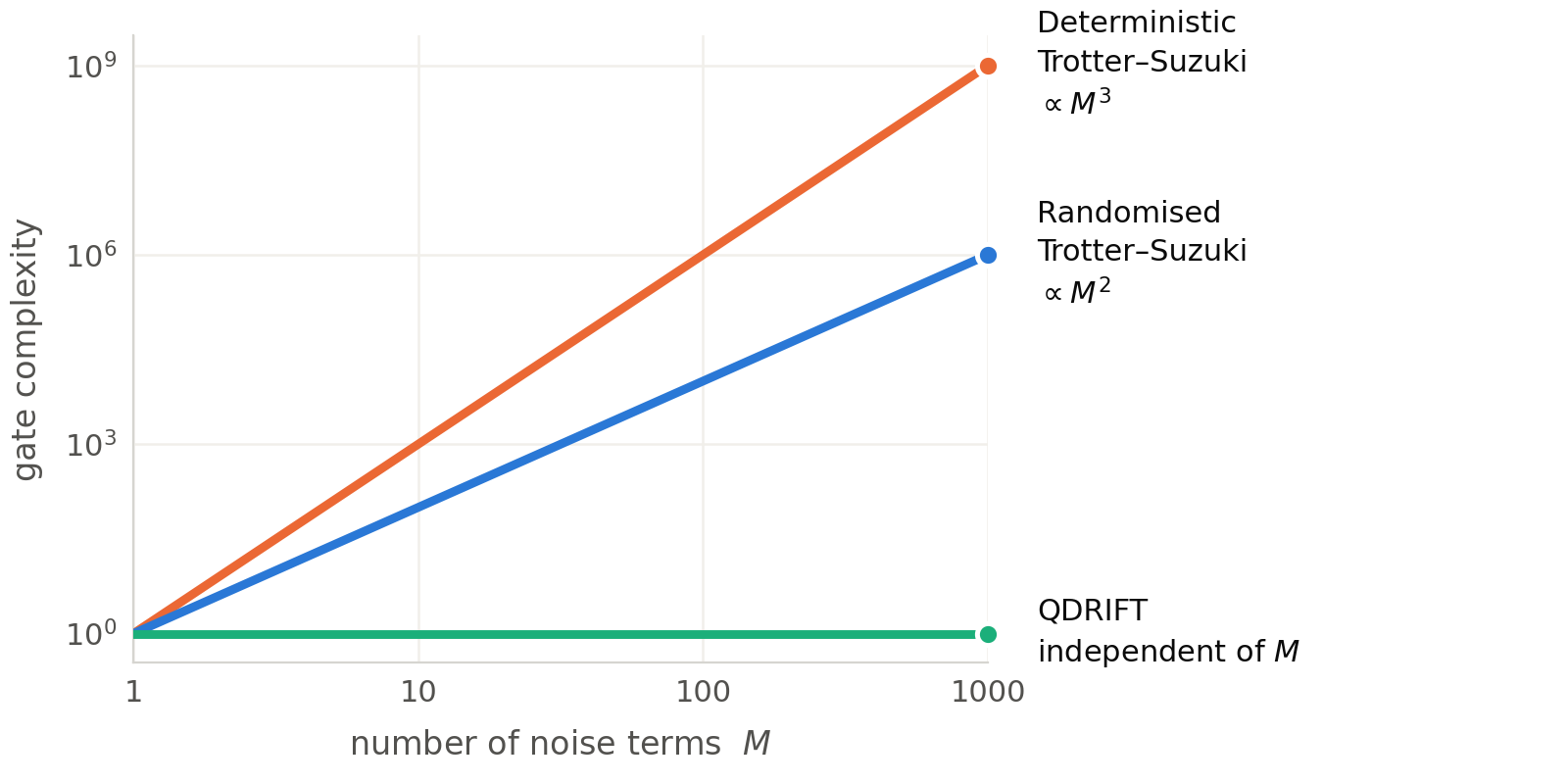
The journal Quantum published work on randomized methods for accelerating the simulation of Markovian open quantum systems [59], alongside quantum simulation of nuclear dynamics in first quantization [58] and a spacetime-dimension compression algorithm for the multidimensional Caldeira-Leggett model [57]. Technical significance: all three point at the same thing — pushing the resource requirements of physical simulation down rather than waiting for hardware to grow up.

A Floquetification rewriting method for stabilizer codes has been published, converting stabilizer codes with high-weight measurements into Floquet codes using only single- and two-qubit measurements, while preserving code distance and the number of logical qubits; the cost is that the new code requires additional physical qubits, with overhead growing linearly in the maximum measurement weight of the original code [61]. Technical significance: high-weight measurements are hard to implement fault-tolerantly in hardware, and rewrites of this kind bring the implementation bar for error-correcting codes within the operation set existing hardware can perform. Landscape impact: this has direct bearing on every hardware vendor currently choosing a code — the choice of code determines the physical-to-logical encoding ratio, and a code's engineerability is critical.

Classiq has unveiled a Qmod-to-Qmod compiler architecture [2]; IonQ has proposed a platform-level approach for deep Trotter circuits (circuits that slice Hamiltonian evolution into many small steps, where enough steps make the circuit too deep to run) aimed at improving quantum chemistry simulation [13]. Technical significance: the compilation layer is becoming an independent competitive dimension — on the same hardware, compilation quality determines how deep a circuit you can run.

A review systematically surveys every experiment to date claiming "quantum computational advantage," listing one by one the challenges, loopholes, and rebuttals that emerged in subsequent work [56]. Technical significance: this is a rare consolidated compilation of negative results for the field, and serves as a directly usable reference table for judging the credibility of "advantage" claims. Landscape impact: a practical reference for investor due diligence — which challenges, loopholes, and rebuttals each claim subsequently ran into is listed item by item in the review.

Quantum control algorithms have been used to explain the magnetoreception mechanism in bird migration [30]; other work applies ideas from image generation models (diffusion-style reconstruction) to explore the recovery of quantum information after loss [129].

One distinction about the word "decoder" is worth recording: a syndrome decoder must keep pace with the error-correction cycle at microsecond timescales, while the syndrome decoding problem (in the cryptographic sense) must remain computationally infeasible forever — the same two words, with exactly opposite requirements [33]. Technical significance: this is not terminological fussiness, it is a common source of false alarms where two entirely different classes of engineering metrics get conflated.

04Industry

Industry and Ecosystem

Capital and National Investment

Canada is investing 195 million (currency unspecified in the source) in Xanadu to expand quantum manufacturing capability and advanced photonics infrastructure [6]. Business significance: the capital expenditure model of the photonics track resembles semiconductors — asset-heavy, long-cycle, dependent on foundry production lines — and national funding is filling exactly the production-line gap that private capital is unwilling to shoulder. Landscape impact: both major players on the photonics track (Xanadu, PsiQuantum) now have national-level backing, and the competition between tracks is becoming a competition between industrial policies.

Quantum Foundry Copenhagen and the Novo Nordisk Foundation have announced a 5,300-square-meter commercial quantum chip fabrication facility, going into operation in 2027, offering commercial services in wafer fabrication, characterization, assembly, and packaging [50][108]. Business significance: this is another instance of the "quantum foundry" model — not building complete machines, but supplying capacity to others. Those affected are small and mid-sized hardware teams without their own production lines, whose tape-out options will expand noticeably after 2027.

Diffraqtion has closed a financing round of more than $10 million for quantum camera development, with investors including Lockheed Martin and Presidio [116]. Business significance: the commercialization window for quantum sensing opens earlier than for quantum computing, and defense capital is the main buyer in this stretch.

George Mason University is partnering with Oxford-based TreQ to deploy a $7.7 million open-architecture quantum processor at its Northern Virginia campus, with catalytic funding from the Virginia Innovation Partnership Corporation (VIPC); it will be the system's first deployment in the United States [47]. Business significance: a $7.7 million price point brings a complete machine within reach of university procurement budgets, and "open architecture" means universities can modify the hardware rather than merely run jobs in the cloud.

Contraction Signals

NEC is halting quantum computer hardware development [110]. Business significance: this is the negative signal most worth noting this issue — a major Japanese firm with a long history of annealing machine R&D is exiting the hardware layer. Landscape impact: what it affects is the diversity of Japan's domestic hardware supply chain; at the same time it lands in the same week that RIKEN designated QunaSys's QURI SDK Enterprise as the main software layer for the JHPC-quantum project, used to bridge the Fugaku supercomputer with quantum chips such as "ibm_kobe" and "Reimei" [75][104]. Taken together, the two events say one thing — Japan's national strategy is shifting from "building complete machines in-house" to "integrating other people's hardware + in-house software and scheduling layers."

Seven pure-play quantum computing companies have listed on U.S. markets one after another; together with Arqit, the UK quantum encryption company that listed five years ago, once approached a $3 billion market cap, and has since shrunk dramatically, they form a five-year report card [68]. Business significance: this sector's historical return record does not support the "buy early, profit early" narrative, and valuations are driven mainly by narrative rather than revenue.

Regions and Policy

Europe is pinning hopes on the Quantum Act to convert research strength into industrial capability [101]; U.S. Representative Nick Langworthy introduced the American Quantum Competitiveness Act on August 31, 2026, designating the Secretary of Commerce as the President's principal advisor on commercial quantum technology and trusted supply chains, and requiring a public competitiveness strategy within two years of enactment and every three years thereafter [119]. Landscape impact: the U.S., China, and Europe are simultaneously moving quantum out of the research budget and into the industrial-policy toolbox, with the practical effects showing up in procurement priority and export control lists, on a timescale beyond 2027.

SEEQC and Taiwan's Quantum Industry Technology Promotion Office (QITPO, under the Ministry of Economic Affairs) signed an MoU at SEMICON Taipei 2026 to build a cross-border cryogenic chip supply chain [44]; in the same period Classiq signed dual-channel market development agreements with Taiwanese distributors Scientek and Kensho, establishing local distribution, customer enablement, and joint application R&D channels covering the semiconductor manufacturing, defense, materials science, and academic research ecosystems [45][107][124]. Business significance: Taiwan is being positioned as a supply-chain node for quantum hardware rather than an end market, consistent with the structure of its semiconductor industry.

Pasqal and Saudi Arabia's KACST have signed a multi-year quantum security research agreement [121]; QuTech has established a quantum systems integration department [80].

Post-Quantum Cryptography (PQC) and Security

In a StarkWare experiment, the first quantum-resistant Bitcoin transaction was confirmed on-chain [5]; Fidelity Digital Assets published a research report noting that future cryptographically relevant quantum computers could threaten control of private keys under ECDSA and Schnorr signatures — provided the public key has already appeared on-chain — with the report laying out quantum-resistant signature scheme designs, signature size trade-offs, and a soft-fork path [120]. Business significance: Bitcoin's quantum risk has moved from "academic discussion" to the stage of "asset managers writing it into research reports and offering a migration path." Landscape impact: what is affected is the portion of all UTXOs with exposed public keys; a soft fork requires community consensus and operates on a timescale of years, while today's experiment merely shows that Bitcoin users may have an emergency exit [5].

SEALSQ (Nasdaq: LAES) and wolfSSL announced that the QVault TPM hardware security chip has gained native software support from wolfTPM, implementing PQC primitives in silicon per the Trusted Computing Group's TPM 2.0 v1.85 specification [46][114]. Business significance: PQC descending from the protocol stack into silicon means procurement decisions shift from software upgrades to hardware replacement cycles.

Giesecke+Devrient has joined the uPQComing consortium co-funded by the EU's Chips Joint Undertaking (Chips JU), with the goal of migrating critical public digital infrastructure and resource-constrained embedded secure elements such as smart cards to quantum-safe electronic ID card operating systems [43][115]. Landscape impact: ID cards and smart cards typically have lifecycles of a decade, so migrations of this kind must begin long before the cryptographic threat arrives.

Arqit, Es'hailSat, and AIEE completed quantum-safe encryption testing on a live network using the Es'hail-1 satellite and a Doha ground station, with AIEE integrating the software into operational ground and network systems and no service interruption reported [118]; Sparkle and Hellas Sat ran a quantum-safe connection over a 72,000-kilometer geostationary satellite link between Greece and Cyprus, using a software post-quantum layer overlaid on IPsec [123]. Technical significance: both cases are software overlays rather than physical-layer quantum keys, so retrofit costs are low and they can go live without downtime. Landscape impact: satellite communications operators are among the fastest-moving customers in the PQC migration.

QuSecure demonstrated post-quantum security capabilities at the U.S. Army's Project Convergence exercise [112]; QuFi launched a post-quantum verification platform for digital assets [103]; Symmatrics initiated a post-quantum readiness pledge program [111].

People and Perspectives

Cécile Perrault is QuIC's new executive director, Kevin Messerle is Atom Computing's new CFO, and Albert Solana is Qilimanjaro Quantum Tech's new chief of staff [52]. Quantinuum (Nasdaq: QNT) executives will discuss investment opportunities at Bernstein's 23rd Annual Pan-European Strategic Decisions Conference in London on September 9–10 [63]. ERVA's Brian Gaucher offers an assessment: what currently limits quantum progress is engineering, not physics [109].

One talent-flow observation worth noting: Guo Yanliang, after more than a decade of training in France and Austria and publications in Science and Nature, has returned to Beijing [117]. Landscape impact: a single case is a career choice; a pattern is a cross-regional redistribution of training costs and output returns.

05Other

Academic Frontier

An international team (including Nobel laureate Sir Roger Penrose, with the research led by Ben-Gurion University of the Negev) has observed for the first time a long-predicted effect of gravity on falling quantum objects, with the results showing that the core principles of Einstein's theory of gravity remain consistent with how matter behaves in the quantum world [22]. Technical significance: this is a direct test extending the equivalence principle to quantum objects, rather than an indirect inference. Landscape impact: it places real constraints on theory selection in quantum gravity, but changes no engineering track in the near term.

The team of Zhan Mingsheng at the Wuhan Institute of Physics and Mathematics conducted the first test of the weak equivalence principle (WEP — gravity accelerates all objects identically) using continuously free-falling atomic clouds aboard an orbiting space station [24]. Technical significance: the long free-fall times available on a space station are beyond the reach of ground-based apparatus, which opens up the precision ceiling for cold-atom interferometry measurements of this kind.

The BESIII collaboration, led by the Institute of High Energy Physics of the Chinese Academy of Sciences, used quantum-entangled Λ–anti-Λ pairs produced in J/ψ decays to set the most stringent direct measurement limit to date on the Λ hyperon's electric dipole moment (EDM), improving experimental sensitivity by roughly three orders of magnitude over previous work [26]. Technical significance: three orders of magnitude is a rare single-step leap, and the correlations provided by entangled pairs are the source of the precision. Landscape impact: it defines a new exclusion range for searches for CP violation (asymmetry between the behavior of matter and antimatter).

For nearly 80 years physicists have relied on Feynman's path-integral thought experiment to predict the behavior of quantum particles; Chinese researchers have now tested the method directly in the laboratory for the first time [19].

Researchers have used imaging of a Bose-Einstein condensate to directly render the spatial pattern of a quantum field's vacuum fluctuations — previously observable only through indirect effects via electromagnetic sampling; the system simulates a massive relativistic sine-Gordon field [62]. Technical significance: going from "measuring the influence" to "photographing the pattern" is a generational change in observational method.

By screening electron-electron interactions, researchers have completely suppressed superconductivity in magic-angle graphene, providing evidence in the debate over the unconventional origin of the phenomenon [31]. Technical significance: being able to "switch it off" is more discriminating than being able to "see it" — a criterion obtained by directly manipulating the interaction is stronger than indirect observation.

In zirconium pentatelluride (ZrTe₅) near absolute zero and in a 60-tesla magnetic field, quantum oscillations of the electrons persist beyond the point where conventional theory predicts they should vanish [82]. Technical significance: anomalies of this kind directly challenge the limits of applicability of the existing band picture.

Carnegie Mellon University has discovered a new Hall effect phenomenon that challenges long-standing assumptions about how electronic materials respond to magnetic fields [18]; separate work finds that temperature can serve as a tuning knob for topological properties, by way of spin-orbit coupling (SOC — the interaction between an electron's spin and its motion) [25]; on changes in how ultrathin superconductors accommodate magnetic fields, theoretical work discusses quantum confinement effects in metallic thin films [21].

The entanglement structure of four-qubit systems has been fully characterized [73]; perfect qubit transfer was previously limited by pulse-shape mismatch to a ceiling of 4/e²≈0.54, and new work circumvents the dependence on laser pulses [74]. Technical significance: 0.54 is a hard ceiling, and getting around it means inter-node transfer in quantum networks no longer has to sacrifice nearly half its success probability.

A quantum-optical spin glass has been used as an associative memory — the mechanism for recalling a complete memory from partial information [27]; work on symmetry-enriched topological order in tensor networks provides a unified framework for defects, gauging, and anyon condensation [55]; the qudit swap operator structure of the Quantum Max d-Cut problem has been systematically studied [60].

One corrective worth recording: a new theoretical framework points out that certain experiments seemingly showing gravity behaving quantum mechanically may have far more mundane explanations — so-called "superposition of gravity" scenarios can be reproduced classically [81]. Separately, physicists have argued that the neutrino laser proposal does not hold up [23].

AIX Global Innovations claims its proprietary quantum technology stack has solved all six remaining unsolved Clay Mathematics Institute Millennium Prize Problems, but the Lean formalization package it released does not contain the six completed proofs, and its own audit report exposed the missing premises [32]. Landscape impact: this is the class of claim most warranting caution this issue — the whole point of formal proof is that it can be machine-verified, and when the verification result contradicts the press release, the verification wins.

06Impact

Today's Impact

Holders of crypto assets: there's one more emergency exit, but it isn't an evacuation order yet. What changed — the first quantum-resistant Bitcoin transaction has been confirmed on-chain [5], and in the same week Fidelity Digital Assets published a full analysis of quantum-resistant signature scheme designs and a soft-fork migration path [120]. The boundary of the risk is also clearer: the threat only applies if the public key has already appeared on-chain [120]. What to watch next — whether the soft-fork proposal enters the formal BIP discussion process, and whether exchanges and custodians begin disclosing the proportion of their own addresses with exposed public keys.

Suppliers and research institutions in Japan's quantum supply chain: the center of gravity of the national strategy has moved. What changed — NEC is halting quantum computer hardware development [110], while in the same period RIKEN designated QunaSys's QURI SDK Enterprise as the main software layer of the national JHPC-quantum project, used to bridge the Fugaku supercomputer with quantum chips such as "ibm_kobe" and "Reimei" [75][104]. This means Japanese resources are flowing toward the software and integration layers, with hardware relying more on external supply. What to watch next — the allocation ratios in NEDO's subsequent funding rounds, and whether any other domestic Japanese hardware programs contract in turn.

Universities and supercomputing centers buying quantum machines: both the price and the form factor are changing. What changed — a $7.7 million open-architecture processor is heading to the George Mason University campus as the system's first deployment in the United States [47], and Jülich has connected eleQtron's JION ion machine directly into JSC's high-performance computing queue [49][106]. Complete machines are no longer the exclusive preserve of national labs, and procurement criteria are shifting from peak metrics to "can it plug into our existing job flow." What to watch next — the number of papers such campus-level systems produce within a year, the only hard indicator of whether it is a research facility or a showpiece.

Research teams doing quantum simulation: there are usable new tools today. What changed — exponentially accurate open-system modeling with 4 additional qubits [71], Floquetification of stabilizer codes bringing high-weight measurements down to single- and two-qubit operations while preserving code distance [61], and randomized methods accelerating Markovian open-system simulation [59]. All three take the algorithm and encoding route rather than waiting for hardware metrics to improve; but Floquetification is not a pure software rewrite — the new code requires additional physical qubits, with overhead growing linearly in the maximum measurement weight of the original code [61]. What to watch next — validation results for these methods on real machines, especially whether [71] still holds its accuracy under noise.

Investors doing due diligence and allocation: this issue offers two yardsticks. What changed — a review has comprehensively surveyed every quantum advantage claim to date along with the subsequent challenges, loopholes, and rebuttals [56], a five-year report card on listed companies is now on the table [68], and there is a case of a company claiming to have solved all six Millennium Prize Problems whose own released formalization package contains no completed proofs, with its audit report instead exposing the missing premises [32]. What to watch next — separating "claims" from "independent reproductions" into two columns is currently the most effective filter for this sector; also watch what Quantinuum executives say at the Bernstein conference in London on September 9–10 [63].

07Other

Editor's Note

Today's most honest set of signals comes from two things pointing in opposite directions on the same day: a major Japanese firm shut down its own quantum hardware line, while Canada, Denmark, Taiwan, and Virginia were simultaneously building production lines, building foundries, building supply chains, and buying machines. This is not a contradiction; this is a division of labor taking shape. The bar for hardware is now so high that "money and engineers" is no longer enough to get in — it requires a production line sustained for more than a decade, a full supporting stack of materials, packaging, cryogenics, and control electronics, and the ability to compete on the third decimal place of fidelity. Only a very small number of players will remain at that tier, and everyone else — including former hardware players — will fall back to the integration layer, the software layer, and the application layer. Japan's choice shows that falling back to the software layer is not failure; it is clear-sightedness.

The other thread is who gets to define precision. Today one company claimed to have solved all six Millennium Prize Problems, while the formalization package it released itself contains none of the six completed proofs; a review listed, item by item, the subsequent rebuttals to every quantum advantage claim; and a theoretical framework pointed out that certain experimental evidence for "quantized gravity" can be explained away classically. These three things point to the same good news — the field is growing its own immune system. In past years, claims outran verification and press releases outran papers; now the verification tools (formal proof, classical simulation catching up, independent replication) are running faster and faster, fast enough to catch up with a claim within the same week. For researchers, this means the return on doing solid work is rising; for investors, it means the cost of due diligence is falling — no need to wait three years for results when, more often than not, someone has verified it for you within weeks. The ones who should really be anxious are the teams willing to report only their best qubit pair, only conditional fidelity, only single-router success rates. Sooner or later, someone will ask for the full-stack numbers.